
The Revolt of Le Mans and the …
Years: 1070 - 1070
The Revolt of Le Mans and the Restoration of Maine (1069–1070)
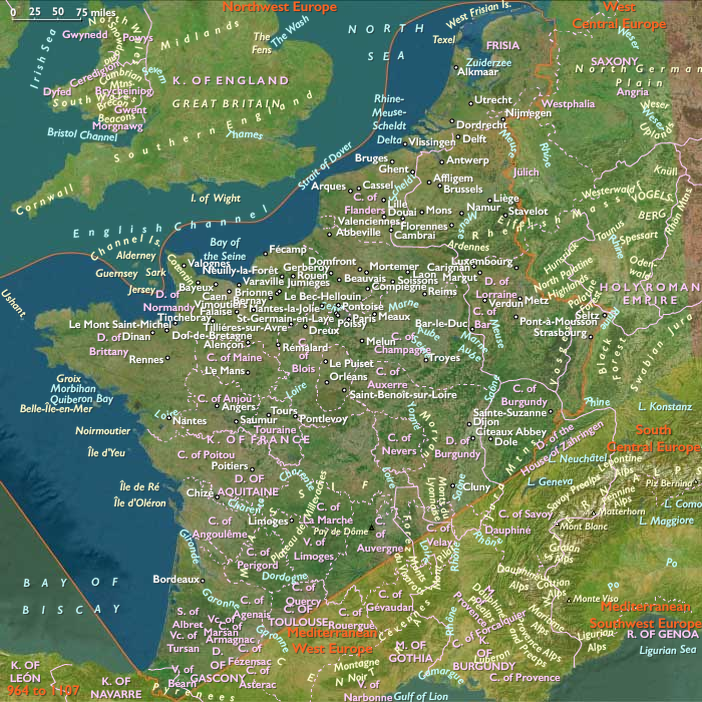
In 1069, the citizens of Le Mans rose in revolt against Norman rule, expelling their occupiers and restoring local control over the County of Maine. By 1070, the Normans had been fully driven out, and young Hugh V was proclaimed Count of Maine, ending William of Normandy’s brief control over the region.
The Revolt Against Norman Rule (1069)
- Norman forces had occupied Maine since William’s conquest of the county in 1063–1064, but their rule was deeply unpopular.
- In 1069, the citizens of Le Mans initiated an uprising, challenging Norman authority.
- Their rebellion quickly gained support from local barons, most notably Geoffrey of Mayenne, a key figure in Maine’s anti-Norman resistance.
- The Normans struggled to contain the insurrection, and by 1070, they were expelled from the county.
Hugh V Becomes Count of Maine
- Following the expulsion of the Normans, the Manceaux proclaimed Hugh V as the new Count of Maine.
- Hugh was the son of Azzo d’Este, an Italian nobleman, and Gersendis of Maine, a sister of the late Count Hugh IV.
- Despite his son’s new title, Azzo d’Este returned to Italy, leaving Gersendis to govern the county.
The Rise of Geoffrey of Mayenne
- In practice, the real power in Maine did not rest with Gersendis but with Geoffrey of Mayenne, a leading baron who had played a major role in the revolt.
- Geoffrey essentially ruled in all but name, securing Maine’s independence from Normandy and acting as the de facto leader of the county.
Consequences and the Future of Maine
- The expulsion of the Normans from Maine in 1070 marked a temporary reversal of William’s territorial expansion.
- Geoffrey of Mayenne’s control over the region ensured that Maine remained independent for now, though the Normans would return in later years.
- This revolt weakened Norman influence in northern France, as William now had to focus on consolidating his rule in England, leaving Maine’s political fate uncertain.
The 1069–1070 revolt in Maine proved that Norman rule was not unchallenged, and while Hugh V was proclaimed count, the real power remained with local barons like Geoffrey of Mayenne, setting the stage for further struggles between Maine and Normandy.
Locations
People
- Albert Azzo II
- Fulk IV
- Geoffroy II de Mayenne
- Hubert II de Beaumont-au-Maine
- Hugh V
- Robert Curthose
- William the Conqueror
Groups
- Breton people
- Maine, County of
- Anjou, County of
- Normandy, Duchy of
- Brittanny, Duchy of
- Normans
- France, (Capetian) Kingdom of
Commodoties
Subjects
Regions

Subregions
Related Events
Showing 10 events out of 50814 total
Years: 1070 - 1070
Locations
People
- Albert Azzo II
- Fulk IV
- Geoffroy II de Mayenne
- Hubert II de Beaumont-au-Maine
- Hugh V
- Robert Curthose
- William the Conqueror
Groups
- Breton people
- Maine, County of
- Anjou, County of
- Normandy, Duchy of
- Brittanny, Duchy of
- Normans
- France, (Capetian) Kingdom of
Commodoties
Subjects
Regions
Subregions