
West Central Europe (909 BCE – CE …
Years: 909BCE - 819
West Central Europe (909 BCE – CE 819): Roman Frontiers, Christian Foundations, and Post-Roman Transformations
Geographic and Environmental Context
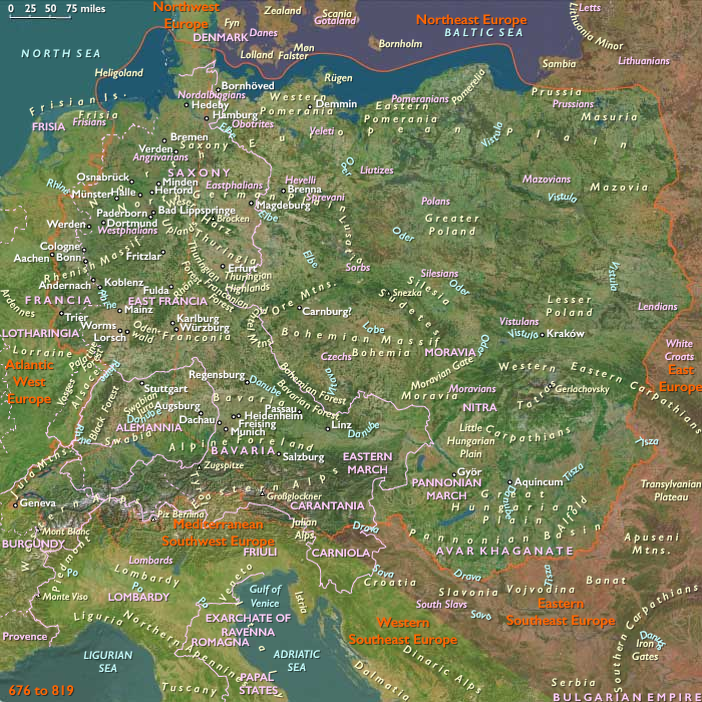
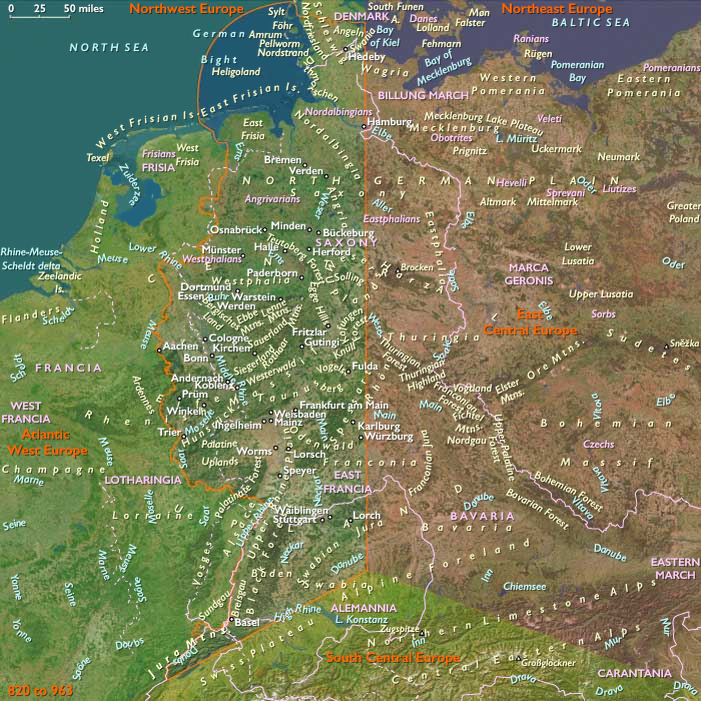
West Central Europe includes modern Germany west of 10°E and the Rhine-adjacent far northwest of Switzerland, including Basel and the eastern Jura Mountains.
-
Defined by the Rhine frontier (limes) between Rome and Germanic peoples.
-
Basel and the Upper Rhine marked a hinge between Gaul and the Germanic interior.
Climate and Environmental Shifts
-
Roman Warm Period (1st c. BCE – 3rd c. CE) favored agricultural prosperity.
-
Late Antiquity brought climatic fluctuations that stressed frontier economies.
Societies and Political Developments
-
Roman era:
-
The Rhine frontier was lined with legionary camps and coloniae: Colonia Agrippina (Cologne), Augusta Raurica (near Basel), Mainz, Trier, and Strasbourg (Argentoratum).
-
These cities became garrison and administrative hubs, tied into imperial roads and river transport.
-
-
Post-Roman era:
-
From the 4th–5th centuries, the Franks expanded into the Rhineland, establishing the Merovingian kingdom with Metz and later Aachen nearby as royal centers.
-
By the 8th–9th centuries, Carolingian rule (from Charlemagne’s court at Aachen) reshaped West Central Europe into the imperial heartland.
-
-
Basel and Jura passes integrated the region with Burgundy and the Rhône world.
Economy and Trade
-
Roman villa agriculture thrived on Rhine plains: cereals, wine, and livestock.
-
Roman roads and bridges facilitated troop and merchant movement.
-
After Rome, Merovingian and Carolingian rulers revived trade: wine, salt, textiles, and metalwork circulated along the Rhine.
Subsistence and Technology
-
Roman aqueducts, roads, and mills reshaped the landscape.
-
Urban decline after Rome gave way to new Carolingian abbeys and episcopal sees (e.g., Cologne, Mainz, Trier, Basel).
-
Iron ploughs and horse harnesses improved Carolingian farming.
Movement and Interaction Corridors
-
Rhine River as the main frontier artery for Roman legions and later as the lifeline of Frankish trade.
-
Jura passes tied Gaul and Italy into the frontier zone.
-
Pilgrimage routes to shrines at Trier and Mainz appeared in the early Middle Ages.
Belief and Symbolism
-
Roman pagan cults gave way to Christianity, with episcopal sees at Cologne, Mainz, and Trier among the oldest north of the Alps.
-
Carolingian kings patronized monasteries like Fulda and Reichenau (just beyond the subregion but influential).
-
Cologne became an archbishopric, cementing the Rhineland’s ecclesiastical role.
Adaptation and Resilience
-
After Rome, cities contracted but episcopal sees preserved continuity.
-
Carolingian agrarian reforms boosted food security.
-
Multiplicity of lords and bishops allowed flexible adaptation through crisis.
Long-Term Significance
By 819 CE, West Central Europe had evolved from a Roman frontier zone into the Carolingian imperial heartland. Its episcopal cities (Cologne, Mainz, Trier, Basel) stood as enduring nodes of power and commerce, setting the stage for its later role as the ecclesiastical and commercial core of the Holy Roman Empire.
People
Groups
- Germania
- Franks
- Christianity, Nicene
- Burgundians, (first) Kingdom of the
- Christianity, Chalcedonian
- Burgundy, Frankish Kingdom of
- Francia (mayors of the palaces of Austrasia and Neustria)
- Francia (Carolingians)
- Frankish, or Carolingian (Roman) Empire
Topics
Commodoties
Subjects
Regions
Subregions
Related Events
Showing 6 events out of 6 total
Years: 909BCE - 819
People
Groups
- Germania
- Franks
- Christianity, Nicene
- Burgundians, (first) Kingdom of the
- Christianity, Chalcedonian
- Burgundy, Frankish Kingdom of
- Francia (mayors of the palaces of Austrasia and Neustria)
- Francia (Carolingians)
- Frankish, or Carolingian (Roman) Empire
Topics
Commodoties
Subjects
Regions
Subregions