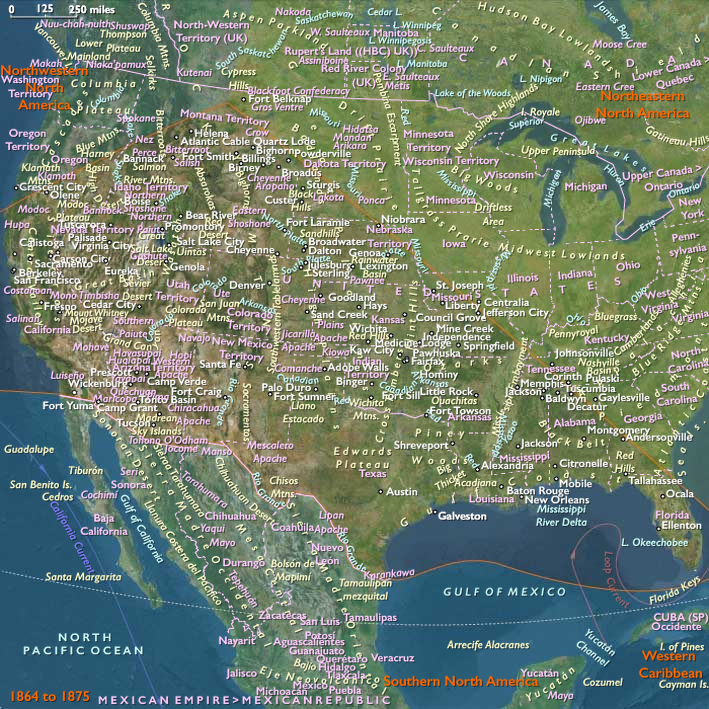
The Medicine Lodge Treaty is the overall…
October 1867 CE
The Medicine Lodge Treaty is the overall name for three treaties signed between the United States government and southern Plains tribes in October 1867, intended to bring peace to the area by relocating the Native Americans to reservations in Indian Territory and away from European-American settlement.
The treaty is negotiated after investigation by the Indian Peace Commission, which in its final report in 1868 will conclude that the wars had been preventable.
They will determine that the U.S. government and its representatives, including the United States Congress, had contributed to the warfare on the Great Plains by failing to fulfill their legal obligations and to treat the natives with honesty.
The U.S. government and tribal chiefs meet at a place traditional for native ceremonies, at their request. near present day Medicine Lodge, Kansas.
The first treaty is signed October 21, 1867, with the Kiowa and Comanche tribes.
The second, with the Kiowa-Apache, is signed the same day.
The third treaty is signed with the Southern Cheyenne and Arapaho on October 28.
Under the Medicine Lodge Treaty, the tribes are assigned reservations of diminished size compared to territories defined in an 1865 treaty.
The treaty tribes will never ratify the treaty by vote of adult males, as it requires.
The Medicine Lodge Treaty calls for two reservations to be set aside in Indian Territory, one for the Comanche and Kiowa and one for the Southern Cheyenne and Arapaho between the Arkansas and Cimarron rivers.
According to the treaty, the government will provide the tribes with housing, agricultural training, and food and other supplies.
In exchange, the tribal representatives agree to cease raiding and attacking settlements.
Dozens of chiefs endorse the treaty and some tribal members move voluntarily to the reservations, but it is never officially ratified and several native groups still on the Plains had not even attended the negotiations.
The treaty will be widely ignored.
Those that do not sign the treaty are called "hostile" and will be continually pursued by the U.S. Army and their native scouts.
Groups
Topics
Regions
Northern North America
View →Subregions