
The Comet of 1729, also known as…
August 1729 CE
The Comet of 1729, also known as C/1729 P1 or Comet Sarabat, is discovered in the constellation of Equuleus by Father Nicolas Sarabat, a professor of mathematics, at Nîmes in the early morning of August 1, 1729.
Observing with the naked eye, Sarabat sees an object resembling a faint, nebulous star: he is at first unsure if it is a comet or part of the Milky Way.
Moonlight interferes with Sarabat's observations until August 9, but after recovering the object and attempting to detect its motion without the aid of any measuring instruments, he becomes convinced that he has found a new comet.
A non-periodic comet with an absolute magnitude of −3, the brightest ever observed for a comet, it is therefore considered to be the largest comet ever seen.
Locations
Subjects
Regions
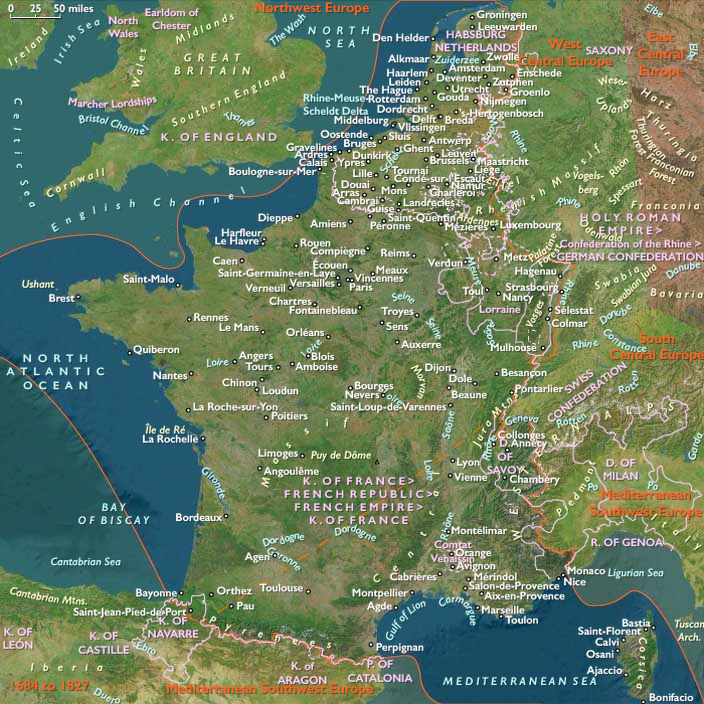
West Europe
View →Subregions

Mediterranean West Europe
View →Related Events
No active filters.
Showing 10 events out of 27715 total
The Yongzheng emperor in 1729 increases the administrative centralization of the government.
The Grand Secretariat is replaced as the top ministerial body by the previously informal Grand Council.
The five or six members of the Grand Council work directly with the Emperor, who confers with them every day.
Their business is handled quickly and secretly.
The Emperor thus personally scrutinizes and directs all important matters of government.
Opium, now imported into China at a rate of two hundred chests a year, has by 1729 become such a problem that the emperor, disturbed by madak smoking at court and carrying out the government's role of upholding Confucian virtue, issues an edict prohibiting the smoking of opium and its domestic sale, except under license for use as medicine.
The ban punishes sellers and opium den keepers, but not users of the drug.
This is the first edict of its kind, representing a new official awareness of the dangers, whether socioeconomic or physiological, of opium addiction.
The origins of the Dresden Skulpturensammlung (English: Sculpture Collection) can be traced back to the Kunstkammer founded in 1560.
However, it is Augustus the Strong who establishes the “Collection of Antique and Modern Sculptures” and turns Dresden into a center of Baroque architecture and sculpture.
After the arrival of antiquities from Rome at the end of 1729, the collection is displayed in the palace in the Großer Garten, surrounded by masterpieces of contemporary sculpture.
The Royal Military Order of Saint George for the Defense of the Faith and the Immaculate Conception had been established by Maximilian II Emanuel, Elector of Bavaria, in 1726 to provide for a means of honoring the nobility and recognizing distinguished civil military service.
The tradition of loyalty to Saint George, the patron saint of chivalry, has been long established in Germany and the various Bavarian Princes who had made pilgrimages to the Holy Sepulcher where they were invested as knights in the fifteenth century had all made a promise to Saint George
The decision to found the order may have been in part the consequence of the failed attempt by the Wittelsbachs to acquire the Grand Magistery of the Constantinian Order of Saint George, which by decision of the Holy See in 1701 had been recognized as pertaining to the Farnese.
Karl-Albrecht, Maximilian’s son, gives the new Order its title of Order of the Holy Knight and Martyr Saint George and the Immaculate Conception of the Holy Virgin Mary and its statutes on March 28, 1729, as a Military Order of Chivalry for Roman Catholic noblemen.
Its status as a Catholic order had been confirmed in a Papal Bull of 15 March, 1728, specifically comparing the Order with the Teutonic Order, which had likewise been transformed from a crusading order to an exclusive chivalric religious institution for the nobility.
A fire in Constantinople in 1729 destroys twelve thousand houses and kills seven thousand inhabitants.
The Persians are understandably disloyal to their Afghan rulers, and the Hotaki dynasty, whose ruler have massacred thousands of religious scholars, nobles, and members of the Safavid family, is ousted from Persia following the 1729 Battle of Damghan.
Nadr installs Tahmasp II as shah in Isfahan in 1729.
Shah Ashraf repels both the Russian and Turkish attacks, but a brigand chief, Nader Qoli Beg, defeats the Afghans at Damghan in October 1729 and expels them from Persia.
Ashraf is murdered during the retreat, probably on orders from his cousin, who holds the city of Qandahar.
...defeats the Gilzai Afghans in September at Mehmandust, and...
...again at Damghan in October 1729, driving them from Persia.
Ashraf is murdered during the retreat, probably on orders from his cousin, who is now holding Qandahar.
Nasir-ud-din Muhammad Shah, the ineffective, pleasure-loving son of Shah Jahan, had been made Mughal emperor on September 29, 1719, by the powerful Sayyid brothers, 'Abdullah and Husayn 'Ali, the two generals who had killed the emperor Farrukh-Siyar.
The assassination in 1720 of Husayn 'Ali and the defeat of 'Abdullah at the battle of Hasanpur (southwest of Delhi) had liberated Muhammad Shah from effective Sayyid control.
he had married the daughter of Farrukh-Siyar in 1721.
The provinces have steadily slipped out of imperial control since 1724, when Nizam-ul-Mulk Asaf Jah, the court-appointed vizier, had left the court in disgust.