
The Dutch colonial state has its foundation…
1828 CE to 1839 CE
Unlike the violence used earlier by the VOC, the military expansion of the nineteenth century is deliberately territorial and penetrates far beyond the coastal areas.
It generally has as its goal fundamental regime change and—although in truth this is often beyond Batavia's capability—the establishment of control by a centralized authority.
Quite different from the eighteenth century, too, colonial forces enjoy a degree of technological superiority over most of their adversaries, a result of the industrial revolution.
And, whereas the VOC had fought with an assortment of indigenous allies, now the colonial state fights for its own interests, engaging indigenous men as soldiers.
The colonial government's separate fighting force, known as the Royal Netherlands Indies Army (KNIL), had been founded only a few weeks before Diponegoro's surrender in 1830.
Although assigned the task of maintaining rust en orde (tranquillity and order) throughout the colonial state's territories, the KNIL will become best known for its role in the colonial wars of expansion.
Dominated by ethnic Dutch, and later Eurasian, officers, in the mid-nineteenth century about two-thirds of KNIL troops will be Indonesians, predominantly Javanese and Ambonese, and the rest "European," a confusing category that includes not only white Europeans but also a small number of black Africans and others.
People
Topics
Regions
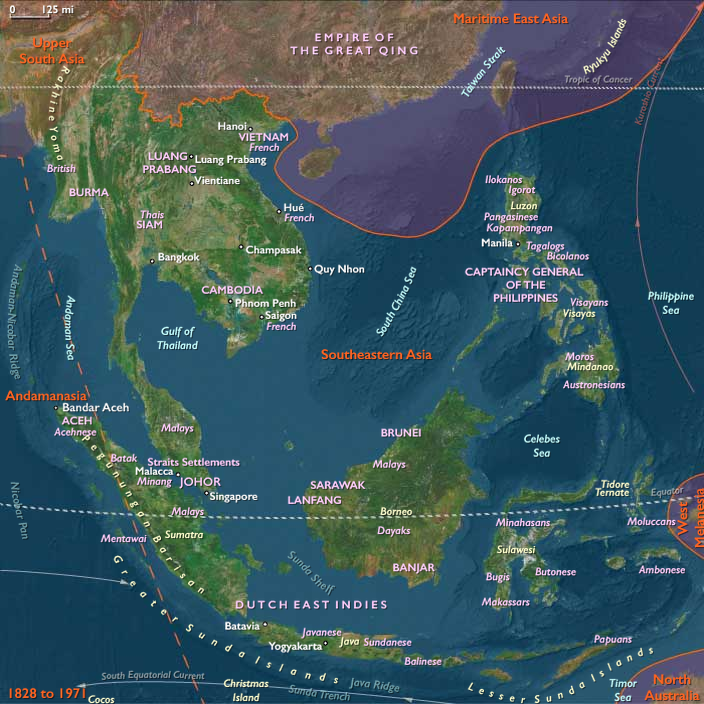
Southeast Asia
View →Subregions
