
The Struggle Between Liberalism and Absolutism in…
1816 CE to 1827 CE
The Struggle Between Liberalism and Absolutism in Portugal (1823–1826)
Following the Liberal Revolution of 1820, Portugal became deeply divided between liberals, who supported the new constitutional government, and royalists (absolutists), who sought to restore monarchical rule without constitutional constraints. This ideological conflict led to several uprisings, culminating in King João VI’s return to moderate absolutism until his death in 1826.
The First Royalist Uprising – The Absolutist Rebellion in Trás-os-Montes (February 1823)
- The first significant absolutist reaction surfaced in February 1823 in Trás-os-Montes, where the Count of Amarante led an insurrection against the liberal regime.
- The rebellion failed to gain widespread support at first, but it foreshadowed greater absolutist resistance.
The Vilafrancada (May 1823) – Miguel Joins the Absolutists
- In May 1823, the Count of Amarante launched another revolt, this time at Vila Franca de Xira, just north of Lisbon.
- Parts of the Lisbon garrison defected, and Prince Miguel, the king’s younger brother, joined the absolutist cause, refusing to swear allegiance to the 1822 Constitution.
- The uprising, known as the Vilafrancada, successfully forced a shift in power:
- King João VI sided with the absolutists, suspending the liberal constitution.
- Prince Miguel was rewarded, being made generalissimo of the Portuguese army.
The Abrilada (April 1824) – Miguel’s Failed Coup
- In April 1824, Miguel attempted to fully restore absolutist rule by launching a coup against his father, João VI.
- With the backing of royalist officers, Miguel arrested several liberal politicians and tried to take control of the government.
- However, King João VI—supported by Beresford, who had been allowed to return to Portugal—opposed Miguel’s actions.
- Miguel was dismissed from his position as generalissimo and exiled to France, effectively ending his immediate influence in Portugal.
The Suspension of the 1822 Constitution and João VI’s Rule (1824–1826)
- Following Miguel’s exile, King João VI suspended the 1822 Constitution, choosing to govern under moderate absolutism.
- His rule attempted to balance the interests of both liberals and royalists, though tensions remained high.
- João VI ruled in this manner until his death in 1826, after which Portugal’s succession crisis reignited the struggle between absolutists and liberals.
Conclusion – A Temporary Return to Absolutism
The Vilafrancada and Abrilada demonstrated the deep divisions within Portugal regarding its political future. While King João VI’s death in 1826 would reopen the conflict, his later rule represented a temporary victory for moderate absolutists. However, the liberal-royalist struggle would continue, shaping Portugal’s politics for decades to come.
Locations
People
Regions
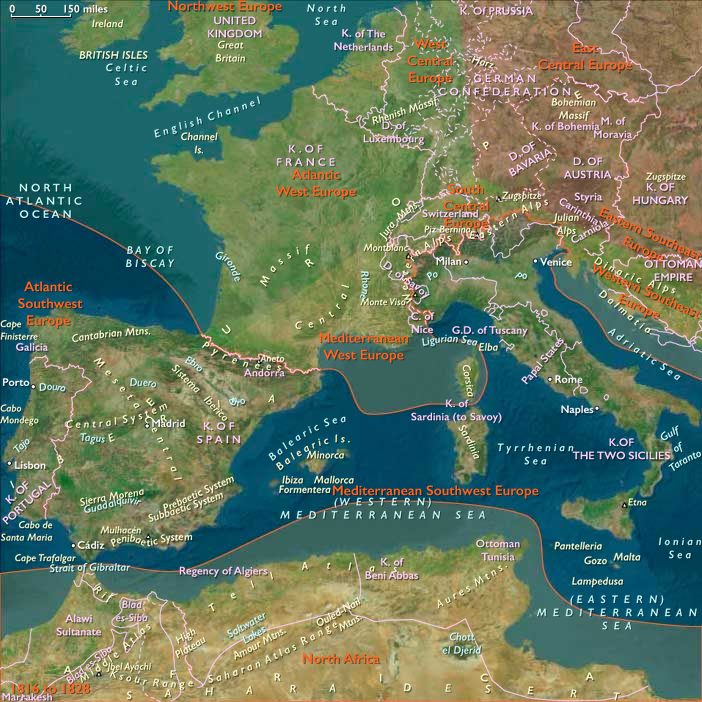
Southwest Europe
View →Subregions
