The construction of the Prayer Hall of …
Years: 786 - 786
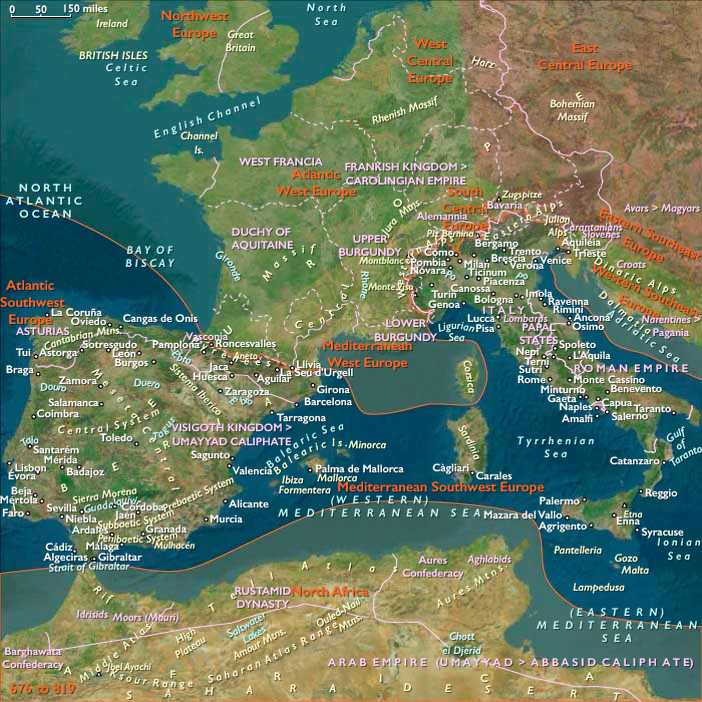
The construction of the Prayer Hall of the Great Mosque of Córdoba begins in 785-786.
Locations
People
Groups
Topics
Subjects
Regions
Subregions
Related Events
Filter results
Showing 10 events out of 55002 total
Empress Irene favors the restoration of the use, in religious devotion, of pictorial representation of saints or of the Trinity, prohibited by imperial decree since 730.
In 784, the imperial secretary Patriarch Tarasius, on of Irene’s supporters, had been appointed successor to the Patriarch Paul IV—he had accepted on the condition that intercommunion with the other churches should be reestablished; that is, that the images should be restored.
However, a council, claiming to be ecumenical, had abolished the veneration of icons, so psychologically another ecumenical council is necessary for its restoration, to rule on the use.
Pope Adrian I, who had been invited to participate, had gladly accepted.
However, the invitation intended for the oriental patriarchs could not even be delivered to them.
The Roman legates were an archbishop and an abbot, both named Peter.
In 786, the council meets in the Church of the Holy Apostles in Constantinople.
However, soldiers in collusion with the opposition enter the church, and break up the assembly.
As a result, the government resorts to a stratagem.
Under the pretext of a campaign, the iconoclastic bodyguard is sent away from the capital—disarmed and disbanded.

Al-Hadi's persecution of the 'Alids precipitates revolts in Medina, Egypt, and Iraq, all of which are put down brutally.
The revolt of Husayn ibn Ali ibn Hasan broke out when Husayn declared himself caliph in Medina.
Al-Hadi had crushed the rebellion and killed Husayn and many of his followers, but Idris bin Abdallah, a cousin of Husayn, had escaped to reach Morocco, where some years later he will found the Idrisi state.
Al-Hadi also crushes a Kharijite rebellion as well as faces an invasion by the forces of Constantinople.
However, the imperial forces are turned back.
Throughout his short reign, he has struggled with the question of succession, attempting to annul the rights of his brother.
Yahya has dissuaded the Caliph several times from proclaiming his own son as heir instead of Harun.
He eventually does so, and jails Yahya.
Al-Hadi moves his capital from Baghdad to …
…Haditha shortly before his mysterious death in September 786, which may have been a murder.
Al-Tabari notes varying accounts of this death, e.g.
an abdominal ulcer or assassination.
Rumor suggests that al-Khayzuran was behind al-Hadi's death, because he had resisted her domination.
Al-Tabari (v. 30 p. 42f) notes al-Hadi's assertion of independence from his mother, his forbidding her further involvement in public affairs and his threatening the succession of his younger brother, who is at first imprisoned and soon is released to assume the caliphate.
Harun ar-Rashid thus becomes caliph on September 14, 786, succeeding to the rule of an empire reaching from the western Mediterranean to India.
He makes Yahya his vizier, or chief minister.
With Yahya are associated his sons al-Fa'l and Ja'far, for the vizier at this period is not only an initiator of policy but also has attached to himself a corps of administrators to carry out his decisions.
Al-Khayzuran will have a considerable influence over the government until her death in 789.
The Caliphate's forces have undertaken regular, almost annual raids into imperially held Asia Minor since the failure of the last Arab attempt to conquer the imperil capital Constantinople.
In 782, a major invasion, led by the Abbasid heir apparent, the future Harun al-Rashid, had resulted in a humiliating settlement for the Empire, which had been forced to sue for a truce in exchange for an annual payment of one hundred and sixty thousand gold nomismata.
In 785, Empress-regent Irene had resolved to cease the payment of the tribute, and warfare had recommenced.
The Arabs raided the Armeniac Theme, but in early 786, the Empire retaliated by sacking and razing to the ground the fortress town of Hadath in Cilicia, which the Abbasids had spent the last five years turning into a major stronghold and military base for their cross-border expeditions.
Beatus of Liébana: Scholar, Theologian, and Symbol of Christian Resistance
Beatus of Liébana is best remembered for his Commentary on the Apocalypse, originally written in 776 CE and later revised in 784 and again in 786. Though not highly original, the work serves as a Christian cultural and religious focal point, compiling long extracts from the Fathers and Doctors of the Church, particularly:
- Augustine of Hippo,
- Ambrose of Milan,
- Tyconius,
- Irenaeus of Lyon, and
- Isidore of Seville.
Additionally, Beatus incorporates Jerome of Stridon’s commentary on the Book of Daniel, further enriching his theological synthesis.
Theological Influence and the Adoptionist Controversy
Beatus corresponds with Alcuin of York and plays a prominent role in the Adoptionist controversy, opposing the views of Felix of Urgel and Elipandus of Toledo, who argue that Christ was the adoptive son of God in his human nature. His staunch Nicene orthodoxy reinforces Asturian resistance to theological influences from Muslim-controlled Toledo.
As confessor to Queen Adosinda, wife of King Silo of Asturias, and as the teacher of Alcuin and Etherius of Osma, Beatus holds considerable influence in the Christian intellectual world.
Beatus’s Legacy and Symbolism
Over time, his Commentary on the Apocalypse becomes a symbol of Christian resistance against the Muslim Arabs who dominate much of Iberia during the early Middle Ages. The Beatus manuscripts, with their illuminated illustrations, will later be reproduced across medieval Europe, preserving and spreading the apocalyptic vision of Christian triumph over Islam and heresy.
Charles conquers Bavaria in 787-88, absorbing the duchy in 788.
Harun had made Yahya his vizier when he became caliph.
Under Yahya's influence, the Caliph invites to Baghdad many scholars and masters from India, especially Buddhists.
A catalogue of both Muslim and non-Muslim texts prepared at this time, Kitab al-Fihrist, includes a list of Buddhist works.
Among them is an Arabic version of the account of Buddha’s previous lives, Kitab al-Budd.
Caliph Harun al-Rashid has ordered the rebuilding and fortification of Tarsus, an imperial city destroyed by Arabs more than a century before, and establishes a fort at nearby Hadath in preparation for an invasion of the Eastern Roman Empire.
The ecumenical council is again summoned to meet, this time in Nicaea, since Constantinople is still distrusted.
The Second Council of Nicaea (the seventh ecumenical council of the Christian church) assembles on September 24, 787 at the church of Hagia Sophia.
It numbers about three hundred and fifty members; three hundred and eight bishops or their representatives sign.
Tarasius presides, and seven sessions are held in Nicaea.
At Irene’s urging, and with the support of Pope Adrian and Constantine VI’s representative, Nikephoros, the council declares that whereas the veneration of images is legitimate and the intercession of saints efficacious, their veneration must be carefully distinguished from the worship due God alone; this ruling effectively ends the Greek church’s policy of iconoclasm.
The papal legates voice their approval of the restoration of the veneration of icons in no uncertain terms, and the patriarch sends a full account of the proceedings of the council to Pope Adrian I, who has it translated.
The marshes and moraines near Bremen, a port in northwestern Germany on the banks of the Weser River about forty-three miles (seventy kilometers) from the North Sea, have been settled since about 12,000 BCE.
Burial places and settlements in Bremen-Mahndorf and Bremen-Osterholz date back to the seventh century CE.
Since the age of Renaissance, some scientists have believed that the entry Fabiranum or Phabiranon in Ptolemy's Fourth Map of Europe, written in CE 150, refers to Bremen, but Ptolemy gives geographic coordinates, and by these dates Phabiranon is situated northeast of the mouth of river Visurgis (Weser).
At that time the Chauci lived in the area now called northwestern Germany or Lower Saxony.
By the end of the third century, they had merged with the Saxons.
During the Saxon Wars (772–804) the Saxons, led by Widukind, fight against the West Germanic Franks, the founders of the Carolingian Empire, and lose the war.
Charlemagne, the King of the Franks, makes a new law, the Lex Saxonum, which states that Saxons are not allowed to worship Odin (the god of the Saxons), but rather that they had to convert to Christianity on pain of death.
This period is called the Christianization.
Willehad of Bremen becomes, in 787, the first Bishop of Bremen.