
The Suppression of the Amalricians and the…
1210 CE
The Suppression of the Amalricians and the Condemnation of David of Dinant (1210 CE)
The early 13th century saw a growing intellectual and theological crisis as radical pantheistic and Aristotelian philosophies challenged orthodox Christian doctrine. Two key figures—Amalric of Bena and David of Dinant—became associated with controversial teachings that led to severe ecclesiastical suppression in 1210.
The Amalricians and Their Persecution (1207–1210)
- Amalric of Bena, a former theology professor at the University of Paris, had been condemned for heresy in 1204 and died in 1207, reportedly from grief at his humiliation.
- After his death, a group of followers, known as the Amalricians, continued to spread his teachings.
Amalrician Beliefs
- The central doctrine of the Amalricians was radical pantheism, summed up in the phrase:
"All things are One, because whatever is, is God."
- They denied traditional Church teachings on creation, seeing the entire universe as identical to God.
- Many priests and clerics were among their ranks, allowing them to spread their teachings undetected for some time.
The Amalrician Crackdown (1210)
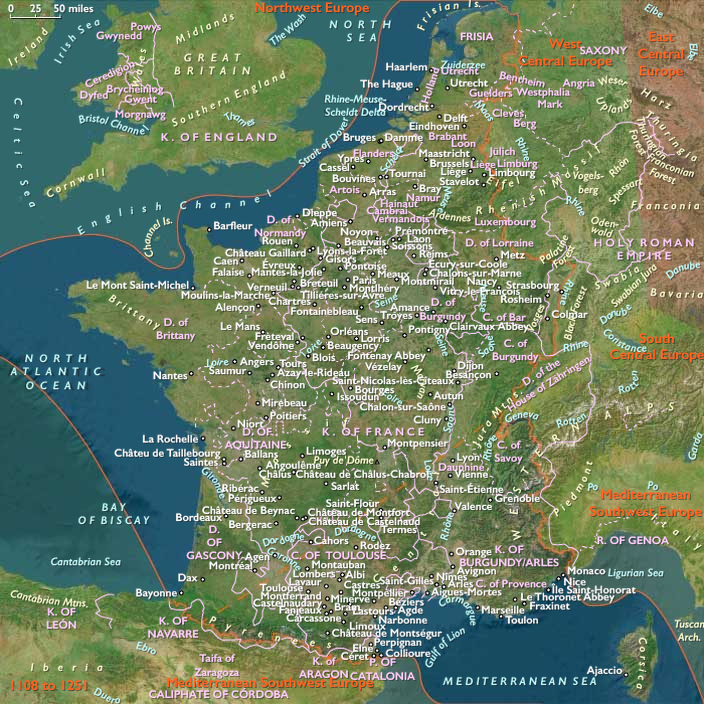
- In 1210, the Bishop of Paris, Peter, and Philip II’s adviser, Chevalier Guérin, uncovered the sect with the help of Master Ralph, an undercover informant.
- A council of bishops and scholars from the University of Paris gathered to punish the Amalricians.
- Sentences were harsh:
- Ignorant converts (including women) were pardoned.
- Four principal members were imprisoned for life.
- Ten Amalricians were burned at the stake in Paris as heretics.
- Amalric’s body was exhumed, burned, and his ashes scattered to obliterate his memory.
David of Dinant and His Condemnation (1210)
Who Was David of Dinant?
- A magister (teacher), likely at the University of Paris, David studied Aristotle’s Physics and Metaphysics, which had recently been reintroduced to Europe after the Crusades.
- He may have lived in Rome under Pope Innocent III, though details of his life remain obscure.
- His major work, Quaternuli (Little Notebooks), developed a radical metaphysical system that blurred the boundaries between matter, intellect, and God.
David’s Pantheistic Philosophy
David believed that everything in existence could be divided into three fundamental elements:
- Matter (yle) – The indivisible essence of physical bodies.
- Intellect (nous) – The fundamental nature of the mind and soul.
- God (Deus) – The eternal, unifying force.
His most heretical claim was that these three were actually the same substance, meaning that:
"All things, material, intellectual, and spiritual, have one and the same essence—God."
This was a direct challenge to Christian orthodoxy, which maintained a strict distinction between Creator and creation.
The Council of Paris (1210) and the Ban on Aristotle
- In 1210, David’s Quaternuli was condemned as heretical by a provincial council led by the Bishop of Sens.
- The council ordered:
- David’s works to be burned.
- Anyone found possessing his writings after Christmas to be declared a heretic.
- A ban on Aristotle’s works on natural philosophy, fearing they were leading to dangerous, unorthodox conclusions.
Although David of Dinant’s own fate is unknown, his ideas were aggressively suppressed, and his influence can only be reconstructed through later critics, such as Albertus Magnus and Thomas Aquinas.
The Broader Impact of the 1210 Condemnations
- The suppression of Amalrician pantheism and David of Dinant’s Aristotelian radicalism reflected growing Church anxieties about rationalist and mystical challenges to doctrine.
- The ban on Aristotle’s works highlighted the conflicted relationship between Christianity and classical philosophy, though Aristotle would later be rehabilitated through figures like Aquinas.
- The Amalricians were eradicated, but their influence persisted in later mystical movements, inspiring radical thinkers and spiritual reformers in later centuries.
The 1210 condemnations marked an important moment in the intellectual history of medieval Europe, showing the limits of theological tolerance in the early 13th century and setting the stage for future conflicts between reason and faith in scholastic thought.
Locations
Groups
Subjects
Regions
West Europe
View →Subregions
