The desertification of North Africa, which will …
Years: 5661BCE - 5518BCE
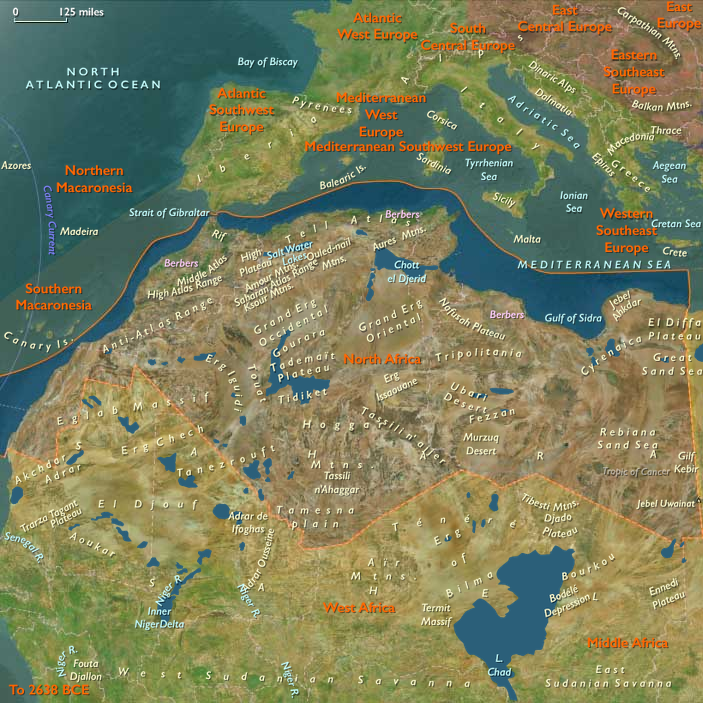
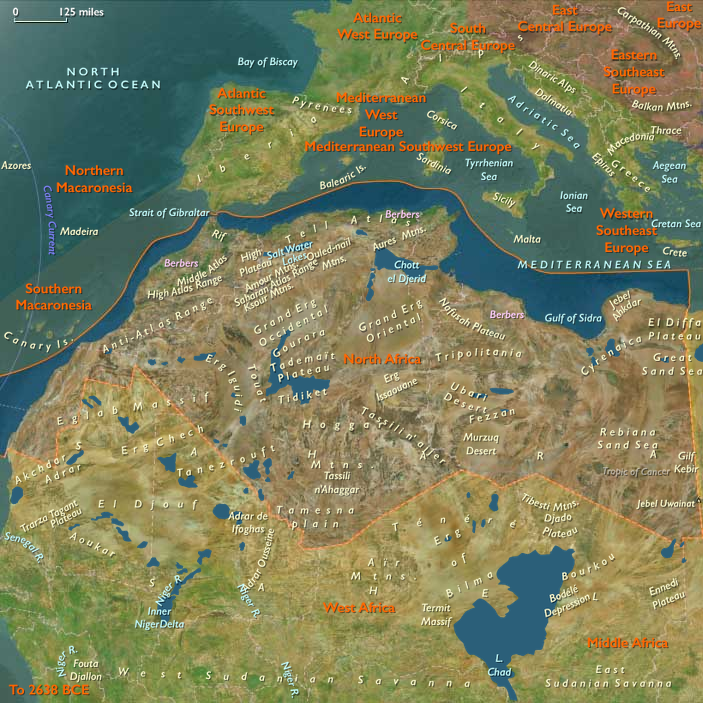
The desertification of North Africa, which will ultimately lead to the creation of the Sahara desert, begins around 5600 BCE.
Locations
Groups
Topics
Subjects
Regions
Subregions
Related Events
Filter results
Showing 10 events out of 69028 total
The Middle East (5661–5518 BCE): Agricultural Intensification and Expanding Settlements
Agricultural Innovation and Productivity
Between 5661 and 5518 BCE, agricultural practices across the Middle East further intensified. Communities such as Çatalhöyük continued refining their farming methods, employing improved cultivation techniques and introducing new crops. This era saw increased productivity in cereals, legumes, and fruit orchards, ensuring sustained growth and food security.
Expanding Settlements and Community Organization
Settlements continued to expand, reflecting growing populations and greater organizational sophistication. New settlements emerged and existing urban centers, like Çatalhöyük, experienced continued growth, prompting further developments in community organization, infrastructure, and architectural complexity.
Technological Advancements and Tool Production
Technological innovation continued to advance, with more refined stone and obsidian tools being produced. These enhancements facilitated agricultural work, hunting, and crafting activities, supporting economic stability and promoting increased efficiency in daily tasks and trade.
Cultural Development and Social Complexity
The period also witnessed significant cultural and social developments. Artifacts and archaeological remains indicate increasing social differentiation, specialized labor roles, and the complexity of communal and possibly ritual practices. Artistic and cultural expressions flourished, continuing the tradition of symbolic representation and communal cohesion.
This age underscores a period of sustained agricultural innovation, settlement expansion, technological progress, and cultural vibrancy, setting critical foundations for subsequent societal complexities in the Middle East.
China’s Neolithic Zhaobaogou culture, found primarily in the Luan River valley in Inner Mongolia and northern Hebei, begins in about 5400, produces sand-tempered, incised pottery vessels with geometric and zoomorphic designs.
The culture also produces stone and clay human figurines.
Neolithic culture thrives along the Danube at such sites as Starcevo, located on the north bank of the Danube in Vojvodina, opposite Belgrade, Serbia.
It represents the earliest settled farming society in the area, although hunting and gathering still provided a significant portion of the inhabitants' diet.
The pottery is usually coarse but finer fluted and painted vessels later emerged.
A type of bone spatula, perhaps for scooping flour, is a distinctive artifact.
The Korös is a similar culture in Hungary named after the River Korös with a closely related culture that also used footed vessels but fewer painted ones.
Both have given their names to the wider culture of the region in that period.
Parallel and closely related cultures also include the Karanovo culture in Bulgaria, Cris in Romania and the pre-Sesklo in Greece.
The Vinca culture emerges around 5500 on the shores of lower Danube.
As in all prehistoric cultures, the majority of the people of the Vinca network are occupied with the provision of food.
The economy is based on a variety of subsistence techniques: arable agriculture, animal husbandry, and hunting and gathering all contributed to the diet of the growing Vin a population.
Vinca agriculture introduces common wheat, oat, and flax to temperate Europe, and makes greater use of barley than earlier cultures.
These innovations raise potential crop yields, and in the case of flax allow the manufacture of clothes in materials other than leather and wool.
There is also indirect evidence that Vinca agriculture made use of the cattle-driven plow, which would have had a major effect on the amount of human labor required for agriculture as well as the types of soils that could be exploited.
Many of the largest Vinca sites occupy regions dominated by soil types that would have required the use of the plow to farm.
Areas with less arable potential were exploited through transhumant pastoralism, where groups from the lowland villages moved their livestock to nearby upland areas on a seasonal basis.
Cattle was more important than caprids (i.e.
sheep and goats) in Vinca herds and, in comparison to the cultures of the period, livestock was increasingly kept for milk, leather and as draft animals, rather than solely for meat.
Seasonal movement to upland areas was also motivated by the exploitation of stone and mineral resources.
The especially rich permanent upland settlements established would have relied more heavily on pastoralism for subsistence.
The Vinca subsistence economy, increasingly focused on domesticated plants and animals, continued to make use of wild food resources.
The hunting of deer, boar and auroch, fishing of carp and catfish, shell-collecting, fowling and foraging of wild cereals, forest fruits and nuts made up a significant part of the diet at some Vinca sites.
These, however, were in the minority; settlements were invariably located with agricultural rather than wild food potential in mind, and wild resources were usually underexploited unless the area was low in arable productivity.

The Cucuteni-Trypillian culture, which has its beginnings around 5500 BCE, was initially named after the village of Cucuteni in Iasi County, Romania, where the first objects associated with it were discovered.
Members of this culture belonged to tribal social groups, scattered over an area of southeast Europe encompassing territories in present-day Romania, Moldova, and southwestern Ukraine.
The important physical features of the land were rolling plains, river valleys, the Black Sea, and the Carpathian Mountains, which were covered by a mixed forest in the west, which gave way to the open grasslands of the steppes in the east.
The climate during the time that this culture flourished has been named the Holocene climatic optimum, and featured cool, wet winters and warm, moist summers.
These conditions would have created a very favorable climate for agriculture in this region.
A copper ax found at Prokuplje in present Serbia indicates that human use of metals started in Europe around seventy-five hundred years ago (~5,500B CE), many years earlier than previously believed.
The first evidence of European metallurgy dates from the sixth and fifth millennium BCE, and was found in the archaeological sites of Majdanpek, Yarmovac, and Plocnik, Serbia.
The earliest copper smelting is found at the Belovode site, these examples include a copper ax, dated from 5500 to 5000 BCE and belonging to the Vinca culture.
The Middle East (5517–5374 BCE): Foundations of Urban Civilization at Eridu
Ecological Confluence and the Origins of Eridu
Between 5517 and 5374 BCE, the city of Eridu emerged at the confluence of three distinct ecosystems. According to scholar Gwendolyn Leick, these environments supported varied lifestyles, each agreeing upon mutual access to essential freshwater resources within a desert landscape. Founded approximately in 5400 BCE, Eridu (modern Abu Shahrain, roughly 315 kilometers southeast of Baghdad, Iraq) represented the earliest known settlement in the lower Tigris-Euphrates Valley, known as Mesopotamia, the "Land Between the Rivers."
Agricultural Practices and Early Urban Infrastructure
The earliest agrarian communities around Eridu practiced intensive subsistence irrigation agriculture, derived from the northern Samarra culture, characterized by canals and mud-brick structures. Settlers moved into previously unoccupied marshlands near the head of the Persian Gulf around the mid-fifth millennium BCE, gradually expanding northward along the lower Tigris-Euphrates Valley.
Multi-Cultural Origins of Eridu
Eridu was shaped by contributions from three distinct cultures:
-
Agrarian settlers who brought the Samarra culture from northern Mesopotamia, identified with the Ubaid period.
-
Nomadic Semitic pastoralists, herding sheep and goats in semi-desert conditions.
-
Fisher-hunter communities from the Arabian coast, possibly ancestral to the Sumerians, known for extensive middens and reed dwellings.
These cultural groups collaborated in building the early urban settlement, centered around a prominent temple complex of mud-brick construction in a natural depression, facilitating water accumulation.
Halaf Culture and Regional Trade
Concurrent with Eridu's development, the Halaf culture flourished in southern Mesopotamia, practicing dryland farming reliant on natural rainfall—methods comparable to those of modern Hopi agriculture in Arizona. Halaf communities cultivated emmer wheat, barley, and flax and maintained cattle, sheep, and goats. Although extensive excavations are rare, structures such as the circular domed tholoi at Tell Arpachiyah reveal ritual uses and domestic functions.
Halaf pottery, distinguished by polychrome geometric and animal motifs, was regionally influential, found across northern Mesopotamia, including sites such as Nineveh, Tepe Gawra, and Chagar Bazar. These communities also created figurines, stamp seals indicative of personal property concepts, and tools crafted from stone and clay, with occasional copper use for decorative purposes.
Fortifications and Urban Expansion
The settlement at Hacilar during the second half of the sixth millennium BCE featured fortified complexes and walled settlements, underscoring growing concerns for security and communal organization.
This era signifies crucial developments in urban planning, agricultural practices, multi-cultural integration, and technological advancements, setting significant precedents for urban civilization in the ancient Middle East.
Eridu (modern Abu Shahrain, one hundred and ninety-six miles (three hundred and fifteen kilometers) southeast of Baghdad, Iraq) appears to be the earliest settlement in the region, founded in about 5400 BCE, close to the Persian Gulf near the mouth of the Euphrates River.
Because of accumulation of silt at the shoreline over the millennia, the remains of Eridu are now some distance from the gulf at Abu Shahrain.
Eridu was the first city in the world, according to the Sumerian kinglist.
The Sumerians claimed that their civilization had been brought, fully formed, to the city of Eridu by their god Enki or by his advisor (or Abgallu from ab=water, gal=big, lu=man), Adapa U-an (the Oannes of Berossus).
The first people at Eridu brought with them the Samarran culture from northern Mesopotamia and are identified with the Ubaid period, but it is not known whether these were Sumerians (associated later with the Uruk period).
The fisher-hunter cultures of the Arabian littoral are responsible for the extensive middens along the Arabian shoreline, and may have been the original Sumerians.
They seem to have dwelt in reed huts.