
The Dutch authorities leave it to each…
1615 CE
The Dutch authorities leave it to each province in 1615 to decide whether it wishes to admit Jews.
Although there are economic and social restriction—Jews are banned from retail trade—their status is liberal.
Subjects
Regions
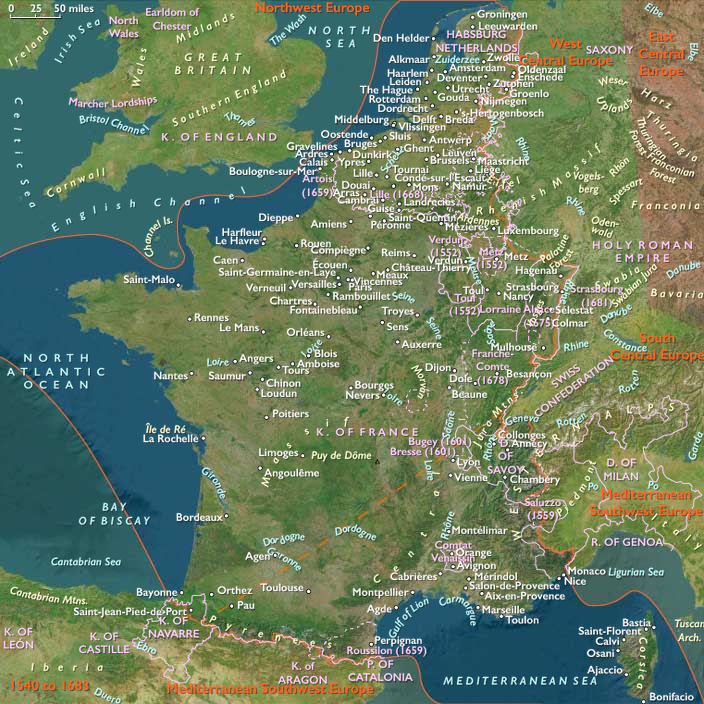
West Europe
View →Subregions

Atlantic West Europe
View →Related Events
No active filters.
Showing 10 events out of 33206 total
Both Russia and the Polish-Lithuanian Commonwealth are shaken by internal strife while many smaller factions thrive.
Polish Lisowczycy mercenaries, who had been essential in the defense of Smolensk in 1612, when most of regulars (wojsko kwarciane) mutinied and joined the konfederacja rohatynska, had been content to guard the Polish border against the Russian incursions for the next three years.
Aleksander Józef Lisowski gathers many outlaws in 1615, however, and invades Russia with six chorągiew of cavalry.
He besieges Bryansk and ...
...defeats the relief force of a few thousand soldiers under Prince Yuri Shakhovskoy near Karachev.
Lisowski then defeats the front guard of a force several times larger than his own, under the command of knyaz Dmitry Pozharsky, who decides to defend instead of attack and fortifies his forces in a camp.
Lisowczycy breaks contact with his forces, burns ...
...Belyov and ...
...Likhvin, ...
...takes Peremyshl, turns north, ...
...defeats the Russian army at Rzhev, ...
...proceeds north towards Kashin, ...
...burns Torzhok, and, heavy with loot, ...
...Lisowski returns to Poland without any further opposition from Russian forces.
Andreas Libavius, as rector of the Gymnasium Casimirianum in Coburg, describes the preparation of metallic antimony by the direct reduction of the sulfide with iron in 1615.
A physician and chemist born in Halle, Germany, as Andreas Libau, he had attended the gymnasium and studied from the year 1576 in University of Wittenberg, then studied from 1577 in the University of Jena in the faculties of philosophy and history, there obtaining the academic degree of magister artium and attending the lectures of the faculty of medicine.
Working at first as a teacher, from the year 1581 in Ilmenau and from 1586 in Coburg, he had gone to Basel in 1588 and gained a promoted to the degree of medicinae doctor, in the same year becoming a professor of history and poetics in Jena, simultaneously supervising the disputations in the field of medicine.
In 1597, he had written the first systematic chemistry textbook, Alchemia, which included instructions for the preparation of several strong acids.
Some of his writings are published under the name Basilius de Varn.