The Dutch Hoge Raad (Supreme Council) had…
October 1657 CE
The Dutch Hoge Raad (Supreme Council) had ruled on August 13, 1651, that guardianship of the year-old Prince of Orange would be shared between his mother, his paternal grandmother and Frederick William, the Elector of Brandenburg, whose wife, Louise Henriette, was his father's eldest sister.
William's mother has shown little personal interest in her son, sometimes being absent for years, and has always deliberately kept herself apart from Dutch society.
William's education had been first laid in the hands of several Dutch governesses, and some of English descent, including Walburg Howard.
The prince has from April 1656, received daily instruction in the Reformed religion from the Calvinist preacher Cornelis Trigland, a follower of the Contra-Remonstrant theologian Gisbertus Voetius.
The ideal education for William is described in Discours sur la nourriture de S. H. Monseigneur le Prince d'Orange, a short treatise, perhaps by one of William's tutors, Constantijn Huygens.
In these lessons, the prince is taught that he is predestined to become an instrument of Divine Providence, fulfilling the historical destiny of the House of Orange.
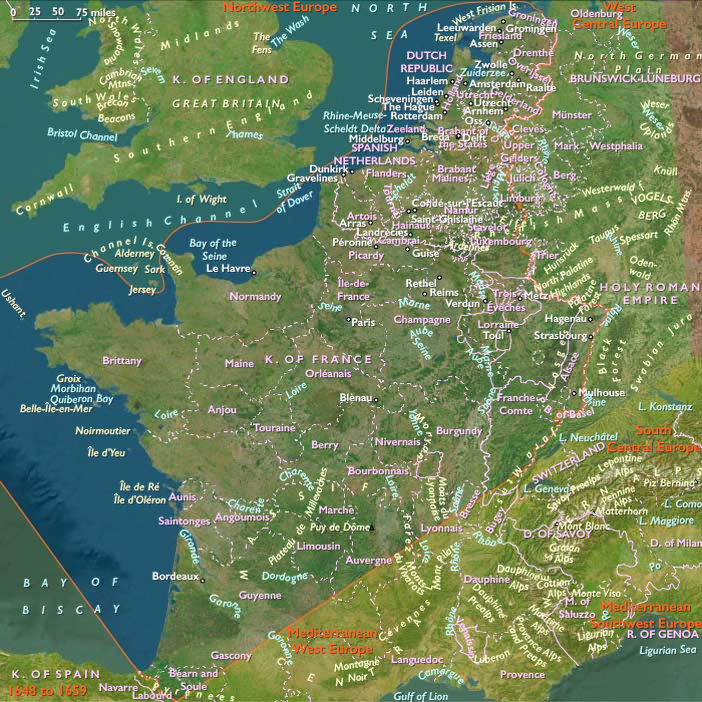
The Treaty of Raalte, signed on October 1, 1657, results in William giving up the stadtholdership of Overijssel.
Locations
Topics
Regions
West Europe
View →Subregions