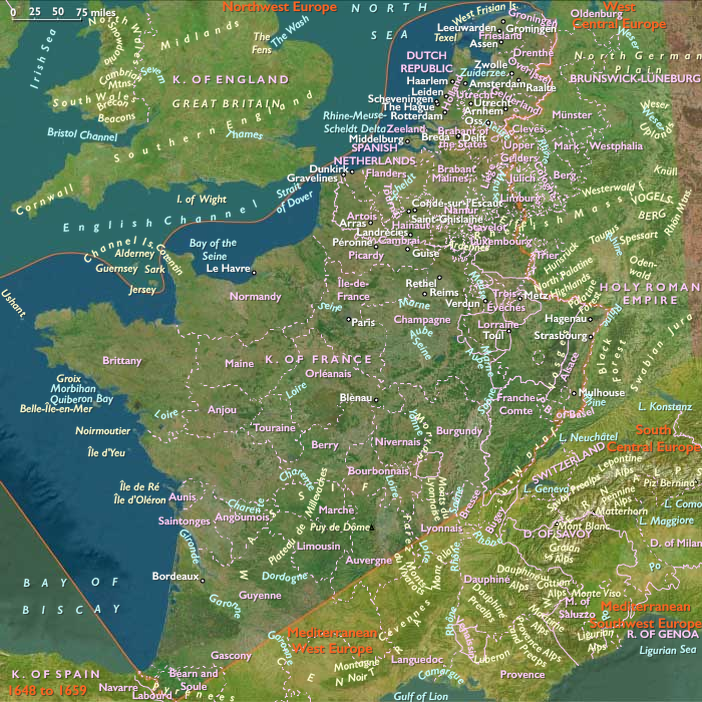
The Dutch Revolt, or Eighty Years' War,…
January 1648 CE
The Dutch Revolt, or Eighty Years' War, which had begun in 1566, is the revolt of the Seven United Provinces of the Netherlands against the Spanish (Habsburg) Empire.
Spain had initially been successful in suppressing the rebellion.
The rebels in 1572 had conquered Brielle, however, and the rebellion had resurged.
During the revolt the Northern Netherlands have become de facto independent and rapidly grown to become a world power through their merchant shipping and experienced a period of economic, scientific, and cultural growth.
However at the same time the Southern Netherlands (situated in modern-day Belgium, Luxembourg and Northern France) remained under Spanish rule.
Despite various attempts, the Dutch have never managed to expel the Spanish.
The French in the final years of the war had allied themselves with the Dutch and attacked the weakened Spanish in the rear.
Large areas of the Southern Netherlands have been lost to France by 1648 and despite many military successes, Andries Bicker, Cornelis de Graeff and many others want to sue for peace.
Bicker, a wealthy merchant in the Muscovy trade, a member of Amsterdam’s vroedschap (city council), the leader of the Arminians, an administrator of the VOC, representative of the States-General of the Netherlands and colonel in the Civic guard, controls the city's politics in close cooperation with his uncle Jacob Dircksz de Graeff and his brother Cornelis Bicker.
Bicker had opposed the late stadtholder Frederick Henry, Prince of Orange, who had intended the centralize the five admiralties, which would have caused the Admiralty of Amsterdam to lose influence.
De Graaf, the mayor of Amsterdam, chief councilor of the Admiralty of Amsterdam, and President of the VOC from 1646, is a member of a family of regents who belong to the republican political movement also referred to as the ‘state oriented’, as opposed to the Royalists.
Groups
Topics
Commodities
Subjects
Regions
West Europe
View →Subregions