
The first humans in the Americas are …
Years: 21645BCE - 19918BCE
The first humans in the Americas are descendants of northeast Asian nomads who had taken part in a series of migrations across the Bering Strait perhaps as early as 30,000 BCE.
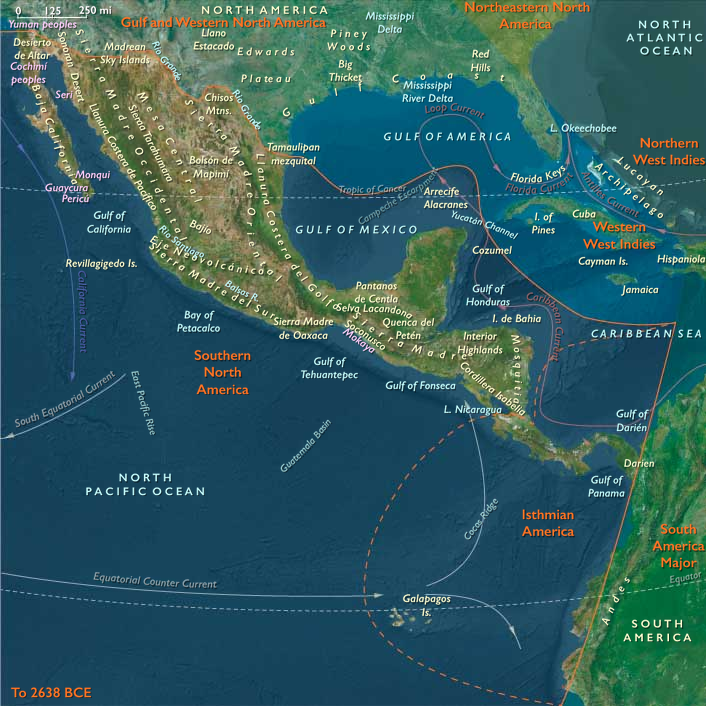
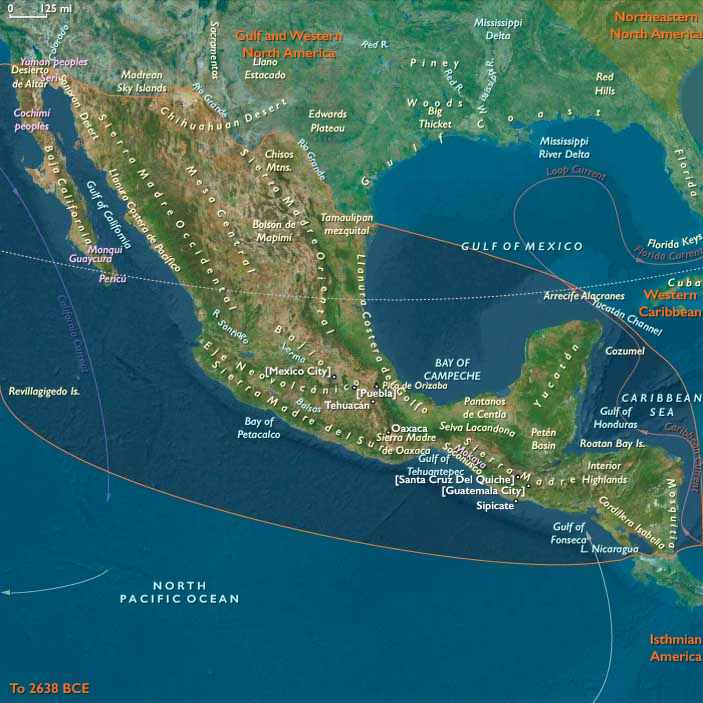
Chips of stone tools found near campfire remains in the Valley of Mexico and radiocarbon-dated to around 21,000 BCE represent the earliest evidence of humans in Mexico.
Locations
Topics
Subjects
Regions
Subregions
Related Events
Filter results
Showing 10 events out of 69446 total
Mitochondrial haplogroups A, B, and G originated fifty thousand years ago, and the bearers subsequently colonized Siberia, Korea and Japan, by thirty five thousand years ago.
Parts of these populations migrate to North America.
Pech Merle: A Window into Prehistoric Art and Life
Located in the Lot département of the Midi-Pyrénées region, near Cabrerets, Pech Merle is one of the few prehistoric cave painting sites in France still open to the public. This vast cave system, extending more than a mile from its entrance, preserves some of the most stunning murals of the Upper Paleolithic period.
Prehistoric Art at Pech Merle
-
The cave features dramatic murals dating from the Gravettian culture (c. 25,000 BCE), though some engravings and paintings may be from the Magdalenian era (c. 16,000 BCE).
-
Seven chambers contain lifelike depictions of:
- Woolly mammoths
- Spotted horses and single-color horses
- Bovids and reindeer
- Human figures and handprints
-
One of Pech Merle’s most famous images is the "Spotted Horses" panel, depicting two horses with distinctive black spots, surrounded by hand stencils—a masterpiece of prehistoric symbolic expression.
Cave Use and Preservation
- During the Ice Age, the cave likely served as a refuge for prehistoric peoples, offering shelter from the Arctic climate and extreme conditions.
- A great river once flowed through the region, cutting underground passages that were later used by early humans.
- Children’s footprints, preserved in ancient clay half a mile underground, provide rare evidence of human movement deep within the caves.
A Sealed Time Capsule of Prehistoric Life
- Over time, earth movements and rain sealed the cave entrances, preserving the artwork in near-perfect condition until its discovery in the 20th century.
- Within a six-mile radius of Pech Merle, there are ten other caves with Upper Paleolithic art, though none are open to the public.
Pech Merle stands as a remarkable testament to early human creativity and survival, offering a rare glimpse into the artistic, cultural, and environmental realities of Ice Age Europe.
The Gravettian Tool Industry (28,000–22,000 Years Ago)
The Gravettian tool industry, named after the site of La Gravette in France, flourished between 28,000 and 22,000 years ago during the Upper Paleolithic period. It is characterized by specialized stone tools that reflect the technological sophistication of Early European Modern Humans (EEMH).
Key Features of Gravettian Technology
- Burins (chisel tools) – Used for carving bone, antler, and wood, demonstrating a shift toward multimaterial craftsmanship.
- Simple end scrapers – Essential for hide processing, indicating advancements in clothing and shelter production.
- Backed blades and bladelets – Small, finely retouched cutting tools, likely used for composite tools, such as hafted knives, arrows, or spears.
Cultural and Technological Significance
- Efficient Hunting Strategies: The backed bladelets suggest the use of projectile weapons, allowing for improved hunting success.
- Expansion Across Europe: The Gravettian culture spread widely across Western, Central, and Eastern Europe, adapting to diverse environments.
- Artistic and Ritualistic Expression: The Venus figurines, found at Gravettian sites, indicate symbolic and artistic developments, possibly linked to fertility or social identity.
The Gravettian industry represents an important technological evolution in tool-making, setting the stage for later Upper Paleolithic cultures, such as the Solutrean and Magdalenian traditions.
The specifics of Paleo-Indian migration remain subject to ongoing research. The traditional 'Clovis First' theory placed human arrival around 13,000 years ago via the Beringia land bridge. However, recent evidence suggests humans reached North America between 15,000-20,000 years ago, with some sites like White Sands potentially dating to 21,000-23,000 years ago.
Two main migration routes are proposed: an inland ice-free corridor between the Laurentide and Cordilleran ice sheets, and a Pacific coastal route. The coastal route is supported by evidence that ice-free coastlines existed earlier than inland corridors. Any early coastal archaeological evidence would indeed be submerged by post-glacial sea level rise.
Current archaeological evidence indicates widespread human habitation occurred during the late glacial period (roughly 16,000-13,000 years ago), well after the Last Glacial Maximum (26,500-19,000 years ago).
Three pottery pieces unearthed at Liyuzui Cave in Liuzhou, Guangxi Province, date to between 19,000 and 16,500 BCE.
Remnants of San communities still survive today in the Kalahari Desert.
The San, who develop their society over thousands of years in isolation, speak a language that includes unique "click" consonants, are smaller statured, and have lighter skin pigmentation than the Bantu speakers who will later move into southern Africa.
San obtain a livelihood from often difficult environments by gathering edible plants, berries, and shellfish; by hunting game; and by fishing.
Gathering is primarily the task of women, who provide approximately eighty percent of the food-
stuffs consumed by the hunter-gatherer communities. Men hunt, make tools and weapons from wood and stone, produce clothing from animal hides, and fashion a remarkable array of musical instruments.
San also create vast numbers of rock paintings—South Africa contains the bulk of the world's
prehistoric art still extant—which express an extraordinary aesthetic sensibility and document San hunting techniques and religious beliefs.
The rock paintings also demonstrate that considerable interaction took place among hunter-gatherer communities throughout southern Africa.
The primary social unit among the San is the nuclear family.
Families join together to form hunter-gatherer bands of about twenty to fifty people. Men and women have equal status in these groups and there is no development of a hereditary chiefdom, although the male head of the main family usually takes a leading role in decision making.
Such bands move about the countryside seeking foodstuffs, sometimes remaining for long periods in particularly productive environments, sometimes splitting apart and joining other groups when food is scarce.
Because they make such limited demands on their environment, San manage to provide a living for themselves for thousands of years.
Population numbers remain small, however, and settlement is generally sparse.
Mean sea levels during the Last Glacial Maximum, which ends around 18,000 BCE, are believed to be one hundred and ten to one hundred and twenty meters (three hundred and sixty-one to three hundred and ninety-four feet) lower than present, with the direct implication that many coastal and lower riverine valley archaeological sites of interest are today under water.
Beringia, the so-called Bering Land Bridge, extends in 18,000 BCE from the Aleutian chain’s Unalaska Island on the southeast, northwestward to the Koryak area’s Cape Olyutorsky north of the Kamchatka Peninsula, and from near the mouth of Canada’s Mackenzie River on the east to near eastern Siberia’s Kolyma and Indigirka rivers on the west.
The sea would long ago have claimed most evidence of temporary or permanent occupation by pre-Holocene peoples.
An alternate, or parallel theory, roiginally proposed in 1979 by Knute Fladmark as an alternative to the hypothetical migration through an ice-free inland corridor, has the first immigrants moving down the coastlands by boat.
Human remains in Sri Lanka dating from as early as 18,000 BCE show a genetic continuum from the prehistoric hunter-gatherers of the island to the present-day Veddas, or Beddahs, more properly known as the Wanniyala-Aetto, or "forest people."
DNA studies suggest that Wanniyala-Aetto may have been the ancestors of most Sinhalese before the arrival of the Indo-Aryans from North India.
According to both Sinhala and Vedda lore, the two races shared a few common ancestors.
