Filters:
Polyphonic Chants in Medieval European Music …
Years: 1108 - 1251
Polyphonic Chants in Medieval European Music
The emergence of polyphonic chants in medieval Europe marked a transformative shift in sacred music, departing from the earlier monophonic traditions of Gregorian chant. By introducing multiple independent vocal lines, polyphony brought greater complexity and expressiveness to medieval liturgical compositions, profoundly influencing the development of Western music.
Characteristics and Development of Polyphony
- Definition and Structure – Polyphony consists of multiple vocal lines sung simultaneously, with each voice maintaining a degree of independence in melody and rhythm, creating a rich, layered sound.
- Origins in Organum (9th–11th centuries) – The earliest form of polyphony, organum, emerged in the 9th century, initially as a simple parallel doubling of Gregorian chant at an interval of a fourth or fifth. Over time, the added voice became more independent, leading to melismatic and free organum by the 11th century.
- The Notre-Dame School and Rhythmic Innovations (12th–13th centuries) – In Paris, the composers Léoninand Pérotin, associated with the Notre-Dame School, pioneered measured rhythm in polyphony. Their works, such as organum duplum, triplum, and quadruplum, introduced greater harmonic and rhythmic sophistication, laying the foundation for later contrapuntal techniques.
- The Rise of the Motet – By the 13th century, the motet emerged as a distinct polyphonic form, incorporating multiple texts sung simultaneously by different voices. This innovation expanded the expressive range of sacred music and introduced secular influences into religious compositions.
Impact on European Music
- Enriched Sacred Music – Polyphony added expressive depth and dynamism to medieval liturgical services, enhancing the emotional impact of sacred texts.
- Foundation for Renaissance and Baroque Music – The polyphonic techniques developed in the medieval period directly influenced the complex contrapuntal structures of Renaissance composers such as Josquin des Prez and Palestrina, eventually leading to the harmonic innovations of the Baroque era.
- Institutional Patronage and Musical Preservation – The Catholic Church, along with medieval cathedrals and universities, played a central role in preserving and disseminating polyphonic traditions, ensuring their continued development across Europe.
By shaping the trajectory of choral and liturgical music, polyphonic chant stands as one of the most significant innovations in medieval European culture, bridging the medieval world with the musical revolutions of the Renaissance and beyond.
Years: 1108 - 1251
Topics
Subjects
Regions
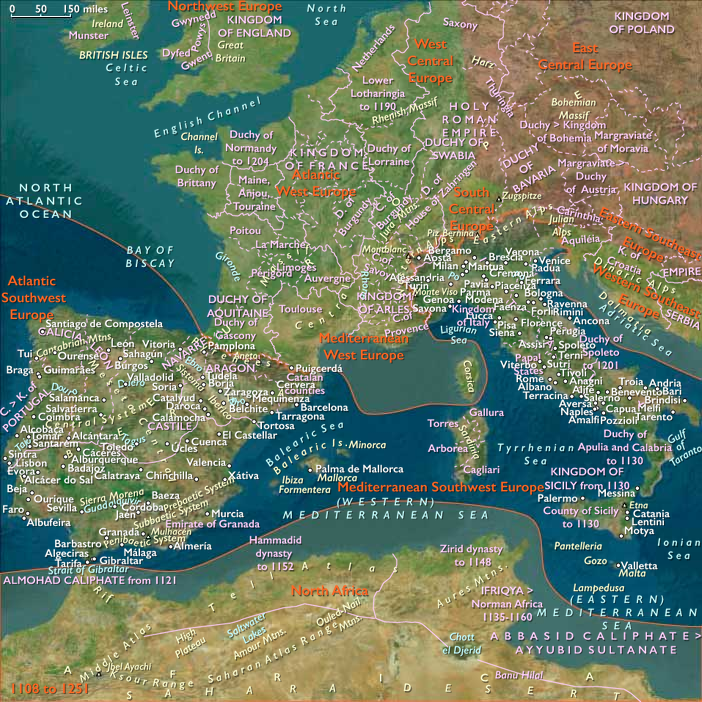
Subregions
- Northeast Europe
- East Central Europe
- South Central Europe
- Mediterranean West Europe
- Mediterranean Southwest Europe
- Atlantic Southwest Europe
- Atlantic West Europe
- West Central Europe
- Northwest Europe