
The comprehensive legal code introduced in 1649 …
Years: 1648 - 1659
The comprehensive legal code introduced in 1649 illustrates the extent of state control over Russian society.
By this time, the boyars had largely merged with the elite bureaucracy, who are obligatory servitors of the state, to form a new nobility, the dvoryanstvo.
The state requires service from both the old and the new nobility, primarily in the military.
In return, they receive land and peasants.
In the preceding century, the state had gradually curtailed peasants' rights to move from one landlord to another; the 1649 code officially attaches peasants to their domicile.
The state fully sanctions serfdom, and runaway peasants become state fugitives.
Landlords have complete power over their peasants and buy, sell, trade, and mortgage them.
Peasants living on state-owned land, however, are not considered serfs.
They are organized into communes, which are responsible for taxes and other obligations.
Like serfs, however, state peasants are attached to the land they farm.
Middle-class urban tradesmen and craftsmen are assessed taxes, and, like the serfs, they are forbidden to change residence.
All segments of the population are subject to military levy and to special taxes.
By chaining much of Muscovite society to specific domiciles, the legal code of 1649 curtails movement and subordinates the people to the interests of the state.
Locations
Groups
- Christians, Eastern Orthodox
- Russians (East Slavs)
- Ukrainians (East Slavs)
- Belarusians (East Slavs)
- Moscow, Grand Principality of
- Tatars
Commodoties
Subjects
Regions

Subregions
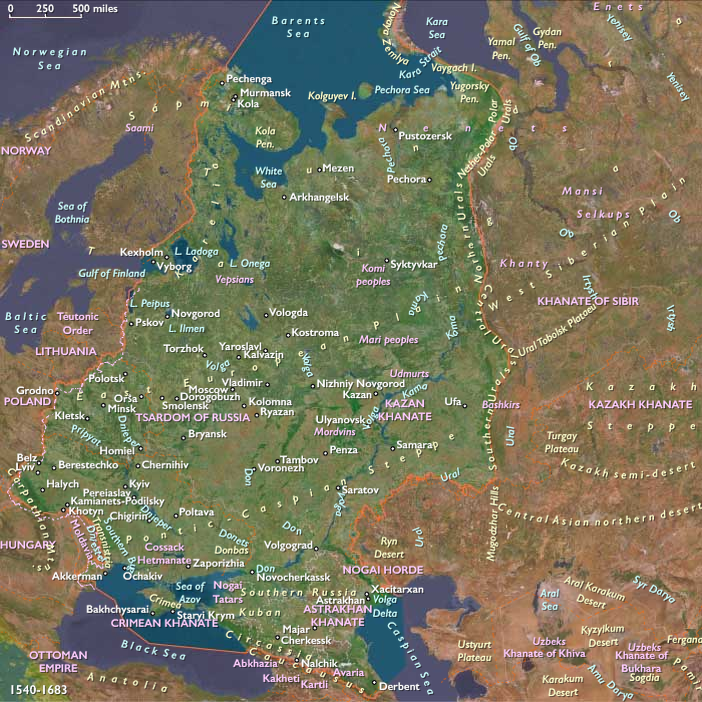
Years: 1648 - 1659
Locations
Groups
- Christians, Eastern Orthodox
- Russians (East Slavs)
- Ukrainians (East Slavs)
- Belarusians (East Slavs)
- Moscow, Grand Principality of
- Tatars
Commodoties
Subjects
Regions
Subregions