
William Merritt Chase paints A Friendly Call…
1895 CE
A new vogue for Oriental aesthetics accounts for the bamboo chair, reed floor mats, and silk wall hangings.
Such elegance transforms a functional workroom into a private exhibition gallery.
The "art for art's sake" movement has made possible this recent rise in the social status of painters.
The painter's wife, Alice Gerson Chase, greets an unidentified caller.
According to the rigid social etiquette of the 1890s, the hostess has not yet asked—or may never permit—her guest to relax, put down her parasol, and remove her gloves, hat, and veil.
The ladies lean symmetrically toward each other and the center of the geometric composition with its long, low banquette and carefully arranged cushions and framed pictures.
Chase, as an impressionist, uses the large mirror to capture a soft-focus reflection of the sunlit hallway and stair leading to his airy studio.
The easygoing painter, now forty-six, has encouraged so many students in Manhattan, Brooklyn, Philadelphia, and at his Long Island summer studio that he boasts, "I believe I am the father of more art children than any other teacher."
Chase cultivates multiple personae: sophisticated cosmopolitan, devoted family man, and esteemed teacher.
Chase had married Alice Gerson in 1887 and together they will raise eight children during Chase's most energetic artistic period.
His eldest daughters, Alice Dieudonnee Chase and Dorothy Bremond Chase, often model for their father.
Images
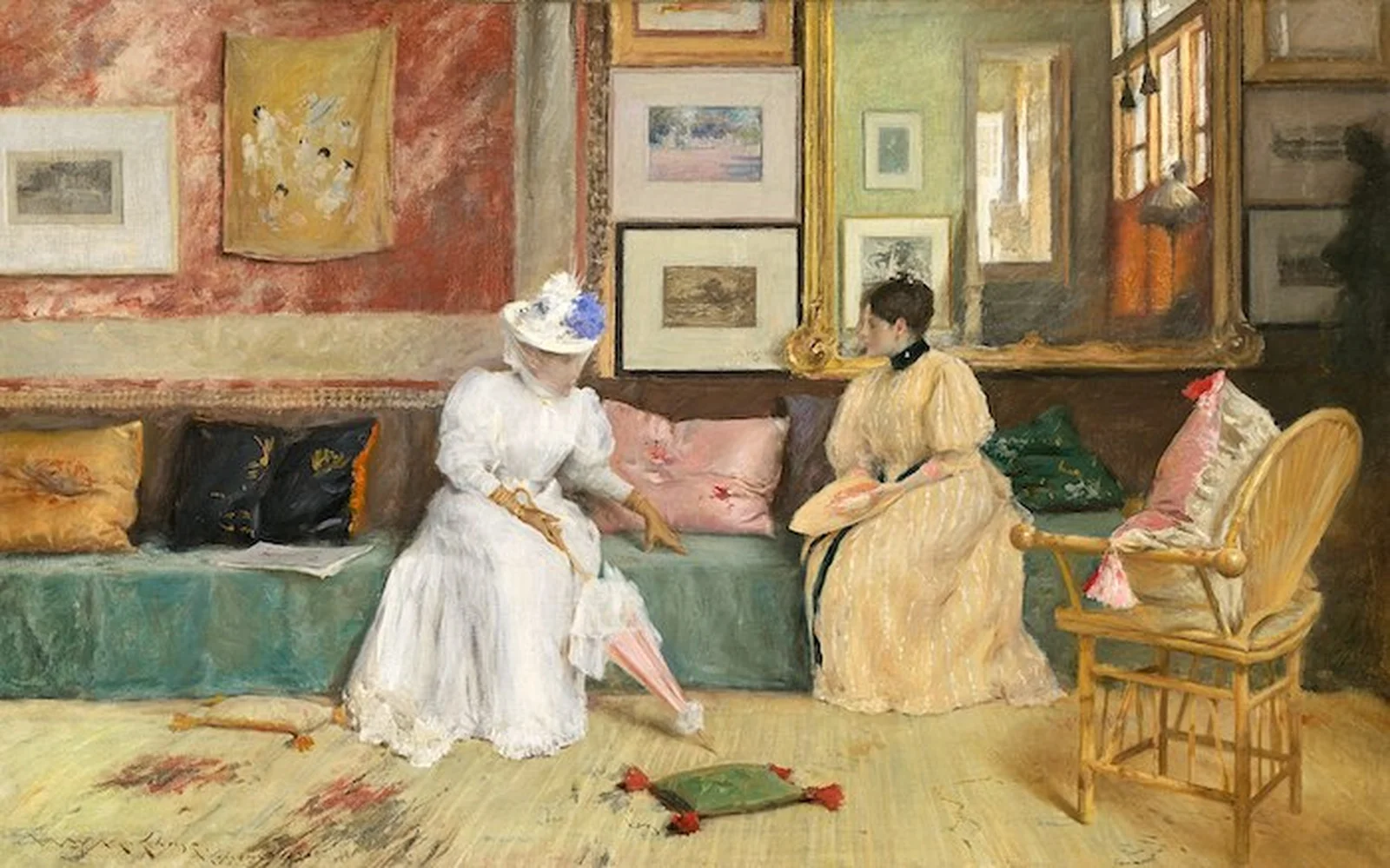
William Merritt Chase: A Friendly Call (1895) painting; 76.5 cm (30.1 ″); Width: 122.5 cm (48.2 ″). National Gallery of Art
People
Subjects
Regions

Northern North America
View →Subregions
