
Atlantic West Europe (820 – 963 CE): …
Years: 820 - 963
Atlantic West Europe (820 – 963 CE): Carolingian Heartlands, Viking Raids, and Monastic Reforms
Geographic and Environmental Context
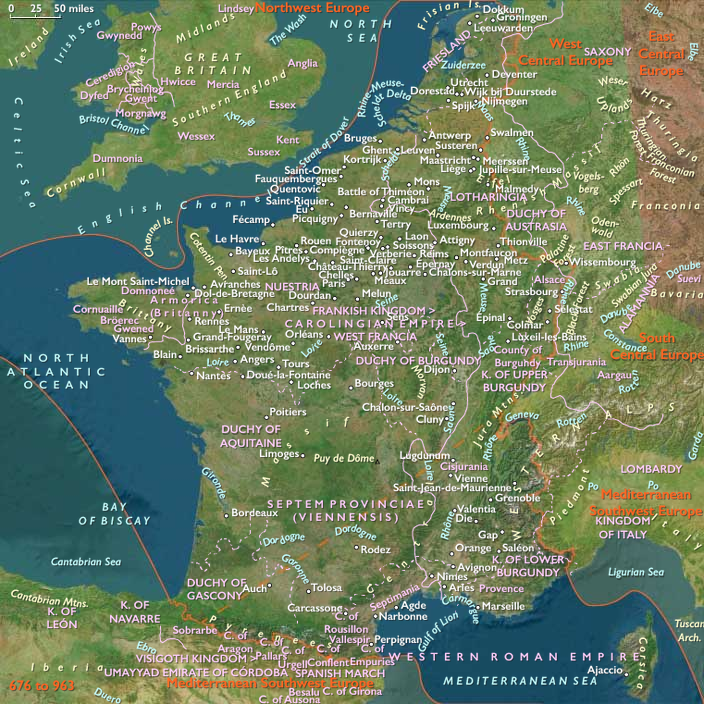
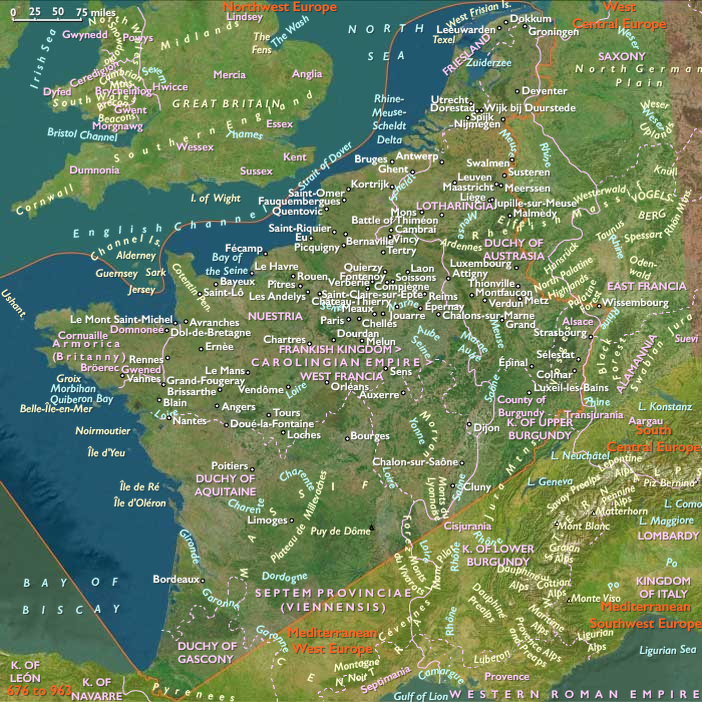
Atlantic West Europe spans northern France and the Low Countries.
-
Anchors: the Seine basin (Paris, Rouen), the Loire Valley (Tours, Nantes, Orléans), Burgundy (Dijon, Cluny), the Channel coasts (Brittany, Normandy, Flanders), and the Scheldt delta (Ghent, Bruges, Antwerp).
Climate and Environmental Shifts
-
Early Medieval Warm Period lengthened growing seasons; fertile plains of Île-de-France and Flanders expanded.
-
Frequent Viking raids exploited navigable rivers (Seine, Loire, Scheldt).
Societies and Political Developments
-
Carolingian fragmentation after Verdun (843) split the region into West Francia, Burgundy, and Lotharingian borderlands.
-
Paris emerged as a defensive stronghold against Viking fleets.
-
Vikings plundered Rouen, Nantes, Paris, Ghent; permanent settlements in Normandy after Treaty of Saint-Clair-sur-Epte (911) created the Duchy of Normandy under Rollo.
-
Flanders developed as a marcher county balancing West Frankish and Lotharingian ties.
-
Monastic reform: Cluny Abbey (910) in Burgundy set a pan-European spiritual movement.
Economy and Trade
-
Loire and Seine valleys: cereals, wine; Burgundy: vineyards, salt.
-
Channel fisheries and salt pans supported local markets.
-
Flanders/Low Countries: wool processing began; Scheldt trade routes tied to Rhine–Meuse.
Belief and Symbolism
-
Monastic reform (Cluny) reshaped religious life.
-
Relics and cathedrals in Tours, Reims, and Chartres anchored pilgrimages.
Long-Term Significance
By 963, Normandy was established, Flanders fortified, Cluny launched reform, and Paris was poised to rise as a Capetian capital.

Atlantic West Europe (with civilization) ©2024-25 Electric Prism, Inc. All rights reserved.
People
Groups
- Franks
- Dutch people
- Francia (Carolingians)
- Aquitaine, (Carolingian) Kingdom of
- Vikings
- Frankish, or Carolingian (Roman) Empire
- Francia Orientalis (East Francia), Kingdom of
- Francia Media (Middle Francia), Kingdom of
- Francia Occidentalis (West Francia, or France), Kingdom of
- Flanders, County of
- Normandy, Duchy of
- Normans
Topics
- Renaissance, Carolingian
- Viking Raids
- Viking Raids in France, Early
- Viking Raids in France, Later
- Medieval Warm Period (MWP) or Medieval Climate Optimum
Commodoties
Subjects
Regions
Subregions
Years: 820 - 963
Atlantic West Europe (with civilization) ©2024-25 Electric Prism, Inc. All rights reserved.
People
Groups
- Franks
- Dutch people
- Francia (Carolingians)
- Aquitaine, (Carolingian) Kingdom of
- Vikings
- Frankish, or Carolingian (Roman) Empire
- Francia Orientalis (East Francia), Kingdom of
- Francia Media (Middle Francia), Kingdom of
- Francia Occidentalis (West Francia, or France), Kingdom of
- Flanders, County of
- Normandy, Duchy of
- Normans
Topics
- Renaissance, Carolingian
- Viking Raids
- Viking Raids in France, Early
- Viking Raids in France, Later
- Medieval Warm Period (MWP) or Medieval Climate Optimum
Commodoties
Subjects
Regions
Subregions