
The Battle of Crécy (August 26, 1346): …
Years: 1346 - 1346
August
The Battle of Crécy (August 26, 1346): A Defining English Victory
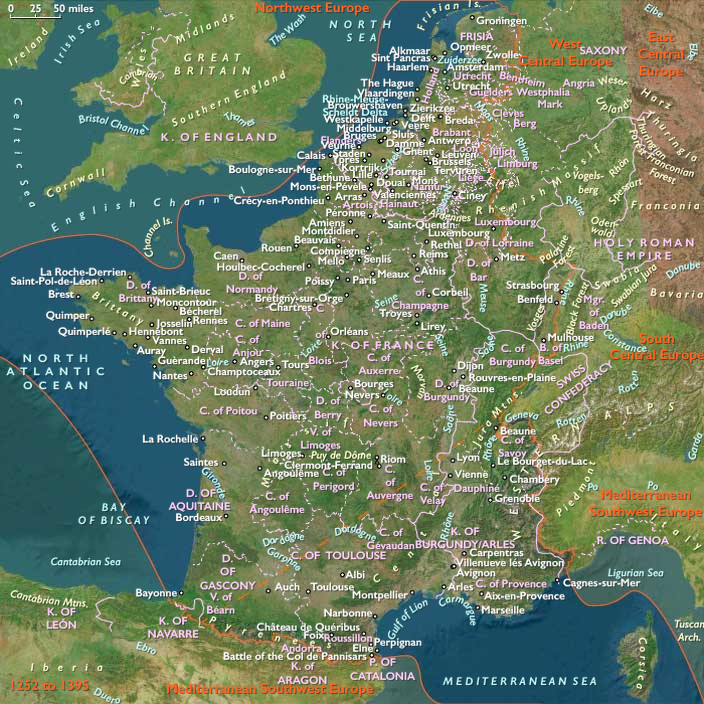
The Battle of Crécy (or Cressy in English) was a decisive English victory in the Hundred Years’ War, marking a turning point in medieval warfare. The English army, using innovative tactics and the longbow, devastated the much larger French force, leading many historians to consider this battle as the beginning of the decline of chivalric warfare.
Edward III’s Maneuvers Before the Battle
- After crossing the Somme River at the tidal ford of Blanchetaque, the English army left Philip VI’s forces stranded on the opposite side, gaining a crucial head start.
- Edward III continued his march toward Flanders, aiming to link up with his allies.
- However, Philip VI’s army pursued relentlessly, and Edward, realizing he could not outrun the French, chose to stand and fight on August 26, 1346.
English Battle Formation and Strategy
- Edward III positioned his army on a hill, giving his men a tactical advantage over the approaching French.
- His troops were arranged in a defensive formation:
- Longbowmen were placed on the flanks, ensuring they could fire into the advancing enemy.
- Men-at-arms were stationed in the center, ready to hold the line.
- Reserves were positioned at the top of the hill, prepared to reinforce the front when needed.
- The total combined English and French forces numbered fewer than 60,000, with the English heavily outnumbered.
The Disaster for France: Poor Leadership and Tactical Failures
- Philip VI allowed his army to attack before it was fully prepared, leading to chaotic assaults that played directly into English hands.
- The French vanguard was led by 5,000 Genoese crossbowmen, commanded by Antonio Doria.
- Heavy rain soaked their crossbow strings, making them almost useless, since unlike English longbows, they could not be easily removed or restrung.
- When the crossbowmen failed to make an impact and began retreating, French knights mistook this for cowardice and attacked their own allies, slaughtering many of them.
The Longbow’s Devastating Effect
- The English longbowmen unleashed volleys of arrows, decimating the first three French infantry regiments before they could even engage.
- As French cavalry charged, their horses were targeted and brought down, creating chaos in the ranks.
- Men-at-arms then moved in, cutting down disorganized and trapped French soldiers.
Key Deaths and Casualties
- The battle was a disaster for the French, with many high-ranking nobles killed on the battlefield.
- Among the dead was John of Luxembourg, King of Bohemia, who, despite being blind, fought heroically alongside 500 Bohemian knights.
- His chivalric bravery became legendary, but his death symbolized the fading dominance of mounted knights against new military tactics.
Aftermath and Legacy
- The French suffered enormous losses, while the English held their position and emerged victorious.
- The Battle of Crécy proved that longbowmen and tactical positioning could defeat traditional knightly charges, marking a fundamental shift in medieval warfare.
- The defeat severely weakened the French military, allowing Edward III to continue his campaign, leading to the Siege of Calais (1346–1347).
The Battle of Crécy was a defining moment in the Hundred Years’ War, showcasing English tactical superiority and marking the beginning of the end for the chivalric age.
Locations
People
Groups
- Genoa, (Most Serene) Republic of
- England, (Plantagenet, Angevin) Kingdom of
- Bohemia, Kingdom of
- France, (Valois) Kingdom of
Topics
Commodoties
Subjects
Regions
Subregions
Related Events
Showing 10 events out of 44373 total
Years: 1346 - 1346
August
Locations
People
Groups
- Genoa, (Most Serene) Republic of
- England, (Plantagenet, Angevin) Kingdom of
- Bohemia, Kingdom of
- France, (Valois) Kingdom of
Topics
Commodoties
Subjects
Regions
Subregions