
The English, the main rival of the …
Years: 1636 - 1636
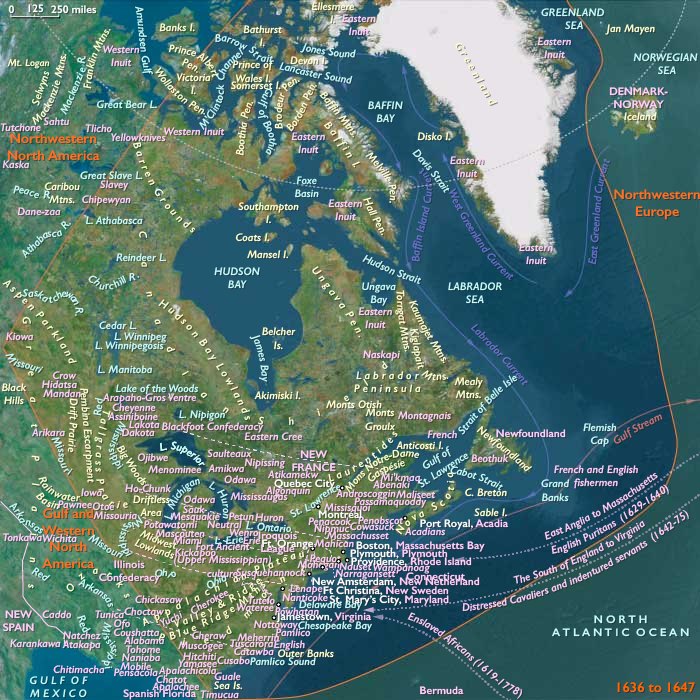
The English, the main rival of the Dutch in North America, had established several settlements on the eastern coast of New England, including Plymouth Colony in 1620, New Hampshire Colony in 1623, and Massachusetts Bay Colony in 1630.
King James I of England had granted the Earl of Warwick, president of the Council for New England, the right to settle the area west of Narragansett Bay to the Pacific Ocean.
Warwick had conveyed the grant in 1631 to fifteen Puritan lords in England as a potential refuge in North America.
The patentees, who included William Fiennes, 1st Viscount Saye and Sele, as well as Lord Brooke, and Colonel George Fenwick, had in 1635 commissioned John Winthrop, Jr., son of the governor of the Massachusetts Bay Colony, as "Governor of River Colony".
Winthrop, on arriving in Boston in October 1635, had learned that the Dutch were planning to occupy the mouth of the Connecticut River at a place called Pasbeshauke, meaning "place at the mouth of the river" in the Algonquian language.
To counter the Dutch, Winthrop had sent a small bark (canoe) to the mouth of the Connecticut with twenty carpenters and other workmen under the leadership of Lieutenant Edward Gibbons and Sergeant Simon Willard.
The expedition had landed near the mouth of the river, on the west bank in present-day Old Saybrook, on November 24, 1635 and located the Dutch coat of arms nailed on a tree.
Tearing down the coat of arms and replacing it with a shield painted with a grinning face, they established a battery of cannon and built a small fort.
When the Dutch ship returned several days later, they sighted the cannon and the English ships and withdrew.
Winthrop had renamed the point "Point Sayebrooke" in honor of Fiennes (Viscount Saye) and Lord Brooke.
Locations
People
Groups
- Puritans
- Netherlands, United Provinces of the (Dutch Republic)
- England, (Stuart) Kingdom of
- New Netherland (Dutch Colony)
- Massachusetts Bay Colony (sometimes called the Massachusetts Bay Company, for its founding institution)
- Plymouth Colony (English Colony)
- Saybrook Colony (English)
- (Connecticut) River Colony (English)
Topics
Commodoties
Subjects
Regions
Subregions
Related Events
Showing 10 events out of 22 total
Years: 1636 - 1636
Locations
People
Groups
- Puritans
- Netherlands, United Provinces of the (Dutch Republic)
- England, (Stuart) Kingdom of
- New Netherland (Dutch Colony)
- Massachusetts Bay Colony (sometimes called the Massachusetts Bay Company, for its founding institution)
- Plymouth Colony (English Colony)
- Saybrook Colony (English)
- (Connecticut) River Colony (English)
Topics
Commodoties
Subjects
Regions
Subregions