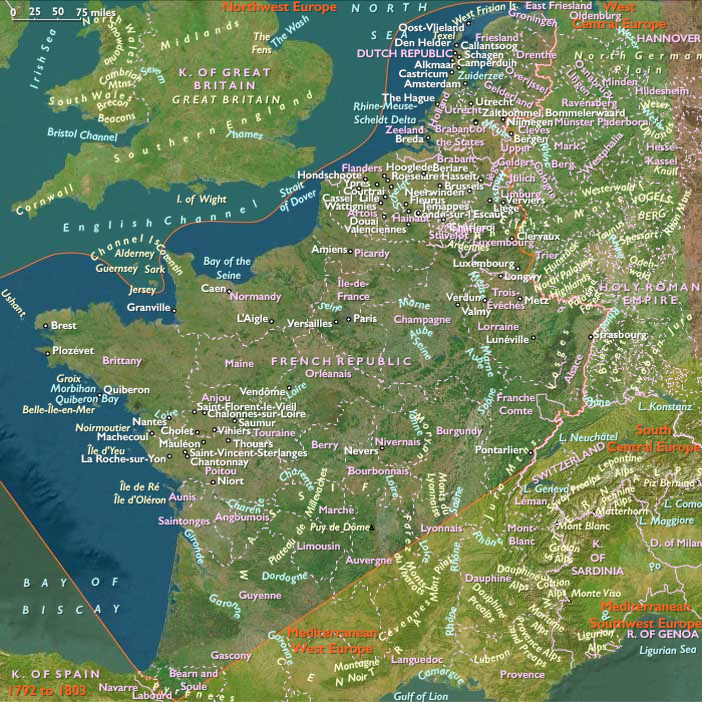
The ensuing movement in favor of more…
August 1795 CE
The ensuing movement in favor of more merciful methods of government had threatened to sweep away the group of politicians who had been mainly instrumental in carrying through the coup d'état.
Nonetheless, largely because of Fouché's intrigues, they had remained in power for a time after July.
This has also brought divisions in the Thermidor group, which soon became almost isolated, with Fouché spending all his energy on countering the attacks of the moderates.
He is himself denounced by François Antoine de Boissy d'Anglas on August 9, 1795, which causes his arrest, but the Royalist rebellion of 13 Vendémiaire Year IV aborts his execution, and he is released in the amnesty which follows the proclamation of the Constitution of 5 Fructidor (August 22, 1795).
By adopting the Constitution of the Year III, the National Convention reestablishes freedom of worship, begins releasing large numbers of prisoners, and most importantly, initiates elections for a new legislative body.
The Constitution of the Year III establishes a liberal republic with a franchise based on the payment of taxes, similar to that of the French Constitution of 1791; a bicameral legislature, (Council of Ancients, and a Council of 500) to slow down the legislative process; and a five-man Directory.
The central government retained great power, including emergency powers to curb freedom of the press and freedom of association.
The Declaration of Rights and Duties of Mankind at the beginning of the constitution include an explicit ban on slavery.
The Constitution, which establishes the Directoire as the national governing body, specifies that the colonies are integral parts of the French Republic and to be governed by the same laws.
Locations
Groups
Topics
Commodities
Subjects
Regions
West Europe
View →Subregions