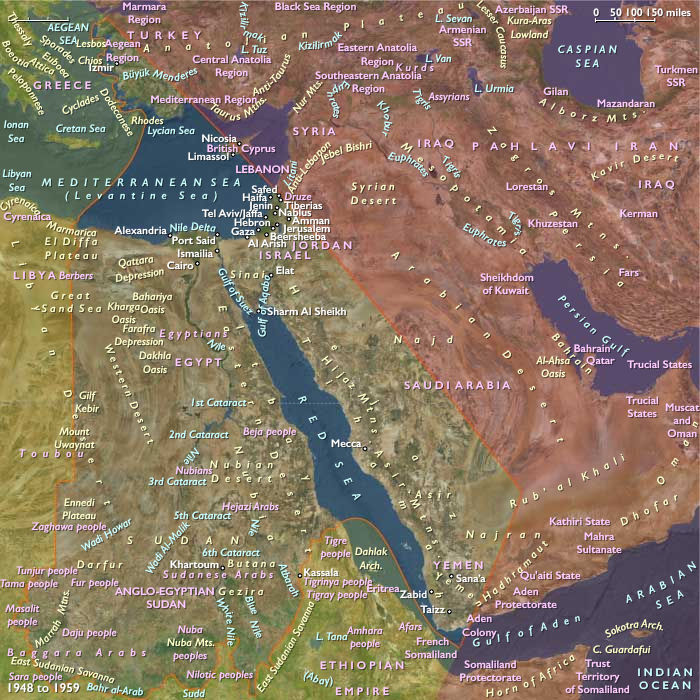
The United Nations partition plan of November…
December 1949 CE
The United Nations partition plan of November 1947 had envisioned the division of Galilee between Israel and the never-created Arab state in Palestine, but it all goes to Israel after the 1948-49 ArabIsraeli war.
The approximately one hundred and fifty thousand Arabs who remain inside post-1948 Israel represent about one-eighth of all Palestinians (and by 1952 will represent roughly the same proportion of the Israeli population); the majority of them live in villages in western Galilee.
Because much of their land has been confiscated, Arabs are forced to abandon agriculture and become unskilled wage laborers, working in Jewish industries and construction companies.
As citizens of the State of Israel, in theory they are guaranteed equal religious and civil rights with Jews.
In reality, however, they live (until 1966) under a military jurisdiction that imposes severe restrictions on their political options and freedom of movement. (Because Israel's parliament never passes a constitution, however, Arab rights in the Jewish state will remained precarious.)
Israel's Arab residents are seen both by Jewish Israelis and by themselves as aliens in a foreign country.
They have been waging war since the 1920s against Zionism and cannot be expected to accept enthusiastically residence in the Jewish state.
The institutions of the new state are designed to facilitate the growth of the Jewish nation, which in many instances entails a perceived infringement upon Arab rights.
Thus, Arab land is confiscated to make way for Jewish immigrants, the Hebrew language and Judaism predominate over Arabic and Islam, foreign economic aid pours into the Jewish economy while Arab agriculture and business receive only meager assistance, and Israeli security concerns severely restrict the Arabs' freedom of movement.
Locations
Groups
Commodities
Subjects
Regions
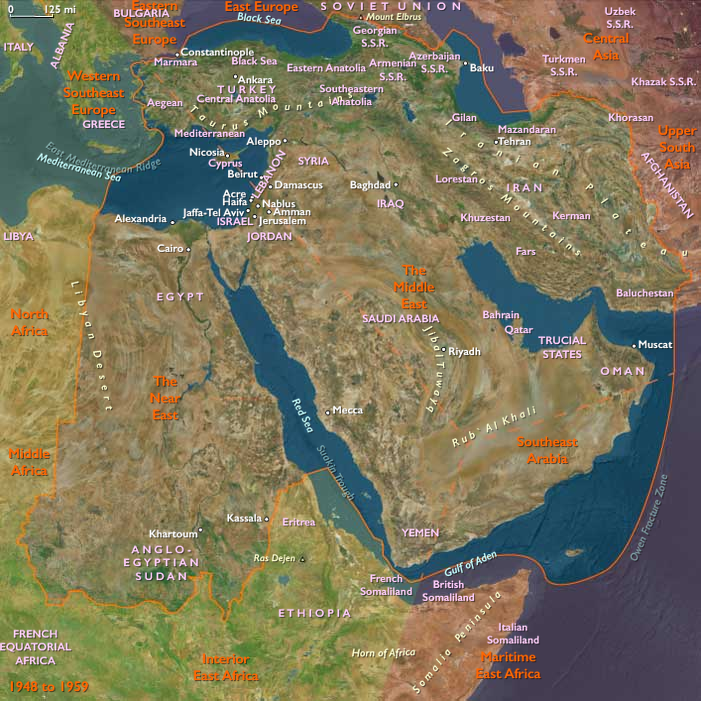
The Near and Middle East
View →Subregions