
The Ethiopians overrun the Meroe-based Kushite kingdom…
350 CE
The Ethiopians overrun the Meroe-based Kushite kingdom around 350, causing its permanent collapse.
Locations
Topics
Commodities
Subjects
Regions
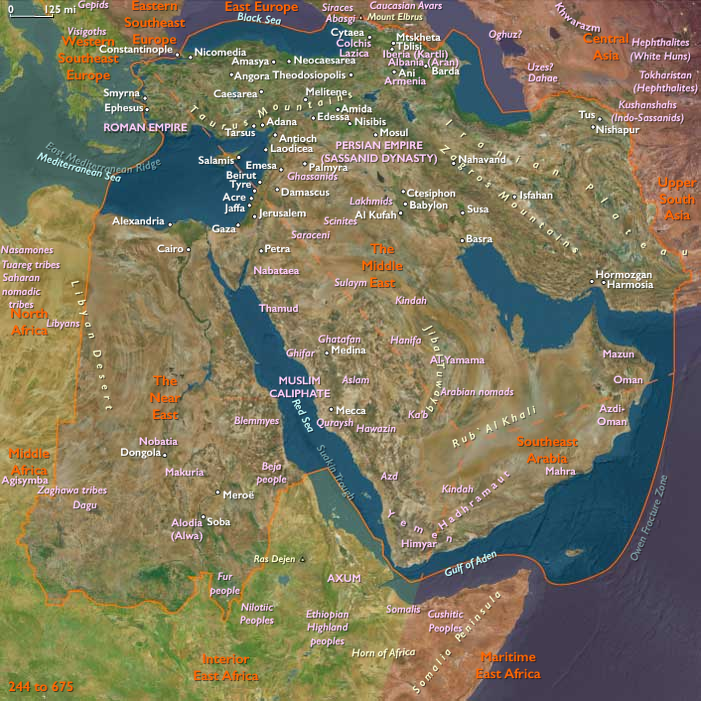
The Near and Middle East
View →Subregions
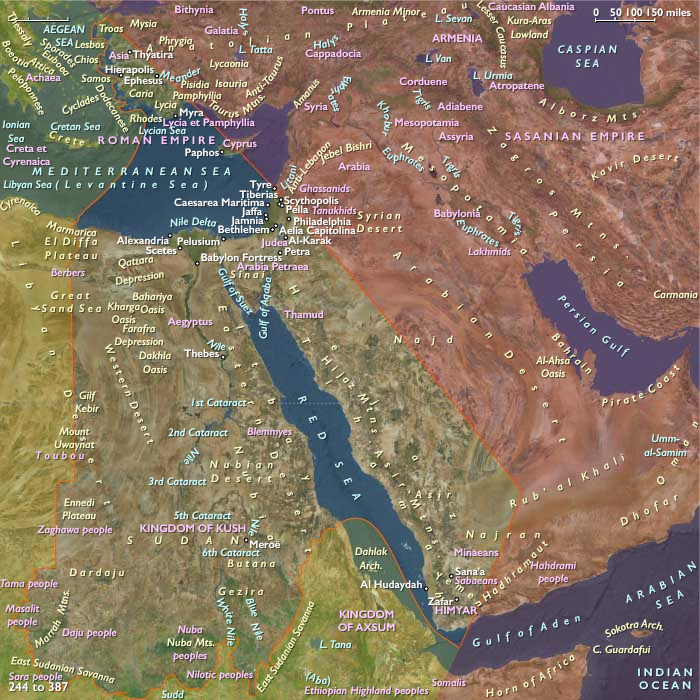
Near East
View →Related Events
No active filters.
Showing 10 events out of 59818 total
Struggles within the Jie Later Zhao regime had resulted in the benefit of Ran Min, who by 350 CE has taken over the regime and massacred the entire ruling Shi family, with the exception of one cousin of Shi Jian, the last emperor of Later Zhao, who leads an uprising against him, beginning the Wei–Jie war.
Shi Jian's cousin, Shi Zhi, had been a Later Zhao general at Xiangguo.
On hearing that Ran Min had massacred the Shi family and declared himself emperor, Shi Zhi had raised a rebellion against Ran Min.
He is quickly joined by several other Later Zhao border armies, mostly composed of Jie soldiers and who despise Ran Min's rule, as well as many other Wu Hu nations.
When he hears of the Jie revolt against him, Ran Min issues his famous "extermination order", in which he calls on the Chinese to kill all the Wu Hu who had conquered them half a century earlier.
The effect is immense; some two hundred thousand Jie are killed in Yecheng (the Wei capital) in a few days, and brutal fighting breaks out between Chinese and Wu Hu throughout North China.
Meanwhile, Ran Min's army meets the main rebel forces under Shi Zhi and defeats them at the Battle of Yecheng.
In spring 351, Ran Min besieges Shi Zhi's capital Xiangguo.
Shi Zhi seeks aid from Former Yan's prince Murong Jun and is able to deal Ran a major defeat.
At this time, the Xiongnu soldiers in Yecheng rebel, capture his son Ran Yin, and surrender to Shi Zhi, who executes Ran Yin.
Ran Min is thought to be dead, but when he appears in Yecheng, the city is calmed.
Shi Zhi has his general Liu Xian besiege Yecheng, but Ran Min defeats Liu in battle and awes him so much that Liu agrees that once he returns to Xiangguo, he will kill Shi Zhi and surrender.
He does so and sends Shi Zhi's head to Ran Min, and Ran Min has Shi Zhi's head burned on a busy street in Yecheng.
Later Zhao is at its final end.
The city of Xiangguo is burned, and its population moved to Yecheng.
Following the victory at Xiangguo, Ran Min's forces proceed northwards and defeat two Later Zhao border armies.
Wherever he capture territory from the rebels, Ran Min's forces massacre any Wu Hu living there, burying them in large pits.
Some one hundred thousand are reputedly killed in this way.
Thousands of Wu Hu flee China or are killed.
Conflict has raged for years between Romans and Persians in northern Mesopotamia, with neither side a clear-cut victor.
Nearly every year the Persians have attacked and pillaged Roman territory; the Mesopotamian towns are besieged, and the great fortress cities of Nisibis, which Shapur has besieged three times without success, and Amida, continue to resist.
Constantius has fought Shapur conscientiously, but his generals have been mediocre, except for Urisicinus, and he himself is clumsy.
However, Shapur is in 350 distracted by the appearance on his eastern frontier of a new enemy, the nomadic Chionites or Xionites, sometimes identified with a tribe known as Red Huns but whose origins remain controversial.
Magnentius' Rise to Power and the Overthrow of Constans (350 CE)
Magnus Magnentius, a pagan of German descent, was born in Samarobriva (modern Amiens, Gaul) and rose to prominence as a distinguished soldier. By 350 CE, he commanded the Herculians and Iovians, two elite imperial guard units, giving him significant military influence (Zosimus, ii.58).
1. Growing Discontent with Constans
- Emperor Constans, ruler of the Western Roman Empire, had become increasingly unpopular among the legions.
- His arbitrary rule and favoritism alienated both the army and the Roman elite.
- By 350 CE, discontent in the ranks of the military had reached a breaking point.
2. The Army Proclaims Magnentius Emperor (January 18, 350 CE)
- On January 18, 350 CE, in Autun (modern France), the army elevated Magnentius to the rank of Augustus, openly declaring rebellion against Constans.
- Magnentius, a capable general and popular leader, quickly gained support from the military and key western provinces.
3. The Fall of Constans and the Beginning of Civil War
- Upon learning of Magnentius’ usurpation, Constans fled southward toward Spain, seeking refuge.
- He was caught and executed by Magnentius' forces in early 350 CE, leaving Magnentius in control of the Western Roman Empire.
- This triggered a civil war with Constantius II, who, as the last surviving son of Constantine the Great, vowed to avenge his brother’s death.
4. The Struggle for the Empire
- The civil war between Magnentius and Constantius II lasted from 350 to 353 CE, culminating in:
- The Battle of Mursa (351 CE)—one of the bloodiest battles in Roman history, where Magnentius was defeated.
- The final Roman campaign in Gaul (353 CE), where Magnentius, losing support, fled into exile and committed suicide.
5. Conclusion: A Failed Bid for Power
- Though Magnentius successfully overthrew Constans, he was ultimately unable to defeat Constantius II, leading to his downfall in 353 CE.
- His pagan beliefs and anti-Christian stance may have also contributed to his loss of elite and imperial support.
- The civil war significantly weakened the Western Roman military, paving the way for future instability and external invasions.
Magnentius' brief rule and ultimate defeat exemplified the power struggles and fragmentation that plagued the Roman Empire in the 4th century, foreshadowing further internal conflicts and the eventual fall of the Western Roman Empire.
Constans, abandoned by all except a handful of retainers, is slain shortly afterwards by a troop of light cavalry near the Pyrenees.
Magnentius quickly attracts the loyalty of the provinces in Britannia, Gaul, and Hispania, in part because he proves to be far more tolerant towards both Christians and Pagans.
He applies his control on Italia and Africa through the election of his men to the most important offices.
Nepotianus is the son of Eutropia, half-sister of Emperor Constantine I, and of Virius Nepotianus; on his mother's part, he is grandson of Emperor Constantius Chlorus and Flavia Maximiana Theodora.
He proclaims himself emperor and enters Rome with a band of gladiators on June 3, 350, which causes the Praefectus urbi Titianus (or Anicius, or Anicetus), allied to Magnentius, to flee, after being defeated at the head of an undisciplined force of Roman citizens.
Magnentius quickly deals with the situation by sending his trusted magister officiorum Marcellinus to Rome.
Nepotianus is killed in the resulting struggle (June 30, 350), his head put on a lance and brought around the city (Eutropius).
In the following days, Eutropia too is killed, within the persecution of the supporters of Nepotianus, most of whom are senators.
Magnentius fails, however, to win failing to win recognition from Constantius.
Magnentius moves toward the Danube, where he allies himself with the commander of the Danubian troops, Vetranio, who at the behest of Constantia, the sister of Constantius II, had stood successfully for election by his troops as Augustus on March 1, 350 and taken power in Illyricum.
Constantia’s brother Constans had been killed by Magnentius earlier this year and she probably thinks Vetranio can protect her family and herself against the usurper.
Vetranio accepts and coins are minted in his name, showing the title of Augustus (full emperor), rather than Caesar.
This revolt has a loyalist mark, since Constantina supports Vetranio and Constantius II himself had recognized him, sending Vetranio the imperial diadem as well as money to raise an army.
This arrangement ends quickly with the abrupt overthrow of Vetranio by Constantius, who has broken off his war in Syria with Persia, and marched west.
Despite Magnentius’s effort to gain Vetranio to his cause, the old general reaches Constantius with his army, first meeting with Constantius at Serdica; …
…the combined forces then move on to Naissus in Pannonia.
On December 25, 350, both men mount a platform before the assembled troops; Constantius manages, by means of a strong speech, to have the soldiers acclaim him emperor.
He then takes the purple away from Vetranio, leads the old man down the stairs of the platform, calls him father, and escorts him to the dinner table. (Constantius will allow Vetranio to live as a private citizen at Prusa on the equivalent of a state pension for six years until his death.)
Julius Constantius' second wife, Basilina, had died soon after the birth of Gallus' half brother Julian, who was thus early left an orphan.
With Gallus, seven years his senior, he had been brought up in obscurity, first by Eusebius, Arian bishop of Nicomedia in Bithynia, and later at the remote estate of Macellum in Cappadocia.
By the patronage of Eusebia, wife of Constantius II, Julian, at age nineteen, had been allowed to continue his education, first at Como and later in Greece.
Having developed a fondness for Hellenic literature, he secretly converts in 351 to the pagan Neoplatonism, recently “reformed” by the late Syrian philosopher Iamblichus, and is initiated into theurgy by Maximus of Ephesus, the Neoplatonist philosopher and theurgic magician whose most spectacular achievement has been the animation of a statue of Hecate.
The domed, circular Mausoleum of Santa Costanza, constructed in Rome around 350 to house the remains of one of Constantine’s daughters, is an early example of the centralized sanctuary type of ecclesiastical architecture.
An alternative to the longitudinal basilica, the more diverse centralized type, which could be built to a circular, polygonal, square, or Greek-cross plan, could serve as a baptistery, a memorial, a martyrium, a mausoleum, or as a congregational church.
Extensive mosaics decorate the ambulatory vaults of the Mausoleum of Santa Costanza with geometric and figurative patterns.
Among these are a magnificent version of the popular Hellenistic motif called the "unswept floor"—a scattering of shells, bowls, pitchers, branches, and birds that might have covered a floor after a feast.
The mausoleum’s dome is adorned with Old and New Testament scenes (now lost).