
The events giving rise to the story…
1284 CE
The events giving rise to the story of the Pied Piper of Hamelin take place in Lower Saxony.
The Pied Piper is he subject of a legend concerning the departure or death of a great number of children from the town of Hamelin (Hameln) in the Middle Ages.
The earliest references describe a piper, dressed in multicolored ("pied") clothing, leading the children away from the town never to return.
In the sixteenth century, the story will be expanded into a full narrative, in which the piper is a rat-catcher hired by the town to lure rats away with his magic pipe.
When the citizenry refuses to pay for this service, he retaliates by turning his power that he put in his instrument on their children, leading them away as he had the rats.
This version of the story will spread as folklore.
The version written by the Brothers Grimm will make it popular throughout the world; it is also the subject of well-known poems by Goethe and Robert Browning.
Theories have been proposed suggesting that the Pied Piper is a symbol of the children's death by plague or catastrophe.
Other theories liken him to figures like Nicholas of Cologne, who is said to have lured away a great number of children on a disastrous Children's Crusade.
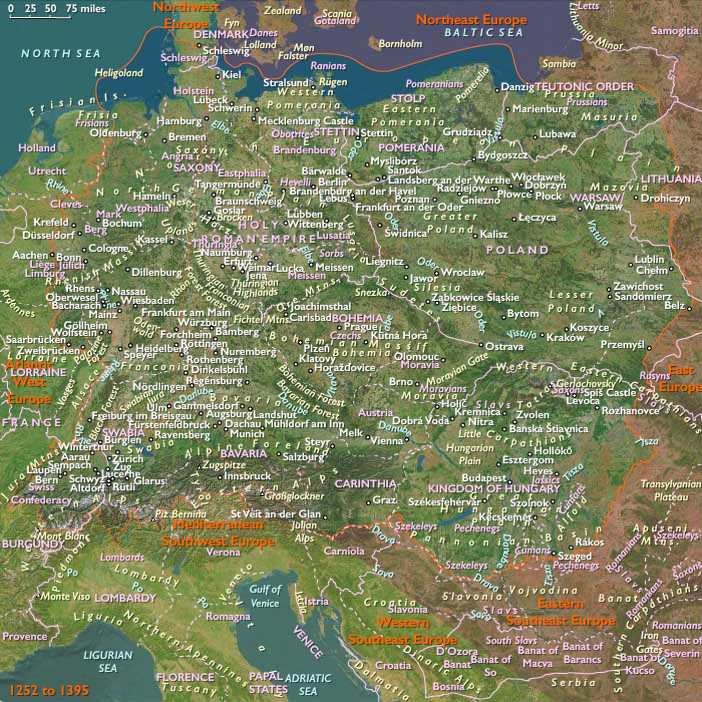
The current theory, generally accepted by scholars and historians, ties the departure of Hamelin's children to the Ostsiedlung, in which a number of Germans left their homes to colonize Eastern Europe.
Added speculation on the migration is based on the idea that by the thirteenth century the area had too many people resulting in the oldest son owning all the land and power (majorat), leaving the rest as serfs.
It has also been suggested that one reason the emigration of the children was never documented was that the children were sold to a recruiter from the Baltic region of Eastern Europe, a practice that was not uncommon at the time.
In her essay Pied Piper Revisited, Sheila Harty states that surnames from the region settled are similar to those from Hamelin and that selling off illegitimate children, orphans or other children the town could not support is the more likely explanation.
She states further that this may account for the lack of records of the event in the town chronicles.
In his book, The Pied Piper: A Handbook, Wolfgang Mieder states that historical documents exist showing that people from the area including Hamelin did help settle parts of Transylvania.
Transylvania had suffered under lengthy Mongol invasions of Central Europe, led by two grandsons of Genghis Khan and which date from around the time of the earliest appearance of the legend of the piper, the early thirteenth century.
In the version of the legend posted on the official website for the town of Hamelin, another aspect of the emigration theory is presented.
This version states that "children" may simply have referred to residents of Hameln who chose to emigrate and not necessarily to youths: Among the various interpretations, reference to the colonization of East Europe starting from Low Germany is the most plausible one: The "Children of Hameln" would have been in those days citizens willing to emigrate being recruited by landowners to settle in Moravia, East Prussia, Pomerania or in the Teutonic Land.
It is assumed that in past times all people of a town were referred to as "children of the town" or "town children" as is frequently done today.
The "Legend of the children's Exodus" was later connected to the "Legend of expelling the rats".
This most certainly refers to the rat plagues being a great threat in the medieval milling town and the more or less successful professional rat catchers.
(The Legend of the Pied Piper/Rattenfängerstadt Hameln; Accessed August 16, 2014) Linguist Jurgen Udolph favors the hypothesis that the Hamelin youths wound up in what is now Poland, based on his research on Hamelin surnames that have shown up in Polish phonebooks.
Locations
Subjects
Regions
Central Europe
View →Subregions
