The exiled Bolingbroke had been pardoned in…
1731 CE
The exiled Bolingbroke had been pardoned in 1723 after years of petitioning the British government and of trying to assist it with his limited influence at the French court.
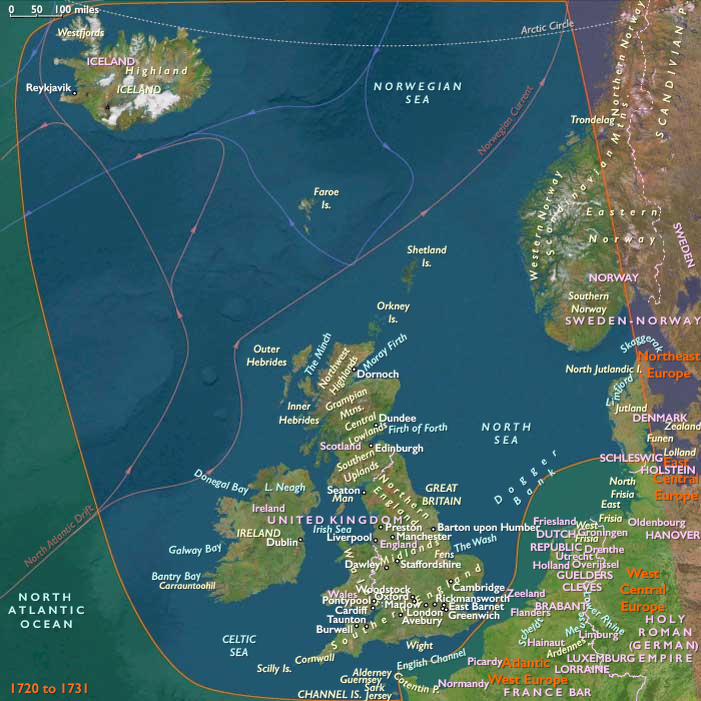
He did not, however, resettle in England until 1725, when an act had allowed him to buy a small estate at Dawley, near London; his attainder is never fully reversed, and he is unable to regain his peerage or reclaim his seat in the Lords.
He imputes this exclusion from parliamentary life to the animosity of Sir Robert Walpole.
Though his own frustrated ambition has clearly motivated his long campaign against Walpole's political ascendancy, he is also concerned by the way Walpole appears to monopolize power by the excessive use of bribery and corruption.
While charges of such behavior are exaggerated, there is enough truth in them to build up a formidable opposition to Walpole.
At the center of a literary circle that includes Jonathan Swift, Alexander Pope, and John Gay, Bolingbroke wages an influential propaganda campaign.
His major contribution in this period to The Craftsman, an opposition journal, is the “Remarks on the History of England” (1730–31), which seeks to end the old Whig–Tory disputes and to weld the disparate elements of the opposition to Walpole into a new Country Party that will protect the independence of Parliament against the encroachments of a corrupt government.
Locations
People
Subjects
Regions
North Europe
View →Subregions