The failure of the Camp David summit…
February 2001 CE
The failure of the Camp David summit and the outbreak of what comes to known as the Aqsa Intifadah convinces a majority of Israelis that they lack a partner in Arafat to end the conflict.
Ehud Barak, who runs for reelection, pays the political price, losing the premiership by nearly twenty-five percent of the vote to Ariel Sharon in elections held on February 6, 2001.
Israelis disillusioned with Barak's inability to halt the fighting vote Sharon into office by the largest margin in Israeli history.
Having receiving only thirty-seven percent of the vote, Barak announces his resignation both as the Labor Party leader and as a member of the Knesset.
At the end of Barak's brief but dramatic interlude, Israel remains poised on the brink of significant change.
At home, the Israelis find themselves grappling with both perennial and new problems.
These include not only the old issue of religion and state and how these institutions related to Jewish identity, but new pressures to reduce religious influence over personal matters such as marriage and divorce and to allow non-Orthodox rabbis to conduct these and other religious ceremonies—raising the very issue of who may legitimately be called a rabbi.
Likewise, Israel faces the question of how to assimilate more than a quarter million non-Jews who had been part of the Russian emigration, raising the question of how one becomes a Jew.
No less problematic is the issue of a large Arab minority that continues to assert its rights and demand equality in a Jewish state.
On the economic front, Israel has only partially completed its transformation from a socialist state into a more competitive market system by the end of the twentieth century.
Israel's military, long a unifying social institution, not only needs to counter new dangers from states such as Iraq and Iran (which both have long-range missiles) but also has to face the difficulties of changing to a more technical, less manpower intensive force.
Likewise, the political system badly needs reform following the failed experiment with direct elections for prime minister.
Against this list of challenges, Israel can marshal its large and highly trained workforce, a dynamic technical sector, a large per capita gross national product, a record of absorbing large groups of immigrants, and a powerful army.
Sharon proceeds to assemble the most rightwing government in Israel's history.
The Labor Party joins the coalition as junior partner, providing a fig leaf for intensified military efforts to repress the Palestinian uprising.
Groups
Topics
Commodities
Regions
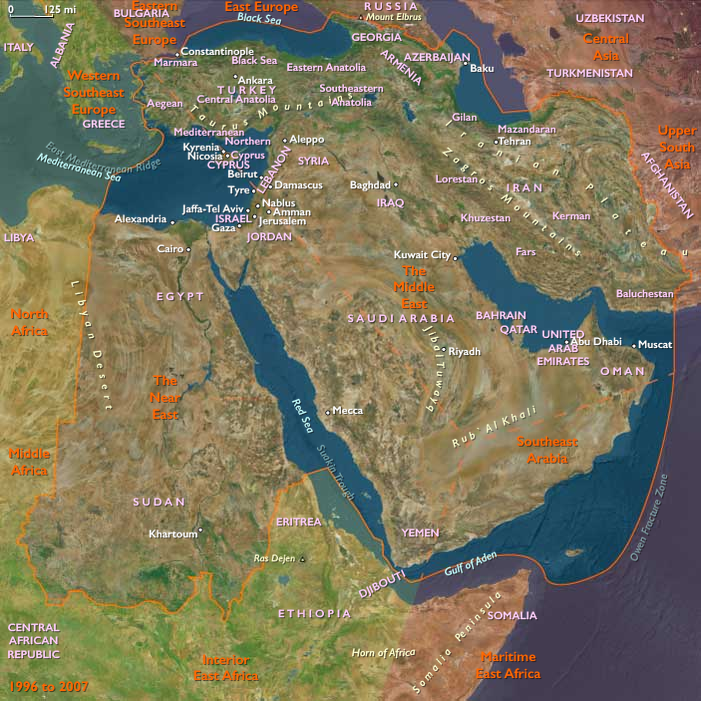
The Near and Middle East
View →Subregions