
Filters:
This period in Egypt is an age …
Years: 964 - 1107
This period in Egypt is an age of great commercial expansion and industrial production.
The Fatimids foster both agriculture and industry and develop an important export trade.
Realizing the importance of trade both for the prosperity of Egypt and for the extension of Fatimid influence, the Fatimids develop a wide network of commercial relations, notably with Europe and India, two areas with which Egypt had previously had almost no contact.
Egyptian ships sail to Sicily and Spain.
Egyptian fleets control the eastern Mediterranean, and the Fatimids establish close relations with the Italian city states, particularly Amalfi and Pisa.
The two great harbors of Alexandria in Egypt and Tripoli in present-day Lebanon became centers of world trade.
In the east, the Fatimids gradually extend their sovereignty over the ports and outlets of the Red Sea for trade with India and Southeast Asia and try to win influence on the shores of the Indian Ocean.
In lands far beyond the reach of Fatimid arms, the Ismaili missionary and the Egyptian merchant go side by side.
The Fatimid bid for world power fails in the end, however.
A weakened and shrunken empire is unable to resist the crusaders, who in July 1099 capture Jerusalem from the Fatimid garrison after a siege of five weeks.
The Fatimids foster both agriculture and industry and develop an important export trade.
Realizing the importance of trade both for the prosperity of Egypt and for the extension of Fatimid influence, the Fatimids develop a wide network of commercial relations, notably with Europe and India, two areas with which Egypt had previously had almost no contact.
Egyptian ships sail to Sicily and Spain.
Egyptian fleets control the eastern Mediterranean, and the Fatimids establish close relations with the Italian city states, particularly Amalfi and Pisa.
The two great harbors of Alexandria in Egypt and Tripoli in present-day Lebanon became centers of world trade.
In the east, the Fatimids gradually extend their sovereignty over the ports and outlets of the Red Sea for trade with India and Southeast Asia and try to win influence on the shores of the Indian Ocean.
In lands far beyond the reach of Fatimid arms, the Ismaili missionary and the Egyptian merchant go side by side.
The Fatimid bid for world power fails in the end, however.
A weakened and shrunken empire is unable to resist the crusaders, who in July 1099 capture Jerusalem from the Fatimid garrison after a siege of five weeks.
Locations
Groups
- Egyptians
- Arab people
- Jews
- Christians, Monophysite
- Christianity, Chalcedonian
- Coptic Orthodox Church of Alexandria
- Greeks, Medieval (Byzantines)
- Islam
- Egypt in the Middle Ages
- Muslims, Shi'a
- Ismailism
- Abbasid Caliphate (Baghdad)
- Ifriqiya, Fatimid Caliphate of
- Amalfi, Duchy of
- Fatimid Caliphate
- Pisa, (first) Republic of
- Amalfi, Duchy of
Topics
Subjects
Regions
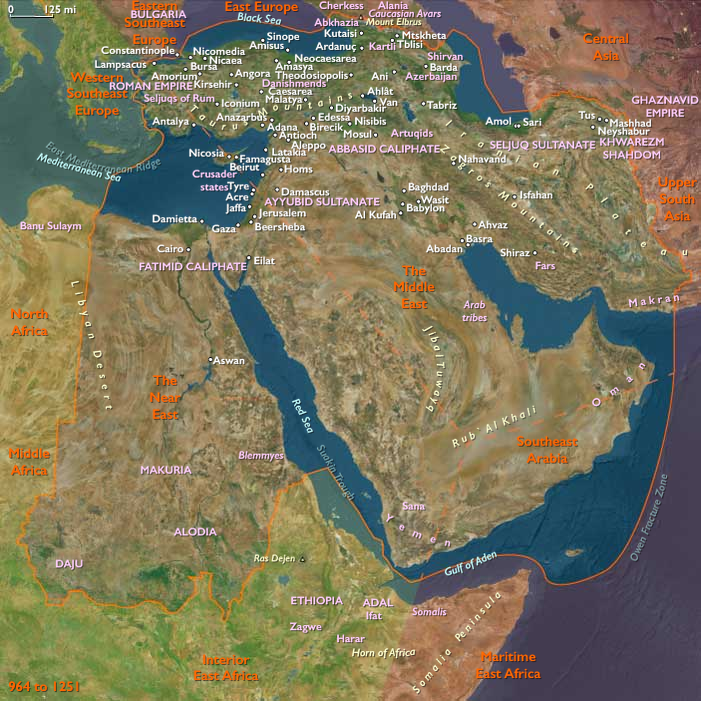
Subregions
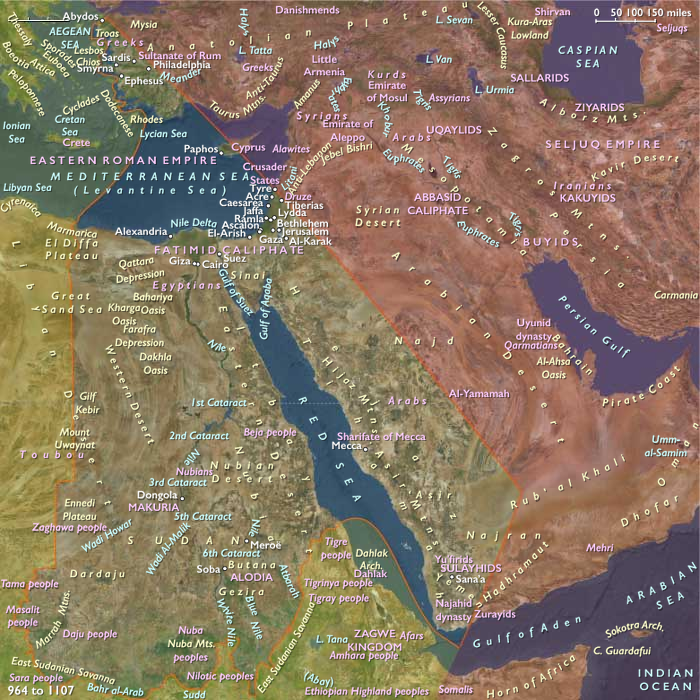
Years: 964 - 1107
Locations
Groups
- Egyptians
- Arab people
- Jews
- Christians, Monophysite
- Christianity, Chalcedonian
- Coptic Orthodox Church of Alexandria
- Greeks, Medieval (Byzantines)
- Islam
- Egypt in the Middle Ages
- Muslims, Shi'a
- Ismailism
- Abbasid Caliphate (Baghdad)
- Ifriqiya, Fatimid Caliphate of
- Amalfi, Duchy of
- Fatimid Caliphate
- Pisa, (first) Republic of
- Amalfi, Duchy of
Topics
Subjects
Regions
Subregions