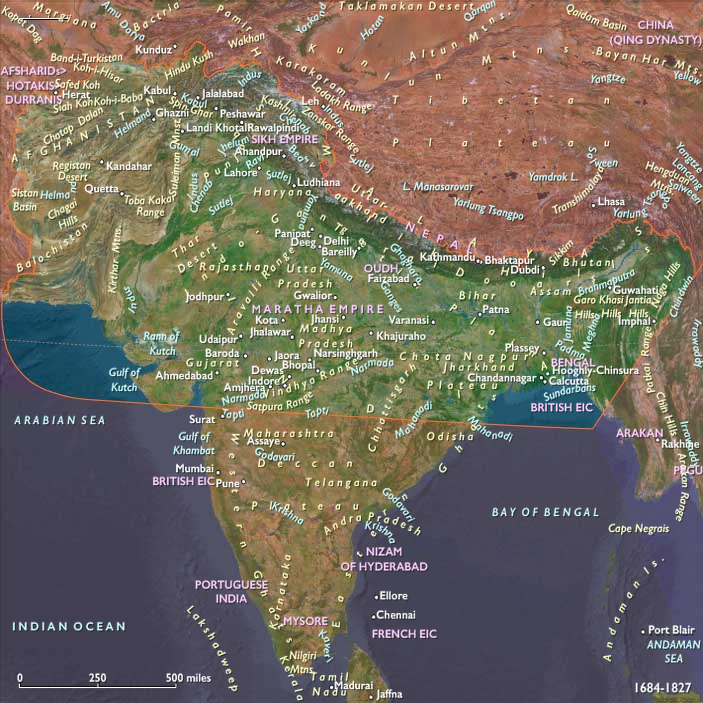
Gurkha, founded in 1559 by Dravya Shah…
1684 CE to 1827 CE
Gurkha, founded in 1559 by Dravya Shah in an area chiefly inhabited by Magars, is among the small hill states struggling for power during the later Malla period.
Legends trace his dynasty to warrior princes who immigrated from Rajputana in India during the fifteenth century.
During its early fight for existence, the House of Gurkha stay out of the two major confederations in western Nepal.
No major expansion of the kingdom had occurred until the reign of Ram Shah, from 1606 to 1633, who had extended his territories slightly in all directions.
During the seventeenth and early eighteenth centuries, Gurkha continues a slow expansion and appears increasingly often as an ally of one or more of the three kingdoms in their quarrels with each other, giving the rulers of the hill state experience in the affairs of the Kathmandu Valley.
Nar Bhupal Shah (reigned 1716-42) extends his lands toward the Kairang Pass in the north and Nuwakot in the east.
He attempts to take Nuwakot and fails, but he does arrange the marriage of his son to the daughter of the raja of Makwanpur.
This son, Prithvi Narayan Shah (reigned 1743-75), makes full use of his position to achieve supreme power and is one of the great figures in Nepalese history.
Following in his father's footsteps, he apparently dedicates himself at an early age to the conquest of the valley and the creation of a single state.
Before going on the offensive, he travels to Banaras, or Varanasi, to seek financial assistance and purchase armaments, thus obtaining a personal view of conditions in the outside world, especially the position of the British East India Company.
On his return to Gurkha, he establishes a number of arsenals and train his troops to use the more modern weapons he has obtained in India.
He arranges alliances with, or buys the neutrality of, neighboring states.
Locations
People
Groups
Topics
Subjects
Regions
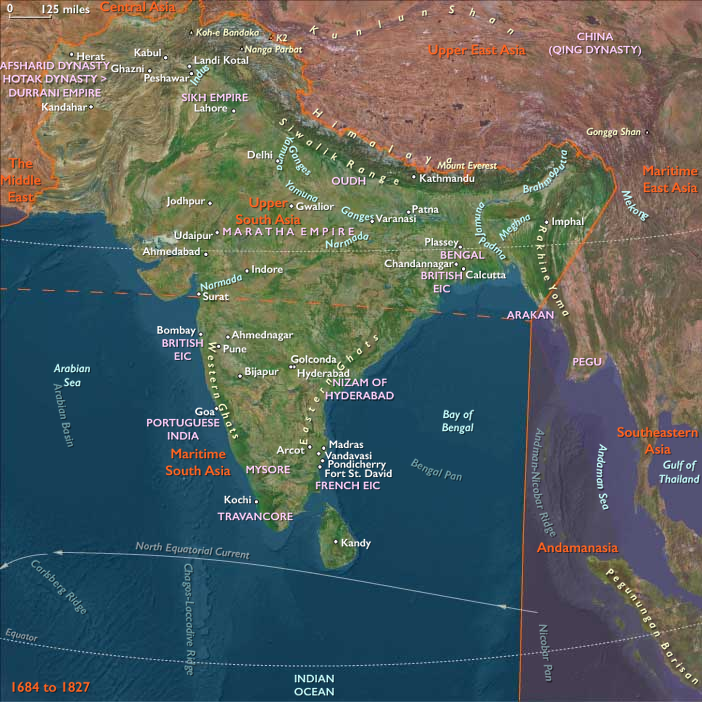
South Asia
View →Subregions