
The first known documentation of Dachau is …
Years: 805 - 805
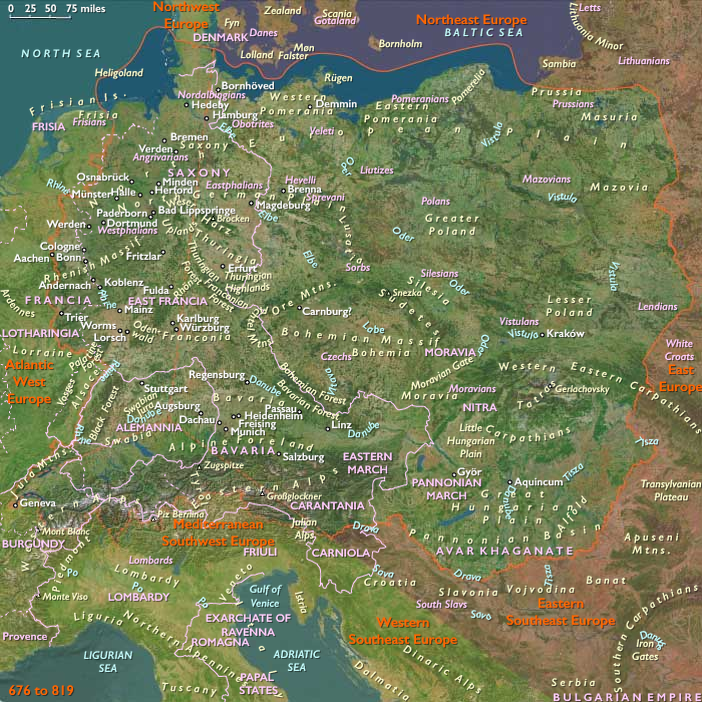
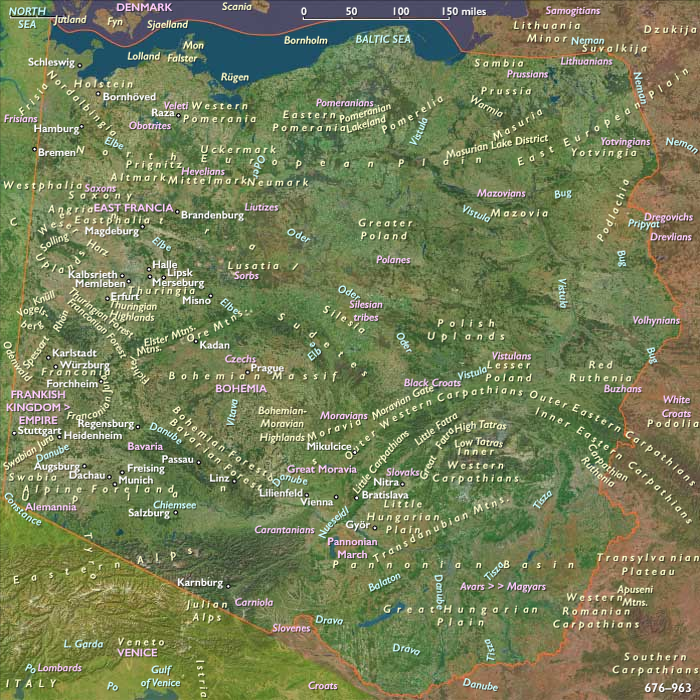
The first known documentation of Dachau is a medieval deed by the Noble Erchana of Dahauua to the Bishop of Freising, both descendants of the lineage of the Aribons.
With this deed dating back to August 15, 805, the Feast of the Assumption of the Blessed Virgin Mary, she donates her entire property in Dachau, including five so called Colonenhöfe and some serfs and bondsman, to devolve to the Bishop of the Diocese of Freising after her death
In prehistoric Upper Bavaria, in the southern part of Germany, the Amper River would divert into backwaters in several places, where many fords made it possible to cross the river.
The oldest findings of human presence here date back to the Stone Age.
The most noteworthy findings were discovered near Feldgeding in the adjoining municipality Bergkirchen.
The Celts had arrived in this area around 1000 BCE and settled here: the name “Dachau” originated in the Celtic Dahauua, which roughly translates to “loamy meadow”, also alludes to the loamy soil of the surrounding hills.
Some theories assume the name “Amper” river may derive from the Celtic word for “water”.
Approximately at the turn of the first millennium, the Romans conquered the area and incorporated it into the province of Rhaetia.
A Roman trade road between Salzburg and today’s Augsburg is said to have run through Dachau.
Remains of this old route are found along the Amper marshlands.
Locations
Groups
- Franks
- Christianity, Chalcedonian
- Bavaria, Carolingian Duchy of
- Frankish, or Carolingian (Roman) Empire
Subjects
Regions
Subregions
Related Events
Filter results
Showing 10 events out of 36 total
Jewish communities in the Rhineland (north of the main departure areas at Neuss, Wevelinghoven, Altenahr, Xanten and Moers) had been attacked in June and July 1095, but the leadership and membership of these crusader groups was not chronicled.
Some Jews have dispersed eastward to escape the persecution.
On top of the general Catholic suspicion of Jews at this time, when the thousands of French members of the People's Crusade arrive at the Rhine, they have run out of provisions.
To restock their supplies, they begin to plunder Jewish food and property while attempting to force them to convert to Catholicism.
In general, the crusader mobs do not fear any retribution as the local courts do not have the jurisdiction to pursue them past their locality nor the ability to identify and prosecute individuals out of the mob.
The pleas of the clergy are ignored on similar grounds (no cases against individuals are brought forward for excommunication) and the mob believes that anyone preaching mercy to the Jews is only doing so because they had succumbed to Jewish bribery.
Not all crusaders who have run out of supplies resort to murder; some, like Peter the Hermit, use extortion instead.
While no sources claim he preached against the Jews, he carries a letter with him from the Jews of France to the community at Trier.
The letter urges them to supply provisions to Peter and his men.
The Solomon bar Simson Chronicle records that they were so terrified by Peter’s appearance at the gates that they readily agreed to supply his needs.
Whatever Peter's own position on the Jews is, men claiming to follow after him feel free to massacre Jews on their own initiative, to pillage their possessions.
Bishop Egelbert of Trier, after being attacked by a mob on April 10, 1096, and threatened with death, offers to save all Jews who are willing to be baptized.
Most Jews choose to drown themselves instead.
Philip I’s Marital Scandal, Excommunication, and the Role of Hugh of Vermandois in the First Crusade (1092–1096)
By 1092, Philip I of France had become entangled in a scandalous affair that led to his excommunication and further complicated his relationship with Pope Urban II. His brother, Hugh of Vermandois, however, emerged as a key figure in the First Crusade, despite Philip’s own inability to participate due to his excommunication. Meanwhile, the Crusade triggered widespread anti-Jewish violence in France and the Rhineland, as religious fervor and millenarian expectations fueled persecution.
Philip I’s Marital Scandal and Excommunication (1092–1095)
- Philip married Bertha of Holland in 1072, and she bore him the necessary heir, Louis VI.
- However, in 1092, Philip fell in love with Bertrade de Montfort, who was already married to Fulk IV of Anjou.
- Philip repudiated Bertha (claiming she was “too fat”) and married Bertrade on May 15, 1092, despite her existing marriage.
- In 1094, Hugh, Archbishop of Lyon, excommunicated Philip for adultery and bigamy.
- At the Council of Clermont in November 1095, Pope Urban II renewed the excommunication, formally severing Philip from the Church.
Philip’s Position on the First Crusade and Hugh of Vermandois’ Role (1096)
- Because of his excommunication, Philip was unable to join the First Crusade, despite its origination at the Council of Clermont in his own kingdom.
- However, Philip’s brother, Hugh of Vermandois, became a leading participant in the Crusade, possibly to restore the family’s standing with the Church.
- In early 1096, Philip and Hugh discussed the Crusade, but Philip remained politically distant due to his conflict with the pope.
- Hugh was reportedly influenced to take the cross after witnessing a lunar eclipse on February 11, 1096, which he interpreted as a divine sign.
- Unlike other Crusader leaders who traveled by land, Hugh’s army departed France in the summer of 1096, crossed into Italy, and sailed across the Adriatic to reach the Byzantine Empire.
Jewish Persecutions in France and the Rhineland (1096)
- The Crusade triggered widespread anti-Jewish violence, beginning in France before spreading to the Rhineland.
- Sigebert of Gembloux wrote that Crusaders believed Jewish communities should convert before the war for the Lord began.
- The first outbreaks of violence occurred in France, where Crusaders attacked Jewish communities in Rouen, Paris, and other cities.
- A contemporary chronicle from Mainz describes how the Jews of France, fearing for their safety, sent letters to the Jewish communities along the Rhine, warning them of impending danger.
- The Jewish leaders in Mainz responded with a call for fasting and prayer, recognizing the grave threat posed by the Crusaders.
Significance and Consequences
- Philip’s excommunication prevented him from playing a major role in the First Crusade, but his brother Hugh of Vermandois ensured Capetian representation in the campaign.
- The anti-Jewish violence of 1096 marked one of the first large-scale massacres of European Jews, setting a precedent for future Crusader attacks on Jewish communities.
- Philip’s marital scandal and subsequent fallout with the papacy weakened his political authority, but he remained King of France, eventually reconciling with the Church years later.
Although Philip I himself could not join the First Crusade, his brother Hugh of Vermandois played a prominent role, while the Crusade’s religious fervor fueled devastating Jewish persecutions across France and Germany.
The largest of these “peoples’ crusades,” and the one most involved in attacking Jews, is that led by Count Emicho of Leiningen, on his way to join the Crusade led by Peter the Hermit.
Setting off in the early summer of 1096, an army of around ten thousand men, women and children proceed through the Rhine valley, towards the Main River and then to the Danube.
Emicho is joined by William the Carpenter and Drogo of Nesle, among others from the Rhineland, eastern France, Lorraine, Flanders and even England.
Emperor Henry IV, absent in southern Italy, had ordered the Jews to be protected when he learned of Emicho's intent.
After some Jews were killed at Metz in May, John, Bishop of Speyer had given shelter to the Jewish inhabitants.
Still, eleven Jews of Speyer are slain on May 3 by Emicho’s crusaders.
Count Emico attacks the synagogue at Speyer, but the Bishop of Speyer calls out his army, and the crusaders depart.
The Bishop of Worms also attempts to shelter Jews, but the crusaders break in to his episcopal palace and kill the Jews inside on May 18, regardless of age or sex.
Kalonymus Ben Meshullam, head of the Jewish community of Mainz, is said to have sent a messenger to King Henry IV in Italy, in consequence of which the king promulgated an order throughout his realm to the effect that the Jews were not to be molested.
However, he, together with fifty-three others, who had taken refuge in the palace of Bishop Adalbert of Worms from the Crusaders, put themselves to death rather than fall into the hands of the enemy during the Worms massacre.
At least eight hundred Jews are massacred in Worms when they refuse Catholic baptism.
One Jew, Simcha bar Isaac Hakohen, on May 25 pretends to submit to baptism.
As he enters the church, he attacks the priest, and is "torn to bits" by the crowd.
News of Emicho's crusade spreads quickly, and he is prevented from entering Mainz on May 25 by Bishop Ruthard.
Emicho also takes an offering of gold raised by the Jews of Mainz in hope to gain his favor and their safety.
Bishop Ruthard tries to protect the Jews by hiding them in his lightly fortified palace.
Nevertheless Emicho does not prevent his followers from entering the city on May 27 and a massacre follows.
Many among the Christian business class (the burghers) in Mainz, have working ties with Jews and give them shelter from the mobs (as the burghers in Prague also do).
The Mainz burghers join with the militia of the bishop and the burgrave (the town's military governor) in fighting off the first waves of crusaders.
This stand has to be abandoned when crusaders continue to arrive in ever greater numbers,and the militia of the bishop together with the bishop himself flees and leaves the Jews to be slaughtered by the crusaders Despite the example of the burghers, many ordinary citizens in Mainz and other the towns are caught up in the frenzy and joined in the persecution and pillaging.
Mainz is the site of the greatest violence, with at least eleven hundred Jews and (possibly more) being killed by troops under Clarambaud and Thomas.
The idea of suicide, normally abhorrent, is considered acceptable or even preferable under these circumstances.
One man, named Isaac, is forcefully converted, together with his two daughters and a friend called Uriah, but later, wracked with guilt, kills his family and burns himself alive in his house.
Another woman, Rachel, kills her four children with her own hands so that they will not be cruelly killed by the crusaders.
Emicho arrives on May 29 at Cologne, where most Jews had already left or were hiding in Christian houses.
The Bishop later escorts them to towns under his protection.
In Cologne, other smaller bands of crusaders meet Emicho, and they leave with quite a lot of money taken from the Jews here.
Emicho continues towards Hungary, soon joined by some Swabians.
The Jewish population of Eller is subjected to a massacre—the second massacre here in a month—on June 27, 1096, in which fifty Jews die.
The First Crusade and the Worsening of Anti-Jewish Persecutions (1096–1097)
The First Crusade (1096–1099) marked a new era of large-scale violence against Jewish communities in Europe, unlike anything seen since the seventh-century expulsions and forced conversions. While previous persecutions of Jews in Latin Christendom had often been localized and sometimes halted by Church authorities, the passions ignited by Pope Urban II’s call to Crusade led to unchecked massacres of Jewish populations, particularly in the Rhineland.
A New Chapter in Anti-Jewish Persecution
- Before 1096, while there had been regional anti-Jewish incidents, they were not systematic, large-scale massacres.
- Notable earlier incidents include:
- Mass expulsion and forced conversions under King Robert II of France, Duke Richard II of Normandy, and Emperor Henry II (1007–1012).
- Localized violence, such as:
- The attack on Jews in Metz (888).
- A plot against Jews in Limoges (992).
- Millenarian persecution in the year 1000, linked to fears of the Second Coming of Christ.
- The threat of expulsion in Trier (1066).
- These previous incidents, however, were often halted by papal or episcopal intervention.
- The First Crusade changed this dynamic, as popular religious fervor overrode previous restraints, leading to massacres of Jews across France and Germany.
Godfrey of Bouillon’s Threats Against the Jews
- Godfrey of Bouillon, one of the most prominent Crusader leaders, was reported to have sworn to avenge Christ’s death by massacring Jews:
- “To go on this journey only after avenging the blood of the crucified one by shedding Jewish blood and completely eradicating any trace of those bearing the name 'Jew,' thus assuaging his own burning wrath.” (Patrick J. Geary, ed. Readings in Medieval History, 2003).
- This statement alarmed Jewish communities, prompting Kalonymus Ben Meshullam, the Jewish leader in Mainz, to notify Emperor Henry IV, who then prohibited such actions.
- Godfrey later denied he intended to kill Jews, yet the Jewish communities of Mainz and Cologne were forced to bribe him with 500 silver marks to secure his protection.
Godfrey’s Financing of His Army
- Like many Crusader lords, Godfrey needed significant funds to finance his army.
- He took loans and sold lands to Bishop Henry of Liège and Bishop Richer of Verdun, securing money to equip thousands of knights and foot soldiers.
- His brothers, Eustace III of Boulogne and Baldwin of Boulogne, joined him—Baldwin particularly because he had no lands in Europe and sought wealth and territory in the East.
The Formation of Crusader Armies
- Godfrey was one of several powerful nobles to gather large forces for the Crusade.
- The most significant Crusader leaders and their armies included:
- Raymond IV of Toulouse (Raymond of Saint-Gilles) – the oldest and one of the most famous Crusader nobles, leading the largest army.
- Adhemar of Le Puy, the papal legate, traveled with Raymond.
- Bohemond of Taranto, a Norman knight from southern Italy, led a fierce, ambitious army.
- Robert II of Flanders, leading another major contingent.
Each of these armies traveled separately, either marching overland through Hungary or sailing from southern Italy across the Adriatic.
Godfrey’s Army Departs (August 1096)
- Godfrey and his brothers set out in August 1096, leading an army from Lorraine, reportedly 40,000 strong.
- They followed what Pope Urban II called “Charlemagne’s road”, a symbolic reference to the path to Jerusalem.
- This was the beginning of the largest armed pilgrimage ever undertaken, blending religious fervor with military conquest.
Significance and Legacy
- The First Crusade’s mobilization led to massive anti-Jewish violence, particularly in France and the Rhineland, setting a precedent for future Crusades.
- Godfrey’s role as a Crusade leader was financially and ideologically linked to this persecution, as anti-Jewish rhetoric helped justify the Crusaders’ mission.
- The departure of the Crusader armies marked the beginning of one of the most significant military and religious campaigns in medieval history, one that would reshape Christian-Muslim relations and European politics for centuries.
The Crusade's initial mobilization in 1096 was not only a march to Jerusalem but also a turning point in Christian-Jewish relations, as religious zealotry, financial necessities, and political ambitions fueled widespread violence and persecution in Europe.
Alexios I Komnenos, a well educated emperor, has reformed Constantinople’s monetary and taxation systems.
Alexios had undoubtedly solicited the help of mercenary troops from the West but not for the liberation of the Holy Land from the infidel.
The urgent need is the protection of Constantinople and the recovery of Anatolia.
The Greeks are more realistic about their Muslim neighbors than the distant popes and princes of the West.
The immediate threats to Constantinople had come from the Pechenegs to the north and the Normans to the west.
Alexios, who had doubtless anticipated some sort of auxiliary force, apparently soon realizes that he will have to provide for and police a much larger influx of warriors.
The main Crusading force, which had begun to move as Urban had directed in August 1096, consists of four major contingents, largely French and Norman knights under baronial leadership.
Hugh I of Vermandois, brother of King Philip I of France, had left first with a small following that had been reduced by shipwreck while crossing the Adriatic from Bari to Dyrrhachium.
Godfrey of Bouillon, duke of Lower Lorraine since 1089, is the only major prince from the German kingdom, though he and his associates largely speak French.
His brothers, Eustace and Baldwin of Boulogne, and a kinsman, Baldwin Du Bourcq, join him.
Taking the land route, Godfrey had crossed Hungary without incident, aided by that country's King Colomon, who had protected Hungary's Jewish communities from further mischief.
Markets and provisions had been supplied in imperial territory, and, except for some pillaging, the army reaches Constantinople without serious incident in late December.
Nikephoros Bryennios, a favorite of the emperor, who has given him the title of caesar, assists Alexios in dealing with Godfrey.
The siege of Tripoli, a city ruled by the Banu Ammar emirs (theoretically vassals of the Fatimid caliphs in Cairo) has been going on since 1102, and in 1108, it becomes more and more difficult to bring food by land to the city’s besieged residents.
Many citizens seek to flee to Homs, Tyre, and Damascus.
The nobles of the city, who had betrayed the city to the Franks by showing them how it was being resupplied with food, are executed in the crusader camp.
Fakhr al-Mulk, left to wait for help from the Seljuq sultan Muhammad I, goes to Baghdad at the end of March with five hundred troops and many gifts.
He passes through Damascus, now governed by Toghtegin after the death of Duqaq, and is welcomed with open arms.
In Baghdad, the sultan receives him with great spectacle, but has no time for Tripoli while there is a succession dispute in Mosul.
Fakhr al-Mulk returns to Damascus in August, where he learns the nobles of Tripoli have handed over the city to al-Afdal Shahanshah, vizier of Egypt, who had tired of waiting for him to return.
Years: 805 - 805
Locations
Groups
- Franks
- Christianity, Chalcedonian
- Bavaria, Carolingian Duchy of
- Frankish, or Carolingian (Roman) Empire
