
Carlyle's first work, Sartor Resartus ("The Tailor…
1837 CE
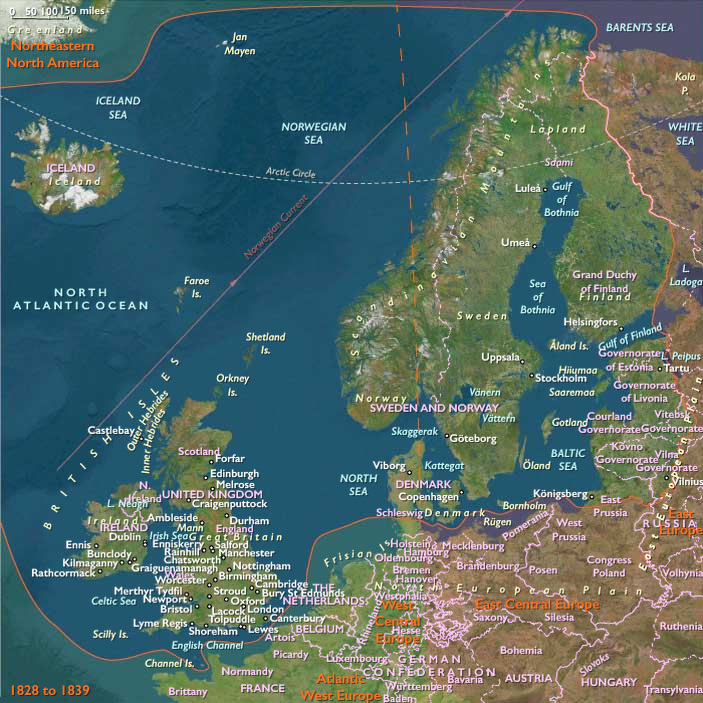
Carlyle's first work, Sartor Resartus ("The Tailor Retailored") had been written at his home in southwest Scotland, Craigenputtock, and had been intended to be a new kind of book: simultaneously factual and fictional, serious and satirical, speculative and historical.
First published periodically in Fraser's from 1833 to 1834, it ironically comments on its own formal structure, while forcing the reader to confront the problem of where 'truth' is to be found.
In 1834, Carlyle had moved to London and begun to move among celebrated company.
Carlyle had happened upon the idea of writing a general history of the French Revolution when the philosopher John Stuart Mill, a friend of his, found himself caught up in other projects and unable to meet the terms of a contract he had signed with his publisher for just such a work.
Mill had therefore proposed that Carlyle produce the work instead; Mill had even sent his friend a library of books and other materials concerning the Revolution, and by 1834, Carlyle was working furiously on the project.
Mill's maid had accidentally burned the only completed manuscript of the first volume, famously mistaking it for trash.
Carlyle (who will never completely forgive Mill for the mishap) had then written the second and third volumes before rewriting the first from scratch.
The resulting work is filled with a passionate intensity, hitherto unknown in historical writing.
The three-volume work, first published in 1837, charts the course of the French Revolution from 1789 to the height of the Reign of Terror (1793-4) and culminates in 1795.
In a politically charged Europe, filled with fears and hopes of revolution, Carlyle's account of the motivations and urges that inspired the events in France seems powerfully relevant.
A massive undertaking that draws together a wide variety of sources, Carlyle's history—despite the unusual style in which it is written—is considered an authoritative account of the early course of the Revolution.
The French Revolution, A History, which immediately establishes Carlyle's reputation as an important intellectual, also serves as a major influence on a number of his contemporaries, most notably, perhaps, upon Charles Dickens, who will compulsively read and reread the book while producing A Tale of Two Cities, destined to become one of the novelist's most popular works.
Locations
Subjects
Regions
North Europe
View →Subregions
