
The First Peace of Thorn had in …
Years: 1418 - 1418
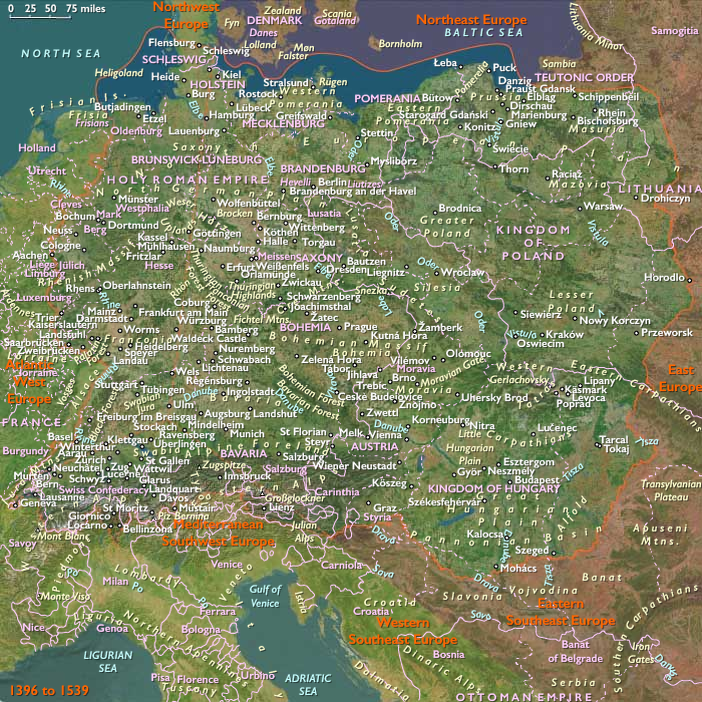
The First Peace of Thorn had in 1411 ended the Polish–Lithuanian–Teutonic War, in which the Teutonic Knights fought the Kingdom of Poland and Grand Duchy of Lithuania.
However, the peace was not stable and further conflicts arose regarding demarcation of the Samogitian borders.
The tensions had erupted into the brief Hunger War in summer 1414.
It was concluded that the disputes would be mediated by the Council of Constance.
The propaganda war had soon grown from a border quarrel to a fundamental dispute of the Teutonic mission – did the Knights have the right to wage the crusade?
was it a Just War?
The Polish position is defended by Paulus Vladimiri, rector of the Jagiellonian University, who challenges the legality of the Teutonic crusade, arguing that a forced conversion is incompatible with free will, which is an essential component of a genuine conversion.
Therefore, the Knights could only wage a defensive war if pagans violated natural rights of the Christians.
Vladimiri further stipulates that infidels have rights that have to be respected, and neither the Pope nor the Holy Roman Emperor has the authority to violate them.
The Poles and Lithuanians also bring a group of Samogitian representatives to testify concerning atrocities committed by the Knights.
John of Falkenberg proves to be the fiercest opponent of the Poles.
In his Liber de doctrina, Falkenberg argues that "the Emperor has the right to slay even peaceful infidels simply because they are pagans (...).
The Poles deserve death for defending infidels, and should be exterminated even more than the infidels; they should be deprived of their sovereignty and reduced to slavery."
In Satira, he attacks Polish King Jogaila, calling him a "mad dog" unworthy to be king.
Falkenberg is condemned and imprisoned for such libel, but is not officially accused of heresy.
Other opponents include the Grand Master's proctor Peter Wormditt, Dominic of San Gimignano, John Urbach, Ardecino de Porta of Novara, and Bishop of Ciudad Rodrigo Andrew Escobar, who argue that the Knights are perfectly justified in their crusade as it is a sacred duty of Christians to spread the true faith Cardinal Pierre d'Ailly publishes an independent opinion that attempts to somewhat balance both the Polish and Teutonic positions.
The Council does not make any political decisions.
It establishes the Diocese of Samogitia, with its seat in Medininkai and subordinate to Lithuanian dioceses, and appoints Matthias of Trakai as the first bishop.
Pope Martin V appoints Polish King Jogaila and Lithuanian Grand Duke Vytautas as vicar generals in Pskov and Veliky Novgorod in recognition of their Catholicism.
Locations
People
- Antipope Benedict XIII
- Antipope John XXIII
- Jan Hus
- Jogaila (Władysław II)
- Pierre d'Ailly
- Pope Gregory XII
- Pope Martin V
- Vytautas
Groups
- Samogitians, or Lowland Lithuanians (Eastern Balts)
- Papal States (Republic of St. Peter)
- Christians, Roman Catholic
- Livonian Order
- Teutonic Knights of Prussia, or Monastic state of the Teutonic Knights (House of the Hospitalers of Saint Mary of the Teutons in Jerusalem)
- Poland of the Jagiellonians, Kingdom of
- Lithuania, Grand Duchy of
Topics
- Western Schism or Papal Schism (also known as the Great Schism of Western Christianity)
- Renaissance Papacy
Commodoties
Subjects
Regions
Subregions
Years: 1418 - 1418
Locations
People
- Antipope Benedict XIII
- Antipope John XXIII
- Jan Hus
- Jogaila (Władysław II)
- Pierre d'Ailly
- Pope Gregory XII
- Pope Martin V
- Vytautas
Groups
- Samogitians, or Lowland Lithuanians (Eastern Balts)
- Papal States (Republic of St. Peter)
- Christians, Roman Catholic
- Livonian Order
- Teutonic Knights of Prussia, or Monastic state of the Teutonic Knights (House of the Hospitalers of Saint Mary of the Teutons in Jerusalem)
- Poland of the Jagiellonians, Kingdom of
- Lithuania, Grand Duchy of
Topics
- Western Schism or Papal Schism (also known as the Great Schism of Western Christianity)
- Renaissance Papacy
Commodoties
Subjects
Regions
Subregions