
The first printed reference to a ship’s…
1574 CE
The first printed reference to a ship’s log appears in 1574 in the first native English manual of navigation, written by William Bourne of Gravesend.
Locations
Subjects
Regions

North Europe
View →Subregions
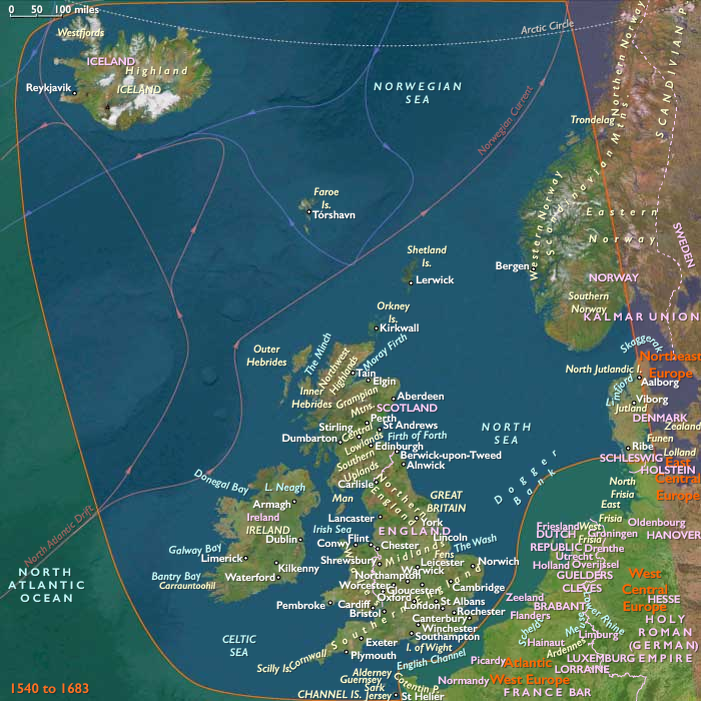
Northwest Europe
View →Related Events
No active filters.
Showing 10 events out of 35244 total
Ternate’s ruling Muslim sultan Baabullah, son and successor of Hairun, who was murdered at the Portuguese fortress in 1570, has besieged the fortress for four years.
His forces finally capture the fortress in 1574 and massacre the Portuguese garrison.
Lan Xang has weakened, and Bayinnaung, pursuing his an intermittent twenty-year effort against the Laos, in 1574 sends his Burmese troops to seize the Laotian capital and ravage the country.
Nobunaga has suffered tremendous losses to the Ikko resistance in Nagashima, including a couple of his brothers.
He finally surrounds the enemy complex and sets it afire, again killing some twenty thousan, including many noncombatants, mostly women and children.
The Ishiyama Hongan-ji continues to withstand the siege, but with Nagashima's destruction, the only true threat to Nobunaga is the Takeda clan, now led by Takeda Katsuyori.
A Jesuit province is established in Poland in 1574, separate from that created in Austria in 1563 for the entire region of East Central Europe.
Henri, chafing, at the restrictions on monarchic power under the Polish-Lithuanian political system of "Golden Liberty", finds his ability to rule Poland entirely constricted by the reformed constitution and the Henrician Articles of 1573.
The Protestant Reformation has spread rapidly in Transylvania following Hungary's collapse, and the semi-independent Ottoman vassal state, under the religiously tolerant Prince István Báthory, is on the way to becoming one of Europe's Protestant strongholds.
Transylvania's Germans adopt Lutheranism, and many Hungarians convert to Calvinism.
The Protestants print and distribute catechisms in the Romanian language, but fail to lure many Romanians from Orthodoxy.
The Transylvanian Diet approves a law guaranteeing freedom of worship and equal rights for Transylvania's four "received" religions: Roman Catholic, Lutheran, Calvinist, and Unitarian.
The law is one of the first of its kind in Europe, but the religious equality it proclaims is limited.
Orthodox Romanians, for example, are free to worship, but their church is not recognized as a received religion.
The Selimiye Mosque, commissioned by Sultan Selim II, is constructed in Edirne by architect Sinan between the dates 1568-1574.
Surrounded by four tall minarets, the Mosque of Selim II has a grand dome atop it.
While conventional mosques are limited by a segmented interior, Sinan's effort at Edirne is a structure that makes it possible to see the mihrab from any location within the mosque.
The amalgamation of the main hall, created through eight pillars incised in a square shell of walls, forms a fused octagon with the dome-covered square.
behind the arches formed by eight massive dome supports, the octagon is pierced by four half dome covered corners of the square, intermediary sections between the huge encompassing dome (thirty-one and a quarter-meter diameter with spherical profile) and the walls.
The beauty resulting from the conformity of geometric shapes engulfed within each other is the culmination of Sinan's lifelong search for a unified interior space.
Moldavia’s prince John the Terrible (reigned 1572–74) rebels, unsuccessfully, against a demand for higher tribute payments to the Ottoman government.
Tahmasp I, Safavid ruler of Iran, had regularized relations with the Ottoman Empire through the Peace of Amasya in 1555. Amicable relations have continued between the Iranian shah and Selim II.
Tahmasp falls ill in 1574, and discord breaks out among the Qizilbash once more, this time over which prince is to succeed him.
The shah's Georgian and Circassian wives have also introduced a new faction into the court.
Seven of Tahmasp's surviving sons are by Georgian or Circassian mothers and two by a Turcoman.
Of the latter, Mohammed Khodabanda is regarded as unfit to rule because he is almost blind, and his younger brother, Ismail, has been imprisoned by Tahmasp since 1555.
One court faction nevertheless supports Ismail, while another backs Haydar Mirza, the son of a Georgian.
Tahmasp himself is believed to favor Haydar but he prevents his supporters from killing Ismail.
Akbar now commands the entire area of his the Indian possessions of his father Humayun.
He had by the mid-1560s also developed a new pattern of king-noble relationship suited to the current need of a centralized state to be defended by a nobility of diverse ethnic and religious groups.
He had insisted on assessing the arrears of the territories under the command of the old Turani clans and, in order to strike a balance in the ruling class, promoted the Persians, the Indian Muslims, and the Rajputs in the imperial service.
Akbar has placed eminent clan leaders in charge of frontier areas and staffed the civil and finance departments with relatively new non-Turani recruits.
The revolts in 1564–74 by the members of the old guard—the Uzbeks, the Mirzas, the Qaqshals, and the Atgah Khails—shows the intensity of their indignation over the change.
Ahmadnagar has not annexed Bidar, owing to intervention by Ibrahim Qutb Shah of Golconda, but the sultanate does acquire Berar in 1574.