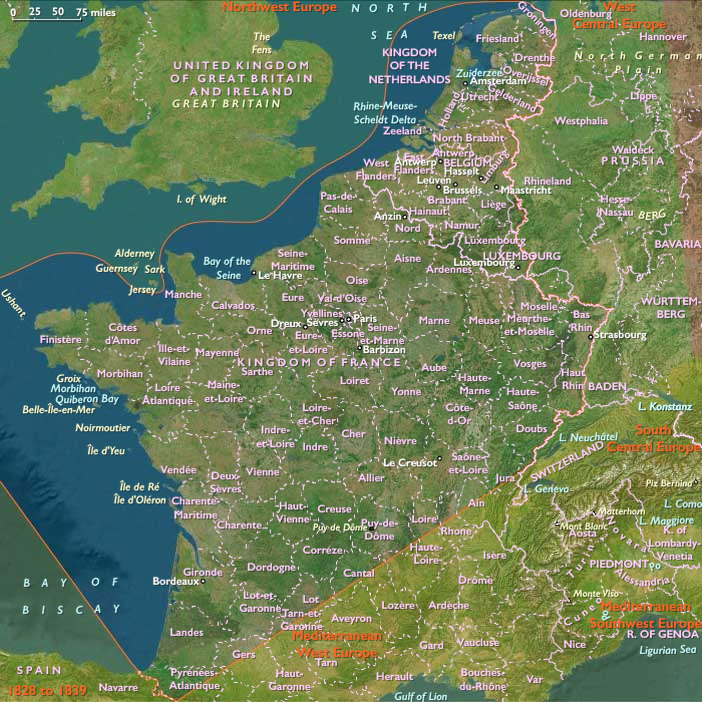
The first railway built in France starts…
1832 CE
The first railway built in France starts operation in 1832, not long after the first line had opened in Britain, but French progress will fail to keep pace over the next decade.
Circumstances do not favor a start as early and as successful as Britain's, because Britain generally has a higher level of industrialization.
Other more comparable nations, such as Belgium, have embarked on large railway-building projects soon after the technology appears.
France also suffers the handicap of the destruction and turbulence of the Napoleonic Wars and the subsequent process of rebuilding, which also hinders the development of railways.
It will take a full decade to begin railway construction on a national scale.
France's economy in 1832 has not developed sufficiently to support a national railway network.
The limited iron industry for many years will forced French railways to import many of their rails from England at great cost.
French coal supplies also remain underdeveloped compared to those of England and Belgium.
Until these complementary industries develop, French railways are to be at an economic disadvantage compared to those of other states.
Another obstacle to French railway development is the powerful opposition to the changes that railways would bring.
For example, in 1832, the Rouen Chamber of Commerce opposes a rail link between Rouen and Paris, arguing it would be detrimental to agriculture, hurt the traditional way of life, and impinge upon the business of the canals and rivers.
This last argument emerges commonly throughout France.
Unlike Russia or Germany, which do not have well-developed canal systems, France has a great deal of capital invested in waterborne transport.
These interests see the railways as dangerous competition.
France is naturally endowed with many navigable waterways and much terrain suitable for the construction of canals.
Much of France also lies not far from the coast, and coastal shipping successfully and cheaply carries much trade.
Thus, the interests which profit from canals, river, and coastal shipping all use their sway in government to limit the construction of railways.
While other countries, such as Britain, already utilize canals and coastal shipping well, these nations do not have government-controlled railways, and thus the vested interests of waterborne trade are less able to oppose new competition.
Locations
Commodities
Regions
West Europe
View →Subregions