
The First Silesian War, which inaugurates, and …
Years: 1740 - 1740
October
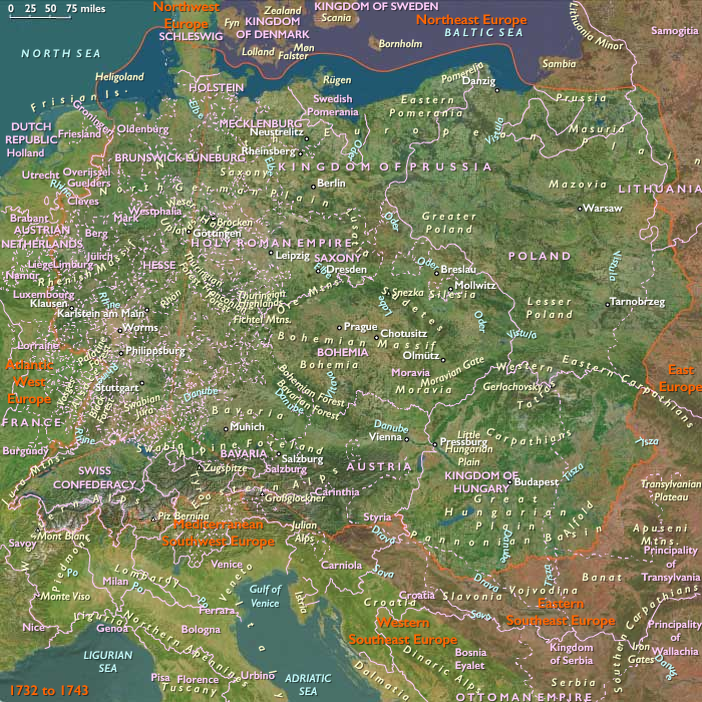
The First Silesian War, which inaugurates, and is generally seen in the context of, the wider ranging War of the Austrian Succession, owes its origins to the Pragmatic Sanction of April 19, 1713 whereby the Emperor Charles VI had decreed the imperial succession arrangements as set out in his will, according precedence to his own daughters over the daughters of his (by now deceased) elder brother Joseph I.
This had proved prescient: the Emperor’s own eldest daughter was born in May 1717, and on his death in 1740, she duly succeeds to the thrones of lands within the Habsburg Monarchy (Austria, Bohemia, Hungary and present-day Belgium) as the Queen Maria Theresa.
However, her succession to the Holy Roman Empire is contested widely because she is a woman.
Charles had ignored the advice of Prince Eugene of Savoy, who had urged him to concentrate on filling the treasury and equipping the army rather than on acquiring signatures of fellow monarchs.
During the emperor’s lifetime, the Pragmatic Sanction had been generally acknowledged by the German states: following his death on October 20, 1740, probably of mushroom poisoning, the agreement is promptly contested both by Frederick II, the new king of Prussia, and by Bavaria's king Charles Albert.
The Bavarian king launches a claim to the imperial throne and to the Habsburg territories, while Prussia demands Silesia and a part of the Habsburg territories for itself.
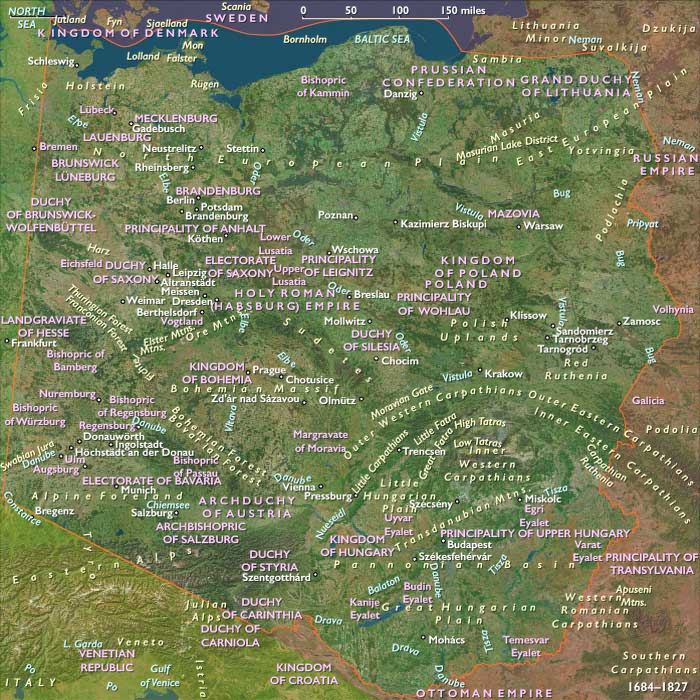
Frederick II of Prussia bases his demands on a breach of the 1537 Treaty of Schwiebus, whereby the Silesian princedoms of Liegnitz, Wohlau and Brieg were to pass to Brandenburg on the extinction of the Piast dynasty.
With the death in 1675, of George William of Legnica, the Piast line had died out: at that time no attempt had been made to implement these old treaty provisions, and the Prussian Elector (ruler) had been persuaded to renounce the claim in return for a payment.
An extensive alliance has formed sixty-five years on in support of Prussia’s newly asserted claims on Silesia.
Prussia is supported by France, Bavaria, and Sweden along with various smaller European powers.
The shared objective within the alliance is the destruction or at least the diminution of the Habsburg Monarchy and of its dominant influence over the other German states.
The Habsburgs find themselves supported by the Russians along with the maritime powers, the Dutch and the British/Hanoverians whose imperial aspirations beyond Europe always incline them to join available eighteenth century European wars on the anti-French side.
Britain and Austria are bound by the Anglo-Austrian Alliance, which has existed since 1731.
Locations
People
- Charles VI, Holy Roman Emperor, King of the Romans (King of Germany)
- Charles VII, Holy Roman Emperor
- Francis I, Holy Roman Emperor
- Frederick the Great
- Maria Theresa
Groups
- Germans
- Dutch people
- Poles (West Slavs)
- English people
- Swedes (Scandinavians)
- Austria, Archduchy of
- Russians (East Slavs)
- Saxony, Electorate of
- Sweden, (second) Kingdom of
- Netherlands, United Provinces of the (Dutch Republic)
- France, (Bourbon) Kingdom of
- Habsburg Monarchy, or Empire
- Bohemia, Kingdom of
- Bavaria, Electorate of
- Brunswick-Lüneburg, Electorate of (Electorate of Hanover)
- Prussia, Kingdom of
- Britain, Kingdom of Great
- Russian Empire
Topics
Subjects
Regions
Subregions
Years: 1740 - 1740
October
Locations
People
- Charles VI, Holy Roman Emperor, King of the Romans (King of Germany)
- Charles VII, Holy Roman Emperor
- Francis I, Holy Roman Emperor
- Frederick the Great
- Maria Theresa
Groups
- Germans
- Dutch people
- Poles (West Slavs)
- English people
- Swedes (Scandinavians)
- Austria, Archduchy of
- Russians (East Slavs)
- Saxony, Electorate of
- Sweden, (second) Kingdom of
- Netherlands, United Provinces of the (Dutch Republic)
- France, (Bourbon) Kingdom of
- Habsburg Monarchy, or Empire
- Bohemia, Kingdom of
- Bavaria, Electorate of
- Brunswick-Lüneburg, Electorate of (Electorate of Hanover)
- Prussia, Kingdom of
- Britain, Kingdom of Great
- Russian Empire
Topics
Subjects
Regions
Subregions