The first humans to reach Guyana belong…
1492 CE to 1503 CE
The first humans to reach Guyana belong to the group of peoples that crossed into North America from Asia perhaps as much as thirty-five thousand years ago.
These first inhabitants were nomads who slowly spread south into Central America and South America.
Although great civilizations later arise in the Americas, the structure of native society in the Guianas remains relatively simple.
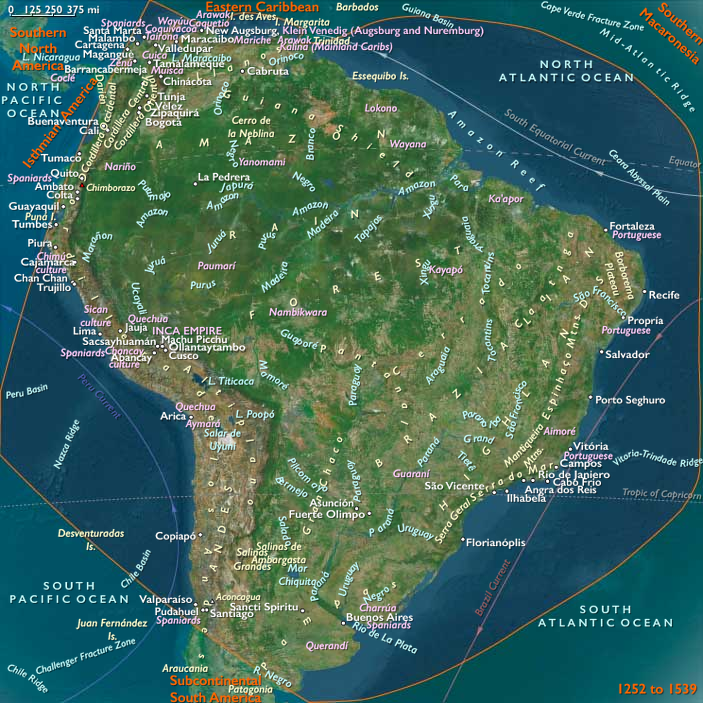
At the time of Christopher Columbus's voyages, Guyana's inhabitants are divided into two groups, the Arawak along the coast and the Carib in the interior.
One of the legacies of the indigenous peoples is the word Guiana, often used to describe the region encompassing modern Guyana as well as Suriname (former Dutch Guiana) and French Guiana.
The word, which means "land of waters," is highly appropriate, considering the area's multitude of rivers and streams.
Historians speculate that the Arawak and Carib originated in the South American hinterland and migrated northward, first to the present-day Guianas and then to the Caribbean islands.
The peaceful Arawak, mainly cultivators, hunters, and fishermen, had migrated to the Caribbean islands before the Carib and settled throughout the region.
The tranquility of Arawak society is disrupted by the arrival of the bellicose Carib from the South American interior.
Carib warlike behavior and violent movement north makes an impact still discussed today.
By the end of the fifteenth century, the Carib have displaced the Arawak throughout the islands of the Lesser Antilles (see Glossary).
The Carib settlement of the Lesser Antilles also affects Guyana's future development.
The Spanish explorers and settlers who come after Columbus find that the Arawak prove easier to conquer than the Carib, who fight hard to maintain their freedom.
This fierce resistance, along with a lack of gold in the Lesser Antilles, contributes to the Spanish emphasis on conquest and settlement of the Greater Antilles and the mainland.
Only a weak Spanish effort is made at consolidating Spain's authority in the Lesser Antilles (with the arguable exception of Trinidad) and the Guianas.
People
Groups
Commodities
Regions
South America
View →Subregions