Charles backs Russia during the Russo-Turkish War…
1876 CE to 1887 CE
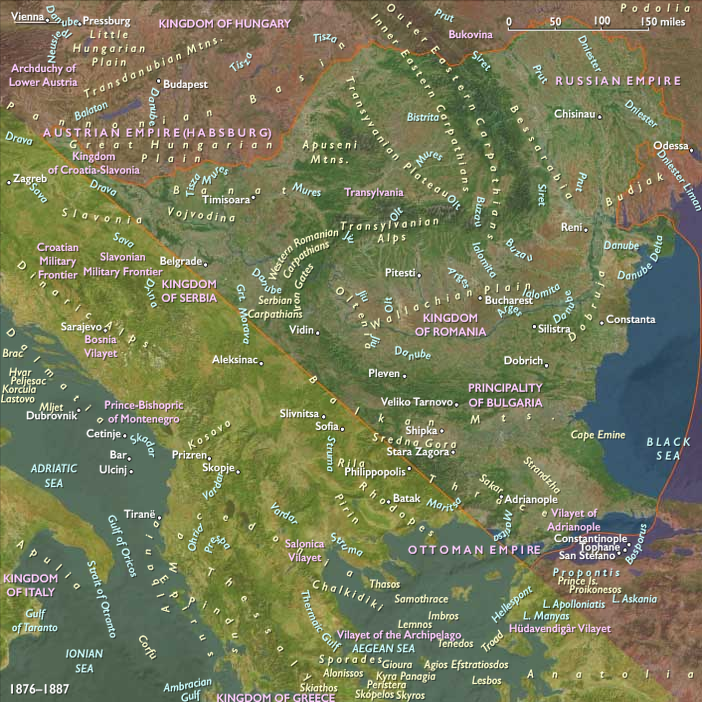
Charles backs Russia during the Russo-Turkish War of 1877-78.
He allows Russian troops to transit Romania and personally leads the Romanian army to aid Russian forces bogged down before Plevna, in the north of present-day Bulgaria.
Finally, after the Ottomans' defeat, Charles proclaims Romania's independence, ending five centuries of vassalage.
Despite the Romanian army's heroism at Plevna, Russia refuses to allow Romania to participate in peace negotiations or in the 1878 Congress of Berlin.
At Berlin, Russia gains southern Bessarabia from Romania and as recompense offers northern Dobruja, a barren land between the Danube and the Black Sea south of the river's delta at this time inhabited mostly by Turks, Bulgarians, and gypsies.
The Congress agrees to recognize Romania's declared independence, but only if Romania accedes to Russia's annexation of Bessarabia and repeals laws that discriminate against Jews.
Romania agrees, and, though its amendments to the discriminatory laws leave many loopholes, the European powers in 1880 recognize Romania's independence.
The tsar later denies Romania the fortress of Silistra, the strategic key to Dobruja on the south bank of the Danube, thereby deepening Romania's distrust of Russia.
People
Groups
Commodities
Regions
Southeast Europe
View →Subregions