
The French king is sufficiently concerned to…
June 1688 CE
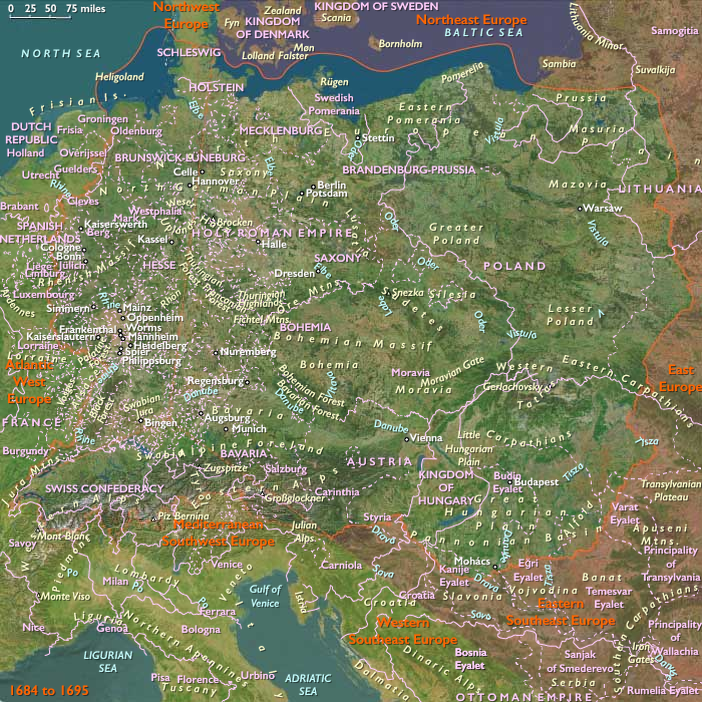
The French king is sufficiently concerned to take steps to perpetuate his influence at Cologne, whose pro-French Archbishop holds a number of strategically important bishoprics (they provide links for the Dutch with the Empire and the Spanish Netherlands), straddling the southern and eastern frontiers of the Dutch Republic.
As the existing Archbishop, Maximilian, is old and frail and Louis wants to be sure of his successor, the king therefore has his client, William Egon of Fürstenberg, elected as coadjutor, and by implication, the next Archbishop.
After the incumbent Archbishop dies in June 1688, and despite all the signs signifying victory for Fürstenberg, an inconclusive election for the position follows, after the brother of the Elector of Bavaria, Joseph Clement (supported by the Emperor and subsequently by Pope Innocent XI) stands against Fürstenberg.
However, the disputed election at Cologne has aroused further fears in Germany of French aggression and helped further to unite the German princes.
Moreover, the Dutch oligarchs and merchants, also more fearful of Louis’ ambitions, give William their wholehearted support.
From June 1688, the disputed election looks as though it will provide the spark to ignite the war between Louis and the German princes.
Groups
Subjects
Regions
Central Europe
View →Subregions
