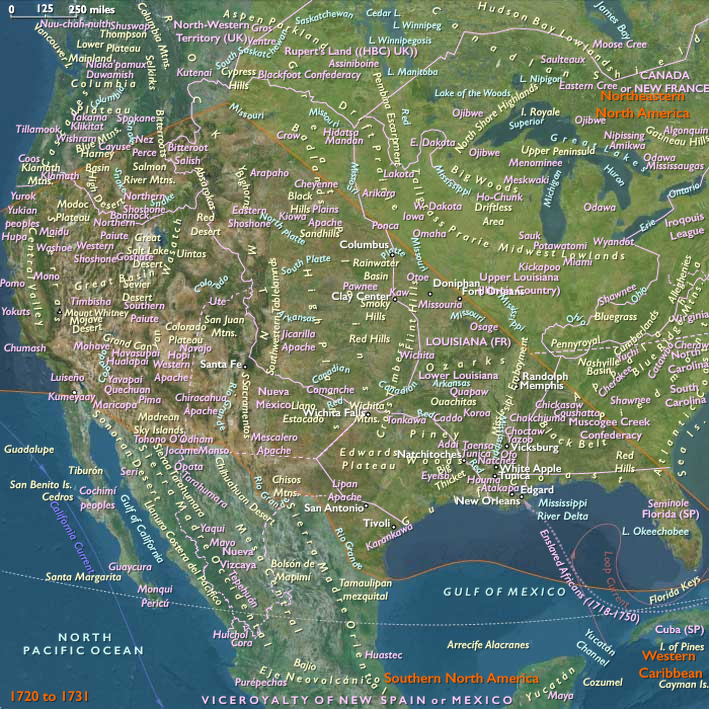
Growing tension between the French and the…
November 1729 CE
Growing tension between the French and the Natchez have erupted into violence several times during the 1720s, culminating in the Natchez Rebellion.
Overshadowing the first three in scale and importance, the 1729 rebellion is sometimes simply called the Natchez War.
All four conflicts involve the two opposing factions within the Natchez nation.
The French regularly describe the Natchez as ruled with absolute, despotic authority by the Great Sun and Tattooed Serpent.
The existence of two opposing factions is well known and documented.
The Great Sun and Tattooed Serpent repeatedly point out their difficulty in controlling the hostile Natchez.
It is likely that the White Apple faction functioned at least semi-independently.
Whatever power the family of the Great Sun and Tattooed Serpent do have over outlying villages is reduced in the late 1720s when both die.
Their successors are relatively young, inexperienced leaders.
While the new Great Sun is technically the paramount chief of the Natchez, the chief of White Apple has become the eldest Sun chief and has more political clout than the Great Sun.
The French, who continue to hold the Great Sun responsible for the conduct of all Natchez villages, insist on dealing with the Natchez as a unified nation ruled from its capital, the Grand Village of the Natchez.
The Great Sun's faction is generally friendly toward the French.
Violence usually begins in or is triggered by events among the Natchez of White Apple.
In all but the last war, peace had been regained largely due to the efforts of Tattooed Serpent of the Grand Village of the Natchez.
The French commander Sieur de Chépart orders the Natchez to vacate one of their villages in November of 1729 so that he can use its land for a new tobacco plantation.
The chiefs of the village send emissaries to potential allies, including the Yazoo, Koroa, Illinois, Chickasaw, and Choctaw.
They also send messages to the enslaved African of nearby French plantations, inviting them to join the Natchez in rising up against the French.
The Natchez attack on November 28.
The entire French colony at Natchez, including Fort Rosalie, is wiped out before the day is over, with Natchez warriors having killed nearly all the males and taken a total of hundreds of women and children captive in the worst massacre of Euro-Americans to take place on Mississippi soil.
The attackers, having killed in total one hundred and thirty-eight Frenchmen, thirty-five French women, and fifty-six children, seized and occupy Fort Rosalie.
Groups
Topics
Commodities
Regions
Northern North America
View →Subregions