
The Goths, according to one theory, maintained …
Years: 196 - 207
The Goths, according to one theory, maintained contact with southern Sweden during their migration.
Chernyakhov settlements tend to cluster in open ground in river valleys.
The houses include sunken-floored dwellings, surface dwellings, and stall-houses.
The largest known settlement (Budesty-Budești) is thirty-five hectares. (Heather, Peter; Matthews, John (1991), The Goths in the Fourth Century, Liverpool: Liverpool University Press, pp. 52–4.)
Chernyakhov cemeteries feature both cremation and inhumation burials; among the latter the head is to the north.
Some graves were left empty.
Grave goods often include pottery, bone combs, and iron tools, but almost never weapons.
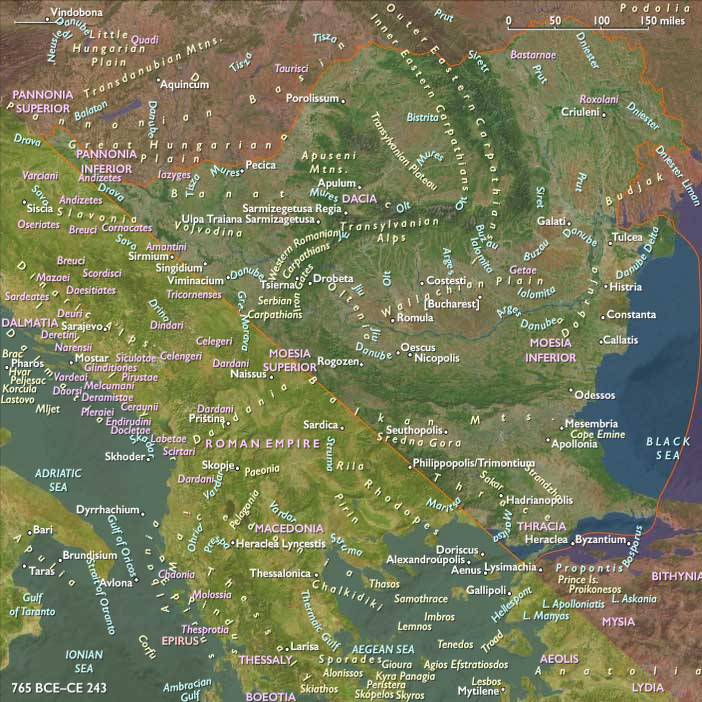
Beginning in the middle second century, the Wielbark culture had shifted to the southeast, towards the Black Sea.
The part of the Wielbark culture that moved is the oldest portion, located west of the Vistula and still practicing Scandinavian burial traditions.
In Ukraine, they had installed themselves as the rulers of the local Zarubintsy culture, forming the new Chernyakhov Culture, which flourishes between about 200 to about 400.
Locations
Groups
Topics
Commodoties
Subjects
Regions

Subregions
Related Events
Showing 10 events out of 60840 total
Years: 196 - 207
Locations
Groups
Topics
Commodoties
Subjects
Regions
Subregions