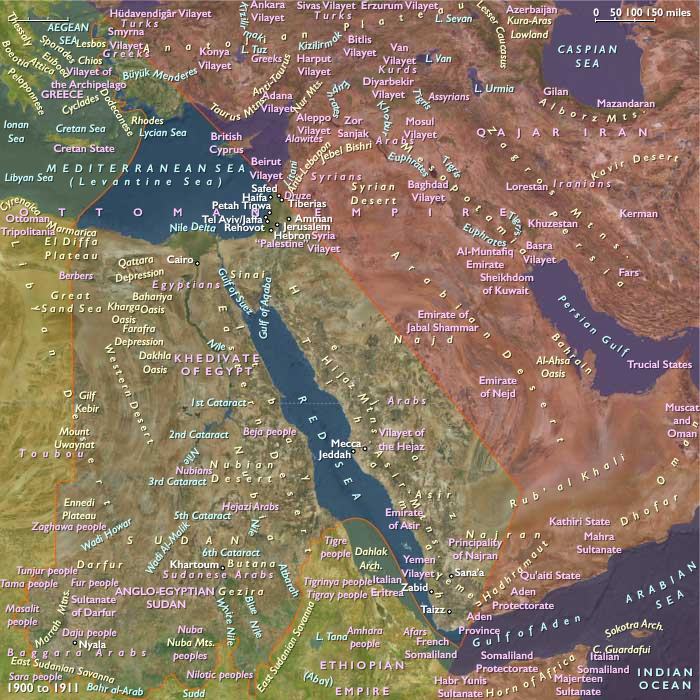
The British dedicate themselves to creating a…
1900 CE to 1911 CE
Jurists adopt penal and criminal procedural codes similar to those in force in British India.
Commissions establish land tenure rules and adjust claims in dispute because of grants made by successive governments.
Taxes on land remain the basic form of taxation, the amount assessed depending on the type of irrigation, the number of date palms, and the size of herds; however, the rate of taxation is fixed for the first time in Sudan's history.
The 1902 Code of Civil Procedure continues the Ottoman separation of civil law and sharia, but it also creates guidelines for the operation of sharia courts as an autonomous judicial division under a chief qadi appointed by the governor general.
Religious judges and other sharia court officials are invariably Egyptian.
There is little resistance to the condominium.
Breaches of the peace usually take the form of intertribal warfare or banditry.
Mahdist uprisings occur in February 1900, in 1902–3, in 1904, and in 1908 but these revolts are of short duration.
In 1916, Abd Allah as Suhayni, claiming to be the Prophet Isa, will launch an unsuccessful jihad.
The problem of the condominium's undefined borders is a greater concern.
A 1902 treaty with Ethiopia fixes the southeastern boundary with Sudan.
Seven years later, an Anglo-Belgian treaty determines the status of the Lado Enclave in the south establishing a border with the Belgian Congo (present-day Democratic Republic of the Congo).
Regions
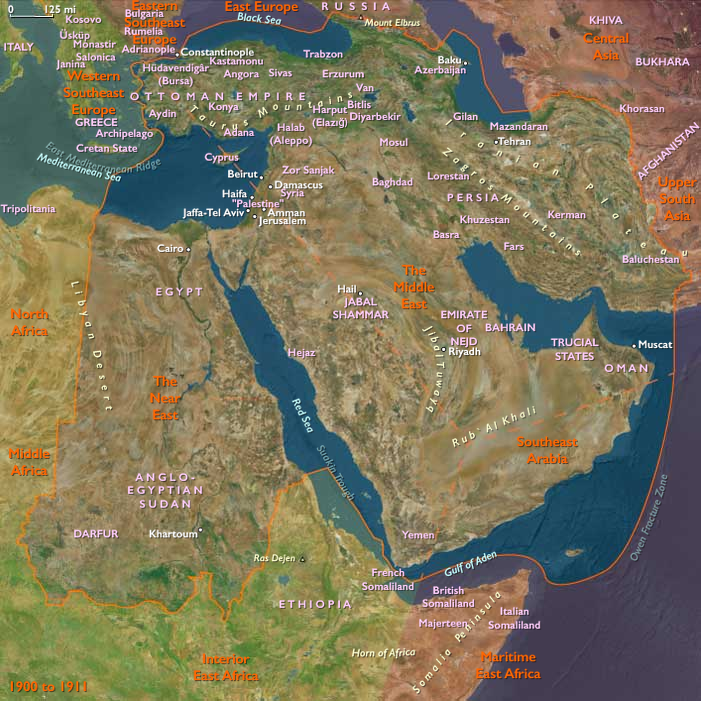
The Near and Middle East
View →Subregions