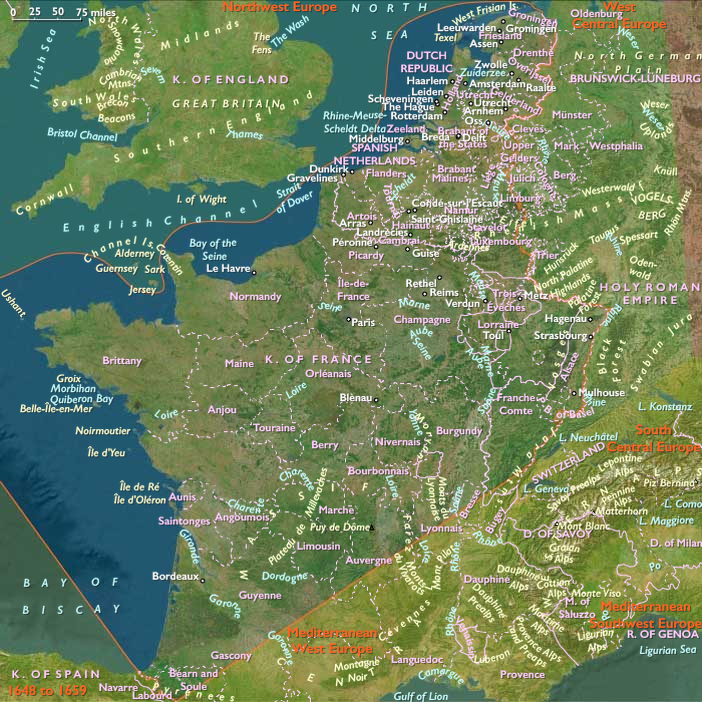
The Great Assembly, held between January and…
September 1651 CE
The Great Assembly, held between January and August, 1651, has addressed a number of important issues.
The first one is that of the stadholderate.
Friesland and Groningen led the opposition to Holland, arguing that the Union of Utrecht required the appointment of provincial stadtholders by implication, as the articles 9 and 21 of the treaty stipulated mediation by stadtholders in case of conflicts between provinces.
In their interpretation the office of stadtholder thereby acquired a federal aspect, but the other provinces were not persuaded: they decided to leave the office vacant indefinitely.
It should be noted, however, that the office was not abolished, not even in Holland and Zeeland.
A second important topic is the reorganization of the command structure of army and navy.
The office of captain general and admiral general is a federal office.
In the absence of the usual occupant of that office, the stadtholder of Holland, the question is who will now fill it.
A possibility would have been to appoint Willem Frederik, who is after all a stadtholder, but in view of his role in the coup of the previous year, he does not have the confidence of Holland.
It is therefore decided to leave this office also vacant, and to divide its functions between the States General and the Raad van State jointly (as far as appointments and promotions of officers is concerned) and the Holland nobleman Jan Wolfert van Brederode as commander-in-chief of the army with the rank of Field Marshal. (The latter is only a temporary solution, however, as Brederode soon after dies, which causes another round of intrigues to keep Willem Frederik from the top job in the army.)
As the function of admiral general had usually been only symbolic, the actual command of the fleets having been left in the hands of the lieutenant-admirals of the five Admiralties, this office does not pose a similar political problem.
The Great Assembly has also addressed the problem of the Public Church in the country, but left the results of the Synod of Dort in place.
It rejects the requests of the provinces of Brabant and Drenthe for representation on the States General.
These results of the attempt at constitutional reform seem meager, but represent a sea change in the political balance within the union by the elimination of the person who holds five stadtholderships in his hand.
The position of Holland becomes unassailable, on the one hand, because the other provinces are internally divided, and because there is not one leader (like the stadtholder had been) to lead them in opposition to Holland.
Subjects
Regions
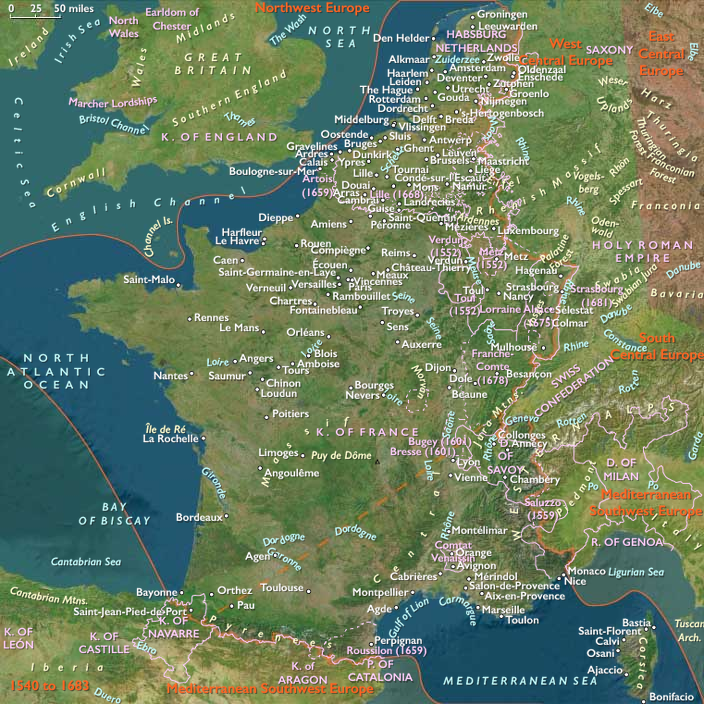
West Europe
View →Subregions