
The Gupta empire reaches its political zenith …
Years: 400 - 411
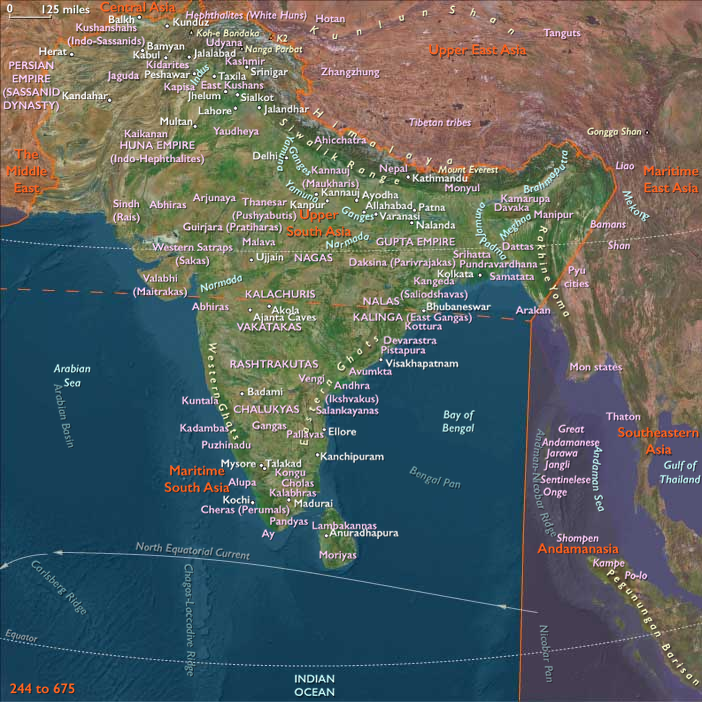
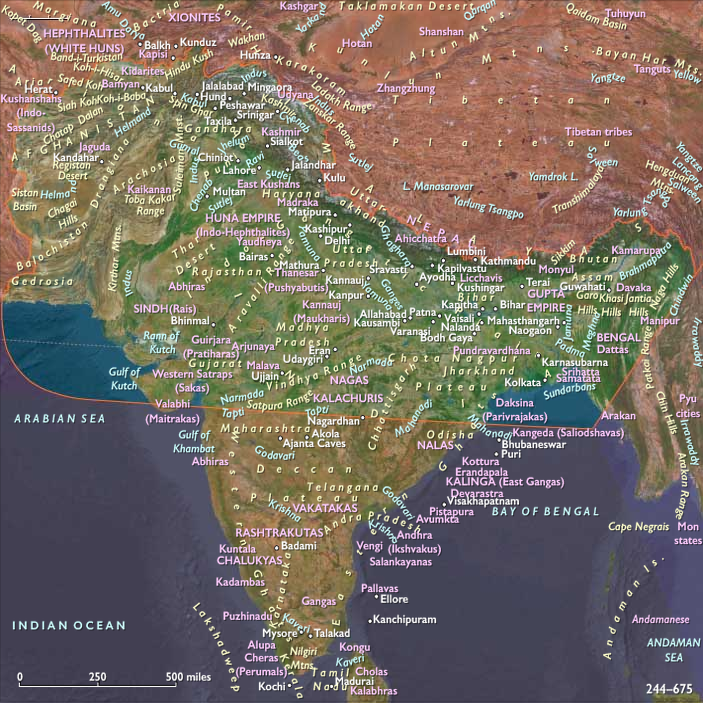
The Gupta empire reaches its political zenith under Chandragupta II, extending far into the Deccan and western India.
A twenty-two-foot- (seven meter-) tall iron pillar represents the remarkable metallurgical advances apparently made under the Gupta dynasty, as the pillar never rusts.
The pillar manufactured by forge welding, is a testament to the high level of skill achieved by ancient Indian iron smiths in the extraction and processing of iron.
The pillar with the statue of Chakra at the top is today at Qutb Minar in Delhi, but its originally location is a place called Vishnupadagiri (meaning “hill with footprint of Lord Vishnu”), identified as modern Udayagiri, situated in the vicinity of Besnagar, Vidisha and Sanchi.
These towns are located about fifty kilometers east of Bhopal, in central India.
There are several aspects to the original site of the pillar at Udayagiri.
Vishnupadagiri is located on the Tropic of Cancer and, therefore, is a center of astronomical studies during the Gupta period.
The Iron Pillar served as a sundial: the early morning shadow of the Iron Pillar falls in the direction of the foot of Anantasayin Vishnu (in one of the panels at Udayagiri) only around the summer solstice (June 21).
The Udayagiri site in general, and the Iron Pillar location in particular, are evidence for the astronomical knowledge that exists in Gupta India.
The pillar bears a Sanskrit inscription in Brahmi script which states that it was erected as a standard in honor of Lord Vishnu.
It also praises the valor and qualities of a king referred to simply as Chandra, who has been identified with the Gupta King Chandragupta II Vikramaditya (375-413).
Locations
People
Groups
Topics
Commodoties
Subjects
- Commerce
- Symbols
- Sculpture
- Labor and Service
- Conflict
- Faith
- Government
- Technology
- Metallurgy
- Astronomy
Regions
Subregions
Related Events
Filter results
Showing 10 events out of 20 total
Hugh had retired to Provence, but continued to carry the royal title until his death in 947.
Lothair II, although he holds the title of rex Italiae, will never succeeded in exercising power here.
He had been betrothed in 931 and had been married, on December 12, 947, to the fifteen-year-old Adelaide, the spirited and intelligent daughter of Rudolph II of Burgundy and Bertha of Swabia.
Their marriage is part of a political settlement designed to conclude a peace between her father and his.
In 933, Hugh of Arles had given up his kingdom (Provence) to his inveterate enemy Rudolph II, who merged the two kingdoms into a new Kingdom of Arles, but died in 937.
The couple have a daughter, Emma, born as early as 948, who will be married in 966 to the Carolingian Lothair of France.
Lothair's power in Italy is nominal.
From the time of the successful uprising of the nobles in 945, when Hugh had been forced into exile, Berengar of Ivrea has kept all real power and patronage in his hands.
Lothair's brief "reign" comes to an end with his death on November 22, 950, presumably poisoned by Berengar II, leaving Adelaide widowed before her twentieth birthday.
Berengar II crowns himself king with his son Adalbert of Italy as his co-ruler and heir apparent.
Failing to receive widespread support for his right to the crown, Berengar II attempts to legitimize his reign and tries to force Adelaide, the respective daughter, daughter-in-law and widow of the last three Italian kings, into marriage with Adalbert.
Adelaide fiercely refuses and is imprisoned by Berengar II at Garda Lake.
Adelaide, after four months’ imprisonment, manages to escape with the help of Count Adalbert Atto of Canossa.
Besieged by Berengar II in Canossa, she sends an emissary across the Alps seeking Otto’s protection and marriage.
Otto, widowed since 946, knows a marriage to Adelaide will allow him to fulfill his ambition of ruling Italy and, ultimately, claiming the imperial crown as Charlemagne’s true heir.
Knowing of Adelaide’s great beauty and immense wealth, the thirty-eight-year-old Otto accepts the nineteen-year-old queen's marriage proposal and prepares for an expedition into Italy.
Otto’s son Liudolph, from his stronghold in Swabia located just north of the Alps, is in closer proximity to the Italian border than his father in Saxony.
Liudolf prepares an Italian campaign is to overthrow Berengar II and therefore render unnecessary Otto's own expedition into Italy, and thus his marriage to Adelaide.
While the exact reason for Liudolf's actions are unclear, dynastic concerns and family ties to Adelaide may have been a factor.
Adelaide's mother, Bertha of Swabia, was a daughter of Regelinda, the mother of Liudolf's wife Ida, from her first marriage to Burchard II, Duke of Swabia.
Liudolf, therefore, may have intervened in the Italian campaign at the request of Adelaide's relatives.
Additionally, Liudolf, nineteen years old himself, does not view the idea of a young stepmother as in his best interests.
Though Otto had named him as his successor, Liudolf fears any potential stepbrother may usurp his claim to the German throne.
While Liudolf is preparing his expedition, the Bavarian Duke Henry, Otto's brother and Liudolf's uncle, conspires against him; Swabia and Bavaria share a long common border and the two dukes are involved in a border dispute.
Henry influences the Italian aristocrats not to join Liudolf's campaign.
Therefore, when Liudolf arrives in Lombardy in early summer 951, he finds no support and is unable to sustain his troops.
His army is near destruction until Otto's own army crosses the Alps.
The King reluctantly receives Liudolf's forces into his command, angry at his son for his inconsiderate and independent actions.
Otto and Liudolf arrive n northern Italy in September 951 without opposition from Berengar II.
As they descend into the Po River valley, the Italian nobles and clergy withdraw their support for Berengar and provide aid to Otto and his advancing army.
Recognizing his weakened position, Berengar II flees from his capital in Pavia.
When Otto arrives at Pavia on September 23, 951, the city willingly opens its gate to the German king.
In accordance with Lombard tradition, Otto is crowned with the Iron Crown of the Lombards on October 10.
Like Charlemagne before him, Otto is now concurrent King of Germany and King of Italy.
Otto sends a message to his brother Henry in Bavaria to escort his bride from Canossa to Pavia, where the two marry.
Soon after his father's marriage, Liudolf leaves Italy and returns to Swabia.
Atlantic West Europe (952–963): Regional Dominance and the Emergence of Capetian Power
From 952 to 963, Atlantic West Europe continued to evolve politically, economically, and culturally. Regional rulers solidified their domains amid weakening royal authority, paving the way for the rise of the Capetian dynasty, while economic growth and monastic reforms further enriched the cultural landscape.
Political and Military Developments
-
West Francia: Prelude to Capetian Ascendancy
- The reign of Lothair (r. 954–986) began amid ongoing fragmentation, challenged by powerful nobles such as Hugh the Great, Duke of the Franks, who extended his influence in the north, setting the stage for Capetian rule.
- Upon Hugh the Great’s death in 956, his son, Hugh Capet, inherited significant territorial and political influence, foreshadowing the shift toward a new royal dynasty.
-
Normandy: Consolidation of Ducal Power
- Richard I ("the Fearless") (r. 942–996) further secured Normandy’s independence and territorial integrity. He strengthened alliances through marriage and diplomacy, ensuring stability and economic prosperity.
-
Aquitaine: Stability under William Towhead
- Duke William III ("Towhead") (r. 935–963) maintained firm control of Aquitaine, fostering internal peace, promoting cultural patronage, and resisting external interference from royal authorities, solidifying Aquitaine’s autonomy.
-
Flanders and Anjou: Continued Expansion
- Arnulf I of Flanders (r. 918–965) bolstered his realm's economic power through trade, fortifying key urban centers such as Bruges and Ghent, further establishing Flanders as a vibrant commercial hub.
- Fulk II ("the Good") of Anjou (r. 942–960) effectively expanded his territory along the Loire Valley, strengthening Angevin political dominance and laying the foundation for future growth under his descendants.
-
Burgundy: Stable Kingship under Conrad
- Conrad I ("the Peaceful"), king of Burgundy (r. 937–993), maintained peace and prosperity in Upper Burgundy (Kingdom of Arles), emphasizing diplomatic and familial alliances, providing stable leadership throughout the region.
Economic and Social Developments
-
Maritime and Commercial Growth
- Trade flourished, especially in Normandy and Flanders, with Rouen, Bruges, and Ghent thriving as important centers for regional commerce, facilitating extensive trade networks across Northern and Western Europe.
-
Agricultural Productivity and Urban Expansion
- Improvements in agriculture led to surplus production and population growth, supporting urbanization across central France, Aquitaine, Burgundy, and the Low Countries. This growth stimulated local markets and artisanal industries.
Religious and Cultural Developments
-
Cluniac and Monastic Reform Movements
- The Cluniac reforms gained widespread adoption, significantly influencing monastic life and spiritual renewal in Aquitaine, Burgundy, and the Loire Valley. Monasteries served as vital centers for intellectual revival, manuscript production, and religious education.
-
Early Scholasticism and Cultural Revival
- Monastic schools in Tours, Cluny, and Auxerre emerged as critical educational and intellectual hubs, preserving classical learning, encouraging scholarly debate, and cultivating the roots of early scholastic thought.
Legacy and Significance
By 963, Atlantic West Europe had experienced key transformations:
- Regional powers such as Normandy, Aquitaine, Anjou, Flanders, and Burgundy had solidified political autonomy amid declining Carolingian authority, establishing lasting patterns of territorial governance.
- Economic growth, driven by thriving commerce and agricultural expansion, facilitated significant urban and demographic developments.
- Monastic reforms and intellectual revival laid cultural and spiritual foundations for medieval European society, influencing subsequent generations.
These trends significantly shaped the region, setting the stage for the impending rise of the Capetian dynasty and the vibrant cultural and economic era that followed.
-
Italy via the Great Saint Bernard Pass
- The Magyars, having devastated Burgundy, move into Italy, crossing the Great Saint Bernard Pass, a key Alpine route.
- Northern Italy, already suffering from political instability, is helpless against the rapid Magyar cavalry raids.
Consequences of the 954 Raid
-
Severe Weakening of West Francia
- This raid exposes the continued weakness of the West Frankish monarchy, as local lords are forced to defend their own lands.
- King Lothair’s inability to organize an effective response further erodes Carolingian legitimacy.
-
Final Phase of Magyar Raids
- The 954 raid is one of the last major Magyar incursions into Western Europe.
- The Magyars are soon defeated decisively by Otto I of Germany at the Battle of Lechfeld in 955, marking the end of their raids into Francia and Italy.
-
Rise of Feudal Defense Strategies
- With kings unable to stop invasions, regional rulers increase fortifications and rely on private armies, reinforcing the feudal system.
Conclusion: The Last Devastation Before the Magyar Defeat
The Great Magyar Raid of 954 is one of the final large-scale invasions of West Francia and Italy, devastating major Frankish heartlands before the Magyars' military power is crushed at Lechfeld in 955. This event marks the last phase of the Hungarian threat to Western Europe, after which Magyar incursions cease permanently, leading to their eventual settlement in Hungary under a Christian kingdom.
Lothair and Hugh the Great’s Failed Siege of Poitiers (955) and the Rout of William III of Aquitaine
By 955, King Lothair of West Francia, still a young ruler, seeks to assert his authority over his magnates. One of his greatest concerns is William III of Aquitaine, whose power in the south threatens royal influence. To curb William’s strength, Lothair joins forces with Hugh the Great, Duke of the Franks, and together they lay siege to Poitiers in August 955.
The Siege of Poitiers (955)
- Poitiers, the heart of William III’s power, is a well-defended stronghold.
- Lothair and Hugh launch a siege, but the city’s defenders hold out successfully, refusing to surrender.
- The siege does not achieve the desired outcome, as Poitiers remains firmly in Aquitanian hands.
The Battle and William III’s Defeat
- After the failed siege, William III gathers his forces and offers battle against Lothair and Hugh.
- In open combat, William’s forces are routed, suffering a decisive defeat.
- This setback weakens his position in Aquitaine, but he still retains control over much of his domain, as Poitiers remains unconquered.
Consequences of the 955 Campaign
-
Royal Authority Remains Weak in Aquitaine
- Despite winning the battle, Lothair and Hugh fail to subdue Poitiers, meaning William III continues to rule Aquitaine independently.
-
Hugh the Great’s Continued Dominance
- Hugh, already the most powerful noble in France, further strengthens his influence by helping to lead the campaign against William.
- His role in the battle underscores his power as the true enforcer of royal authority in the kingdom.
-
Lothair’s Struggle for Control
- Though he participates in the victory, Lothair remains reliant on Hugh, highlighting his limited authority as king.
- His inability to secure Aquitaine further proves the monarchy’s weakness in the feudalized realm of West Francia.
Conclusion: A Partial Victory, but No Lasting Gains
While Lothair and Hugh defeat William III in battle, their failure to capture Poitiers means that Aquitaine remains outside direct royal control. This event highlights the continued fragmentation of West Francia, as the great magnates continue to operate with near-total independence, leaving Lothair as a nominal king with little direct authority.
The Rise of Hugh Capet and the Fragmented Kingdom of the Franks (941–956)
Born in 941, Hugh Capet was the son of Hugh the Great, Duke of the Franks, and Hedwige of Saxony, daughter of Henry the Fowler, King of East Francia. His paternal family, the Robertians, were powerful landowners in the Île-de-France, and his lineage was deeply tied to both the Carolingians and the Ottonian rulers of the Holy Roman Empire.
Hugh Capet’s Royal and Noble Connections
- Grandson of King Robert I of West Francia.
- Great-great-great-great-grandson of Charlemagne, descended from Pepin of Italy through his grandmother Beatrice of Vermandois.
- Grandnephew of King Odo of West Francia.
- Related to the Ottonian emperors, being first cousin to Otto II of Germany.
- Son of Hugh the Great, the most powerful noble in West Francia, though he never took the crown.
Hugh the Great’s Role in the Return of Louis IV (936)
- When King Rudolph (Raoul) of Burgundy died in 936, Hugh the Great orchestrated the return of Louis IV ("d’Outremer"), son of the deposed Charles the Simple, from exile in England.
- Motives remain unclear, but possible reasons include:
- Preventing Rudolph’s brother, Hugh the Black, from claiming the throne.
- Blocking Herbert II of Vermandois or Richard the Fearless, Duke of Normandy, from taking power.
- Though he restored the Carolingian dynasty, Hugh the Great ensured his own dominance, keeping Louis IV as a weak, dependent king.
Hugh Capet Inherits Power (956)
- Hugh the Great dies in 956, leaving his vast estates to his young son, Hugh Capet.
- At the time, Hugh Capet is still a minor, so his mother, Hedwige of Saxony, acts as his guardian.
- Despite his father’s immense influence, Hugh immediately faces challenges from ambitious neighbors.
Loss of Land to Former Vassals
- Theobald I of Blois, a former vassal of Hugh the Great, seizes Chartres and Châteaudun, weakening Hugh’s control in the Loire Valley.
- Fulk II of Anjou, another former client of Hugh the Great, carves out a principality at Hugh’s expense, gaining control over key territories along the Breton border.
The Fragmentation of West Francia
Hugh Capet grows up in a much-reduced West Frankish kingdom, which looks nothing like modern France:
- The king is known as Rex Francorum ("King of the Franks"), not "King of France," a title that will only emerge under Philip II Augustus (1180–1223).
- West Francia is a weak and fragmented realm, with the king controlling only a small portion of the former Carolingian Empire.
- The Holy Roman Empire, ruled by Hugh’s first cousin Otto II and later Otto III, dominates the eastern Frankish lands.
- South of the Loire, the king’s influence is nearly nonexistent, as local rulers act independently.
- Normandy and Burgundy are virtually autonomous, with Hugh’s brothers Otto and Henry ruling Burgundy from 956.
- Brittany is entirely independent, resisting West Frankish authority.
Conclusion: The Future King of a Feudal Kingdom
As Hugh Capet comes of age, he inherits a divided and decentralized realm, where noble power surpasses royal authority. His eventual rise to the throne in 987 will mark the end of Carolingian rule and the beginning of the Capetian dynasty, setting the foundation for the Kingdom of France. However, for now, he remains a young duke in a fractured kingdom, struggling to reclaim lost lands and secure his position.
Bruno the Great: Archbishop, Duke, and Regent of West Francia (956)
Bruno the Great, the younger brother of Otto I of Germany, was not only Archbishop of Cologne (since 953) but also Duke of Lotharingia, making him one of the most powerful figures in 10th-century Europe. His dual authority as both a spiritual and secular ruler earned him the title of "Archduke," as recorded by his biographer Ruotger.
Following the deaths of King Louis IV of West Francia in 954 and Hugh the Great, Duke of the Franks, in 956, Bruno steps in as regent of West Francia, acting on behalf of his nephews:
- Lothair (b. 941), now King of West Francia, the son of Louis IV and Gerberga of Saxony (Bruno’s sister).
- Hugh Capet (b. 941), Duke of the Franks, son of Hugh the Great and Hedwige of Saxony (also Bruno’s sister).
Bruno’s Role as Regent of West Francia (956–965)
-
Maintaining Stability in West Francia
- With Lothair still a minor, Bruno serves as his regent, guiding the young Carolingian king through a period of political instability.
- He also ensures that Hugh Capet, the heir to Hugh the Great, remains a powerful noble but does not threaten the monarchy.
-
Strengthening Ottonian Influence in France
- As maternal uncle to both Lothair and Hugh Capet, Bruno’s regency extends Ottonian influence into West Francia.
- This helps Otto I’s empire maintain a balance of power over its western neighbor, preventing West Francia from falling into complete chaos.
-
Defending Lotharingia and West Francia
- As Duke of Lotharingia, Bruno ensures the stability of this contested region, preventing further West Frankish interference.
- His control over Lotharingia and West Francia places him in a unique position of influence across both realms.
Conclusion: The Most Powerful Man After Otto I
Bruno the Great’s position as both archbishop and duke made him the most powerful man after Otto I in the Holy Roman Empire and beyond. His role as regent of West Francia ensured that Ottonian control extended into France, stabilizing the Carolingian monarchy under King Lothair and managing the rising power of Hugh Capet, setting the stage for the eventual Capetian takeover of France in 987.
The Division of Lotharingia: The End of a Unified Duchy (959)
By 959, Bruno the Great, the Duke of Lotharingia and Archbishop of Cologne, makes a critical administrative decision that permanently ends the unity of Lotharingia. As one of the last dukes of the whole region, Bruno appoints two local nobles, Frederick and Godfrey, as margraves, effectively splitting the duchy into Upper and Lower Lotharingia.
Background: Lotharingia’s Shifting Allegiances
- Originally part of Middle Francia, Lotharingia had long been contested between East and West Francia since the Treaty of Meerssen (870) and the Treaty of Ribemont (880).
- It had shifted from East Francia (Germany) to West Francia (France) and back again, remaining a hotly disputed territory.
- Under Bruno’s rule, Lotharingia was stabilized as part of the Holy Roman Empire, but its vast size and strategic importance made it difficult to govern as a single duchy.
The Division of Lotharingia (959)
To ensure more effective rule, Bruno appoints:
- Frederick I as Margrave of Upper Lotharingia, later recognized as Duke of Upper Lorraine.
- Godfrey I as Margrave of Lower Lotharingia, later known as Duke of Lower Lorraine.
This administrative division is meant to improve governance and military defense but ultimately results in:
- The permanent split of Lotharingia into two distinct duchies.
- A further weakening of centralized control, as regional lords gain more autonomy.
- Continued fragmentation, making Lotharingia a battleground for German, French, and local noble interestsin the following centuries.
Legacy: The Last Duke of a United Lotharingia
- Bruno is one of the last rulers to control all of Lotharingia as a single entity.
- His decision in 959 shapes the future of the region, ensuring that Upper and Lower Lorraine evolve as separate feudal entities.
- This fragmentation reinforces feudal decentralization, marking another step toward the eventual dissolution of the Carolingian world and the rise of independent regional powers.
With Bruno’s death in 965, the once-mighty Lotharingia is permanently divided, reflecting the broader breakdown of centralized authority in medieval Europe.
The Division of Hugh the Great’s Lands and Lothair’s Regency (956–960)
Following the death of Hugh the Great in 956, King Lothair of West Francia is forced to mediate between Hugh’s sons—the powerful Hugh Capet and his younger brothers Otto and Henry—to prevent internal conflict among the most influential noble family in France. This period sees:
- The division of Hugh the Great’s vast territories between his sons.
- Lothair coming under the guardianship of his maternal uncle, Bruno of Cologne, reinforcing Ottonian influence over West Francia.
The Division of Hugh the Great’s Domains (956–960)
To maintain stability and avoid a civil war, Lothair makes the following decisions:
-
Hugh Capet, the eldest son, receives:
- The County of Paris
- The Duchy of the Franks (dux Francorum), the highest noble title in West Francia
- Control over much of Neustria and the Loire Valley
-
Otto of Burgundy (younger brother of Hugh Capet) is invested in 960 as Duke of Burgundy, controlling:
- The Duchy of Burgundy, ensuring its autonomy from Neustria.
-
Henry, the youngest brother, does not receive an immediate duchy but is a key member of the family’s growing influence.
This division ensures that the powerful Robertian family remains dominant, though Hugh Capet emerges as the most powerful of the brothers.
Lothair’s Guardianship Under Bruno of Cologne (956–965)
- With Hugh Capet still consolidating power, Lothair, who had ascended the throne in 954 at age 13, falls under the influence of his maternal uncle, Bruno, Archbishop of Cologne and Duke of Lotharingia.
- Bruno serves as regent, reinforcing Ottonian control over West Francia, as he is also the younger brother of Otto I, Holy Roman Emperor.
- This allows the Holy Roman Empire to maintain a strong presence in Frankish affairs, ensuring Lothair remains politically weak while the Robertians grow stronger.
Consequences of This Power Shift
-
Hugh Capet Establishes the Foundation of the Capetian Dynasty
- Now controlling Paris and Neustria, Hugh Capet emerges as the dominant noble in West Francia, a position he will hold until his eventual rise to the throne in 987.
-
Burgundy Becomes Semi-Independent
- The duchy is now separate from Neustria, meaning West Francia’s royal power is further decentralized.
-
Ottonian Influence Over West Francia
- With Bruno of Cologne as Lothair’s guardian, the Holy Roman Empire has a strong political grip over West Francia.
- This prevents Lothair from acting independently until Bruno’s death in 965.
Conclusion: A Step Toward the Capetian Takeover
While Lothair technically remains king, the division of Hugh the Great’s lands strengthens the Robertians, particularly Hugh Capet, who emerges as the most powerful noble in France. Meanwhile, Ottonian influence over West Francia grows through Bruno of Cologne’s regency, ensuring that Lothair’s rule remains weak and dependent on external forces. This balance of power will eventually lead to the downfall of the Carolingian dynasty and the rise of the Capetians in 987.
Years: 400 - 411
Locations
People
Groups
Topics
Commodoties
Subjects
- Commerce
- Symbols
- Sculpture
- Labor and Service
- Conflict
- Faith
- Government
- Technology
- Metallurgy
- Astronomy
