William Herschel has become known for his…
December 1783 CE
Caroline has spent many hours polishing mirrors and mounting telescopes in order to maximize the amount of light captured.
She has learned to copy astronomical catalogues and other publications that William had borrowed.
She has also learned to record, reduce, and organize her brother’s astronomical observations, recognizing that this work demands speed, precision and accuracy.
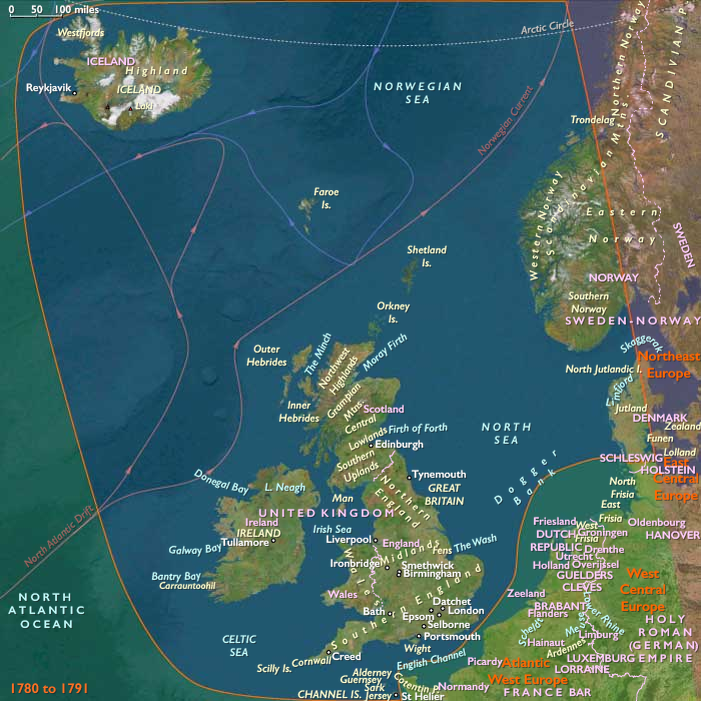
Caroline had been asked to move from the high culture of Bath to the relative backwater of Datchet in 1782, a small town near Windsor Castle where William will be on hand to entertain royal guests.
He presumed that Caroline would become his assistant, a role she did not initially accept.
She was unhappy with the accommodations they had taken; the house they rented for three years had a leaky ceiling and Caroline described it as "the ruins of a place".
She was also aghast at the prices in the city and the fact that their domestic servant was imprisoned for theft at the time of her arrival.
While William worked on a catalogue of three thousand stars, studied double stars, and attempted to discover the cause of Mira's and Algol's variability, Caroline was asked to "sweep" the sky, meticulously moving through the sky in strips to search for interesting objects.
She was unhappy with this task at the beginning of her work, longing for the culture of Bath and feeling isolated and lonely, but gradually developed a love for the work.
On August 28, 1782 Caroline initiated her first record book.
She inscribed the first three opening pages: "This is what I call the Bills & Recs.ds of my Comets", "Comets and Letters", and "Books of Observations."
This, along with two subsequent books, currently belong to the Herschel trove at the Royal Astronomical Society in London.
On February 26, 1783, Caroline makes her first discovery: she had found a nebula that was not included in the Messier catalogue.
That same night, she independently discovered Messier 110 (NGC 205), the second companion of the Andromeda Galaxy.
William now begins to search himself for nebulae, sensing that there are many discoveries to be made.
Caroline is relegated to a ladder on William's twenty—foot reflector, attempting impossible measurements of double stars.
William quickly realizes his method of searching for nebulae is inefficient and he requires an assistant to keep records.
Naturally, he turns to Caroline.
In the summer of 1783, William finishes building Caroline a comet-searching telescope, which she begins to use immediately.[6] Beginning in October 1783, the Herschels uses a twenty-foot reflecting telescope to search for nebulae.
Initially, William attempts to both observe and record objects, but this is inefficient and he requires an assistant to keep records.
Naturally, he turns to Caroline.
She sits by a window inside, William shouts his observations, and Caroline records.
This is not a simple clerical task, however, because she has to use John Flamsteed's catalogue to identify the star William used as a reference point for the nebulae.
Because Flamsteed's catalogue is organized by constellation, it is less useful to the Herschels, so Caroline creates her own catalogue organized by north polar distance.
Each following morning, Caroline goes over her notes and writes up formal observations, which she calls "minding the heavens." (Olson, Roberta J. M.; Pasachoff, Jay M. (2012). "The Comets of Caroline Herschel (1750-1848), Sleuth of the Skies at Slough" (PDF). Culture and Cosmos.)
Subjects
Regions
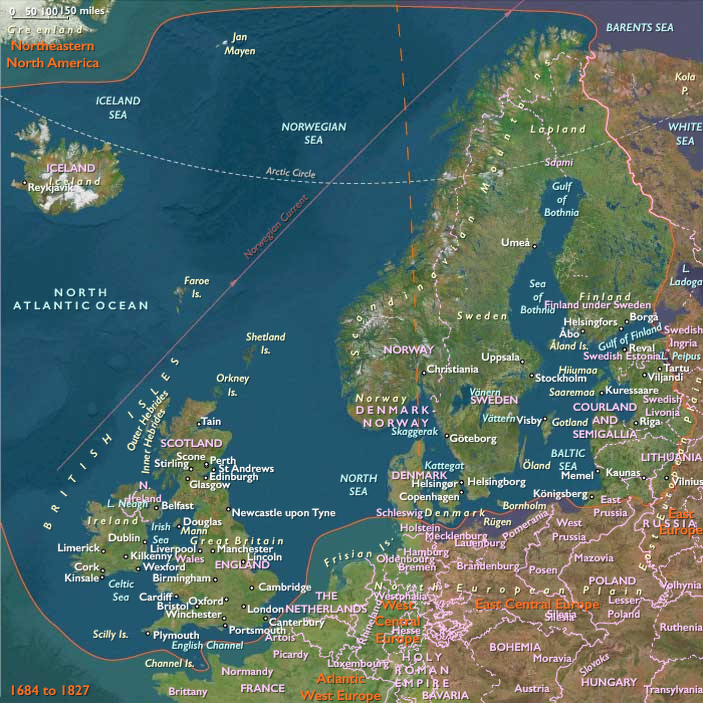
North Europe
View →Subregions