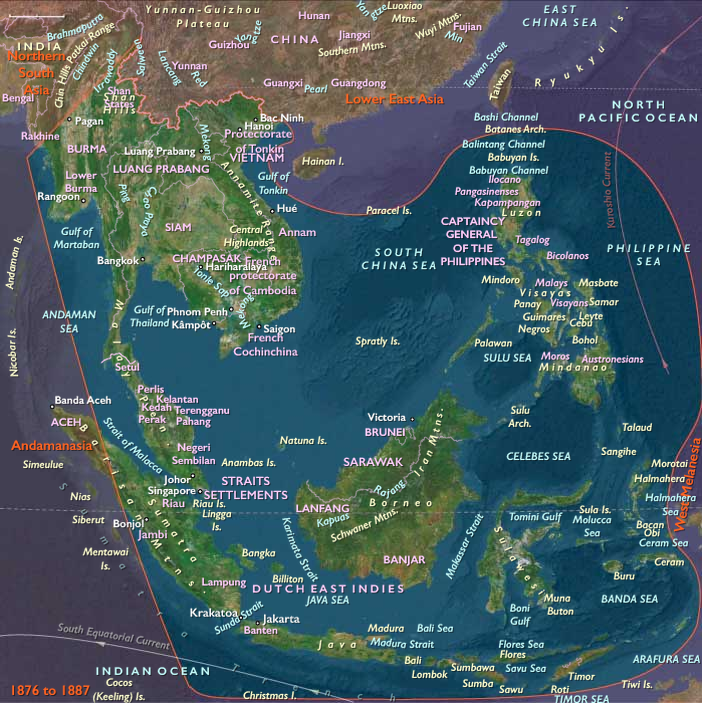
The Haw, armed with modern repeating rifles…
February 1887 CE
The Haw, armed with modern repeating rifles and Birmingham-manufactured ammunition, while many are skilled in guerrilla warfare, use demoralizing tactics such as mutilating captives, employ punji stakes, and make surprise night attacks.
Magic is still believed in and is resorted to by both sides.
Hora (astrologers) accompanying the Siamese troops determine that 10 o'clock on the morning of February 22, 1885, is the most auspicious time to begin the assault.
At the predetermined time, a gun is fired and the attacking forces begin their advance against the Haw stronghold, a well-defended stockade four hundred meters long by two hundred wide, surrounded by bamboo and watched over by seven towers each about twelvemeters high.
The Thai and Laotian troops advance in companies of fifty men, each under the White Elephant flag of Siam, and establish themselves behind a temporary palisade one hundred meters from the Haw fort.
The attacking forces are armed with Armstrong six-pounder (two and a half inch/sixty-four millimeter) guns, but these apparently lack ammunition.
McCarthy noted that most of the firing seemed to come from the Haw watchtowers and, despite Thai and Lao courage and almost reckless indifference to injury, "considerable execution" was caused to them.
The Haw, on the other hand, remain relatively unscathed.
At two o'clock in the afternoon, the Thais suffer a further setback when their commander-in-chief, Phraya Raj, is injured by a shot "weighing about two pounds, which glanced off the post of a Chinese joss house where he was standing and struck him in the leg."
The attack on the Haw stockade eventually has to be given up.
Subsequently, McCarthy makes inquiries into the origins and purpose of the Haw invaders.
He concludes that the Governor of Yunnan had sent them into the region to harass the French.
This may have been true of the Black Flags in Tonkin, but there is no direct indication of official Chinese involvement in Laos.
The Haw will continue their depredations until the mid-1890s, when a combination of Siamese and ultimately French pressure forces them to retreat to China.
People
Groups
Topics
Regions

Southeast Asia
View →Subregions