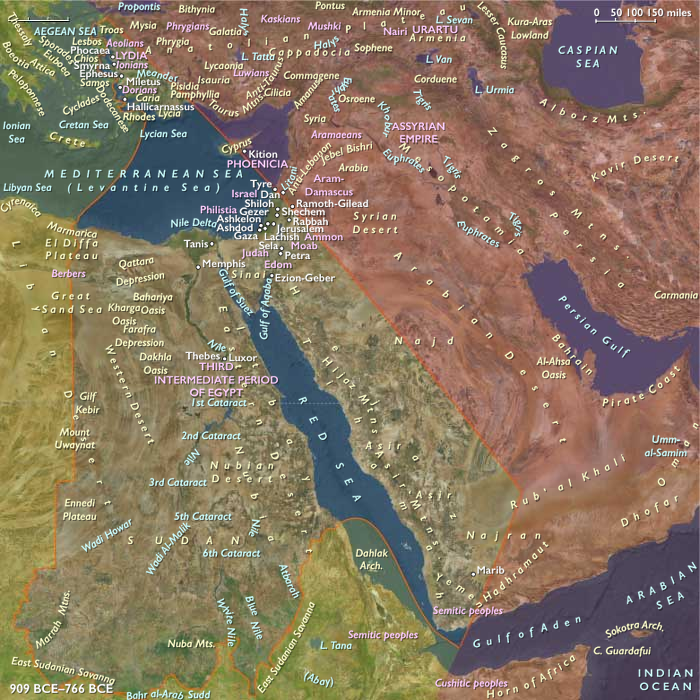
The Hebrew alphabet evolves from the Phoenician-Hebrew…
909 BCE to 766 BCE
The Hebrew alphabet evolves from the Phoenician-Hebrew script, which in turn may be an offshoot of the Proto-Canaanite script and its hieroglyphic ancestors.
The Gezer calendar dates to the tenth century BCE at the beginning of the Monarchic Period, the traditional time of the reign of David and Solomon.
Classified as Archaic Biblical Hebrew, the calendar presents a list of seasons and related agricultural activities.
The Gezer calendar (named after the city in whose proximity it was found) is written in an old Semitic script, akin to the Phoenician one that through the Greeks and Etruscans will later become the Roman script.
The Gezer calendar is written without any vowels, and it does not use consonants to imply vowels even in the places where later Hebrew spelling requires it.
Numerous older tablets have been found in the region with similar scripts written in other Semitic languages, for example Protosinaitic.
It is believed that the original shapes of the script go back to Egyptian hieroglyphs, though the phonetic values are instead inspired by the acrophonic principle.
The common ancestor of Hebrew and Phoenician was called Canaanite, and was the first to use a Semitic alphabet distinct from Egyptian.
Locations
Groups
Topics
Regions
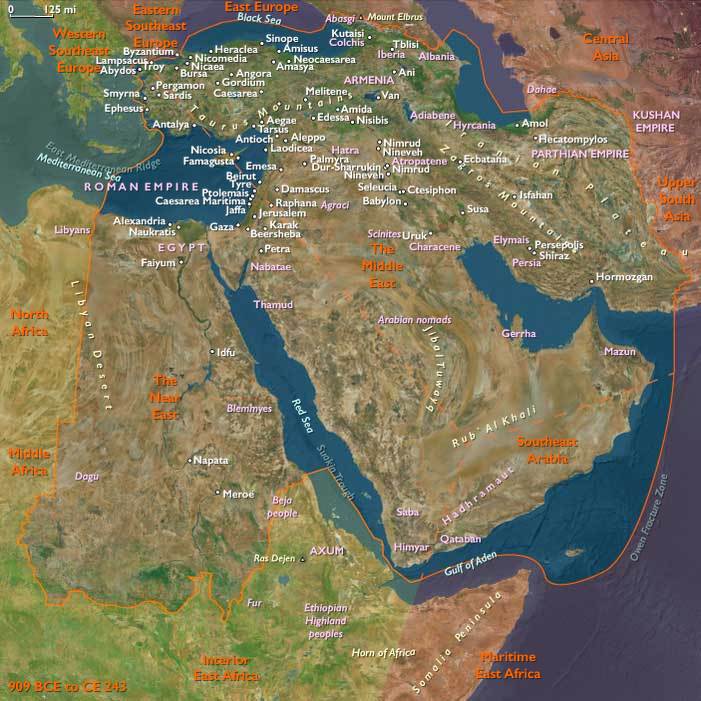
The Near and Middle East
View →Subregions