
The Hungarian king Matthias Corvinus is interested…
1484 CE
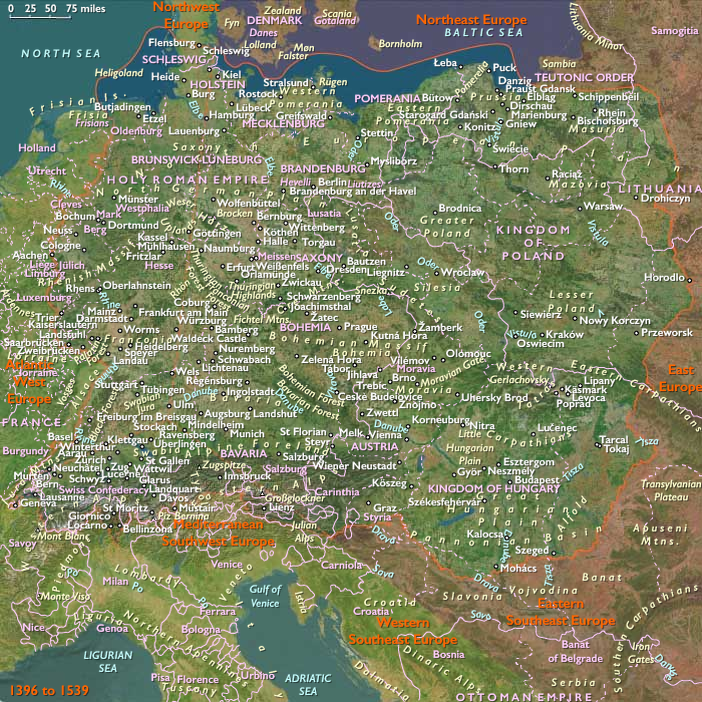
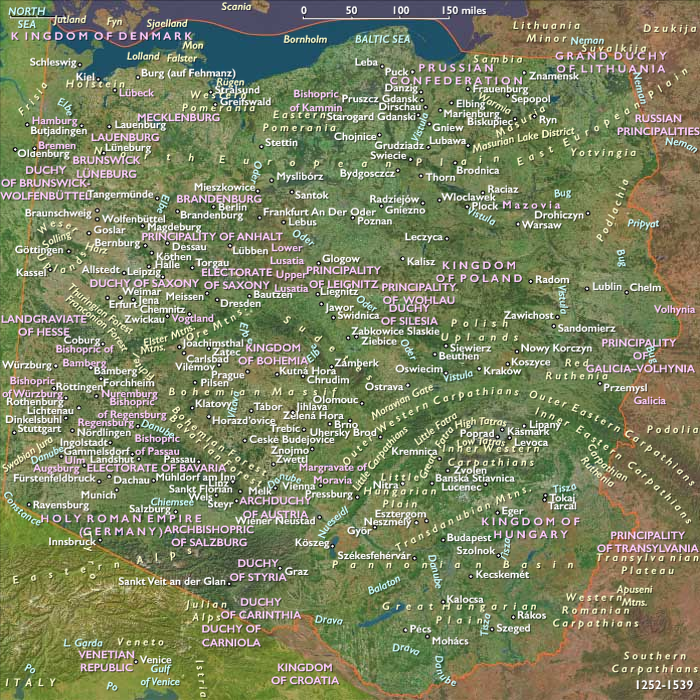
The Hungarian king Matthias Corvinus is interested mainly in establishing his rule over Bohemia and agrees in 1484 to peace with the Ottomans.
Locations
People
Commodities
Subjects
Regions
Central Europe
View →Subregions
East Central Europe
View →Related Events
No active filters.
Showing 10 events out of 40528 total
Clashes between Turks and Poles intensify in Moldavia, which Poland, ruled by King Casimir IV, has incorporated.
In 1484, Turkish naval forces, aiming to cut Polish access to the Black Sea, seize Kiliya and …
…Akkerman (Belgorod-Dnestrovsky) at the mouths of the Danube and Dneister rivers, respectively.
In occupying these two estuarial fortresses, the Ottomans strengthen their hold over the land route to the Crimea, where the khan of the Crimean Tatars has been, in name at least, a vassal of the sultan since 1475; the Ottomans thus control the major entrepôts of northern European trade with the Black Sea and Mediterranean.
The papal bull Summis desiderantes affectibus allegedly gives full papal approval for the Inquisition to prosecute what was deemed to be witchcraft in general and for Heinrich Kramer and Jacob Sprenger specifically.
Kramer, born in Sélestat, Alsace, had joined the Dominican Order at an early age and while still a young man had been appointed Prior of the Dominican house of his native town.
At some date before 1474, he had been appointed Inquisitor for the Tyrol, Salzburg, Bohemia and Moravia.
His eloquence in the pulpit and tireless activity received recognition at Rome and he was the right-hand man of the Archbishop of Salzburg.
By the time of the Bull Summis desiderantes of Pope Innocent VIII in 1484 he is already associated with Jacob (also known as Jakob) Sprenger to make one of the first attempts at prosecuting alleged witches and sorcerer in the Tyrol region.
It is not a success: expelled from the city of Innsbruck and dismissed by the local bishop as a "senile old man", Kramer is opposed by the local clergy partly because of his eccentric behavior (as the Bishop of Innsbruck's verdict indicates), and partly because he didn't hold any official position as an Inquisitor despite his efforts to make himself into one.
Some scholars have suggested that following the failed efforts in Tyrol, Kramer and Sprenger requested and received the papal bull in 1484.
Bonaventure is formally canonized in 1484 by the Franciscan Pope Sixtus IV, and ranked along with Thomas Aquinas as the greatest of the Doctors of the Church by another Franciscan, Pope Sixtus V, in 1587.
Bonaventure is regarded as one of the greatest philosophers of the Middle Ages.
Alberti, learning from Brunelleschi’s design for Santa Maria degli Angeli, and calling a church (or "temple," in contemporary Italian parlance) the greatest and noblest ornament of a city, thus demanded a prominent site for a church—its location in a square and its elevation above the surrounding buildings—so that all of its parts can be admired.
He insisted, moreover, that geometrical proportions must govern the structure in every detail.
The first such church to be built almost to completion, however, Guiliano da Sangallo's Madonna delle Carceri at Prato, begun 1484, shows the inherent difficulties imposed by such a plan (here the Greek cross): geometrical focus is at the center of the plan, whereas the religious or liturgical focus, the altar, is set for practical purposes in the arm of the church opposite the main entrance.
Thus there is a conflict between the geometry of the plan and the implied longitudinal axis.
Giovanni Antonio Amadeo, born in Pavia, had in 1470 been commissioned by Bartolomeo Colleoni to complete his funerary chapel, the Cappella Colleoni in Bergamo, which had been begun by Guiniforte and Francesco Solari.
Amadeo had added polychrome decoration and many sculptures in the ancient style including medallions, small columns, busts, reliefs of "Histories from the Old Testament" and "Histories of Hercules".
Amadeo also designed the funerary monument to Medea Colleoni, which was intended for the church of Santa Maria della Basella in Urgnano.
The condottiero's tomb was realized in collaboration with other artists, with Amadeo providing the reliefs of the lower sarcophagus and of the smaller upper sarcophagus, as well seven statues of the Virtues.
Amadeo was also commissioned by Duke Galeazzo Maria Sforza to work for some years in the Certosa di Pavia.
During 1473-1476, Amadeo had realized half of the bas-reliefs in the right side of the façade.
In 1480 he finishes the arch of the Persian Martyrs in the Olivetani Monastery of Cremona (four marble reliefs remain today, dated 1484).
Also attributed to him are two statues of Justice and Temperance in Cremona, and reliefs in the National Antiquity Museum of Parma.
Heinrich Isaac, a prolific Flemish composer, has already achieved some prominence when he settles in 1484 in Florence, where, except for sojourns in Rome and Austria, he will remain.
His secular music, which includes songs in French, German, Italian, and Latin as well as instrumental pieces, reflects his ability to absorb the musical traditions of the different countries in which he has lived.
However, his sacred music—comprising masses and motets written in the polyphonic style of his native Flanders— best reveals his genius and the total mastery of his art.
His most famous work, the “Choralis Constantinus,” comprises more than three hundred settings of mass propers for all Sundays and many feast days of the liturgical year, and also contains five settings of the ordinary of the mass.
Sixtus had been rendered more eager to sue for peace by the series of victories by Venetian forces, who seized the opportunity to forward their territorial ambitions and had been hasty to declare war on Ferrara on a minor pretext.
Florence, Naples, Mantua, Milan, and Bologna have stood by Ferrara.
While the papal forces were holding in check the Neapolitans who sought to move north to aid Ferrara, and with the Roman Campagna being harassed by the Colonna, and Milan engaged in combat with Genoa, the Venetians had besieged Ferrara into starvation.
With the Venetians ready to take over Ferrara, the Pope, fearing his erstwhile allies, had suddenly changed sides: he made a treaty with Naples, and permitted the Neapolitan army to pass through his territories, giving them the chance to convey supplies to Ferrara and neutralize the siege.
At the same time the Pope had excommunicated the Venetians, and now urges all Italy to make war upon them.
Venice, taking advantage of dissension among the allies arrayed against them, secretly concludes with Milan the Peace of Bagnolo on August 7 1484.
Their battle defeats notwithstanding, the Venetians retain convention rights over Ferrara and Ercole cedes the territory of Rovigo in the Polesine, lost at an early stage of the fighting.
The war comes to a conclusion with the Treaty of Bagnolo and the Venetian forces that are occupying Ferrara-owned territory withdraw.
Ercole has successfully avoided the absorption of Ferrara, seat of the Este, into the Papal States.
The Peace of Bagnolo checks Venetian expansion in the terra firma, ceding to it the town of Rovigo and a broad swath of the fertile delta of the Po.
This acquisition agreed upon at Bagnolo marks the high-point of Venetian territory; never again will Venice control so large a territory nor have so much influence as it does in the last half of the fifteenth century.
Nevertheless, Sixtus is not pleased with the terms reached without consulting him.
When the ambassadors declared to him the terms of the treaty he is thrown into a violent rage, and declares the peace to be at once shameful and humiliating.
Suffering from gout, he dies on the following day, August 12, 1484.