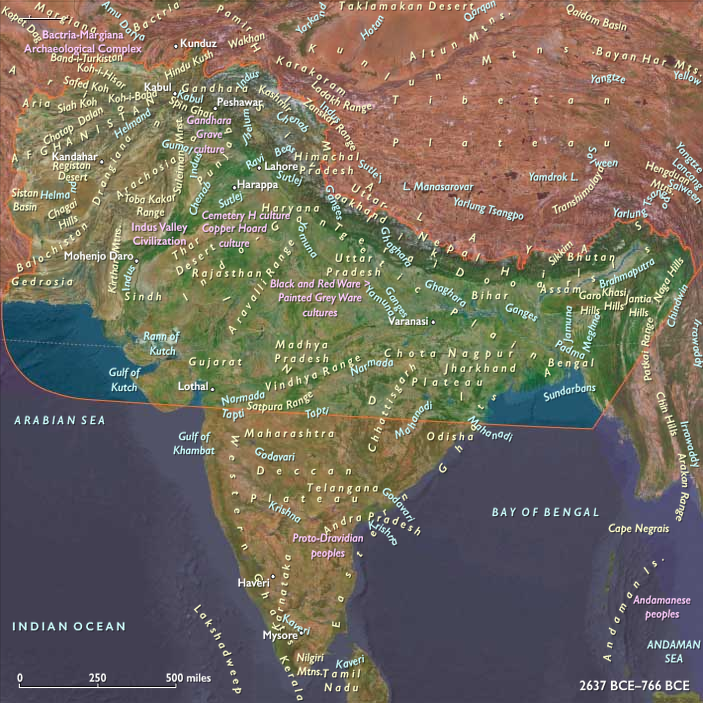
The Indus Valley civilization, which spans much…
1773 BCE to 1630 BCE
The Indus Valley civilization, which spans much of present Pakistan, had suddenly gone into decline around 1800 BCE.
Among the Indus Civilization settlements, which have spread as far south as the Arabian Sea coast of India, as far west as the Iranian border, and as far north as the Himalayas, are the major urban centers of Harappa and Lothal, as well as Mohenjo-daro, which at its peak had been the most developed and advanced city in South Asia.
Mohenjo-daro has been successively destroyed and rebuilt at least seven times.
Each time, the new cities had been built directly on top of the old ones.
Flooding by the Indus is thought to have been the cause of destruction.
The language of the Indus Civilization has yet to be deciphered, and the real name of the city as of other excavated cities in Sindh, Punjab and Gujarat, is unknown.
"Mohenjo-daro" is Sindhi for "Mound of the Dead."
The construction of houses has markedly declined in Mohenjo-daro by about 1750, at which time the Indus civilization begins to be battered by intermittent and devastating floods.
According to one theory, India is around 1700 invaded by Aryan nomads who destroy Mohenjo-daro and Harappa and end the Indus civilization, which in any case had apparently undergone a rapid decline in the early second millennium.
In Mohenjo-Daro, thirty-eight corpses are apparently left unburied in lanes and houses of the final level of occupation, which may indicate a final massacre, possibly by conquering Aryan peoples whose epics refer to their conquest of walled cities.
Other scholars will attribute the decline to an ecological catastrophe that had triggered violent and recurrent flooding along the southern course of the Indus.
Still others will suggest that the Indus civilization may have overextended itself until its collapse under the combined pressures of natural disasters and barbarian incursions.
Locations
Topics
Regions
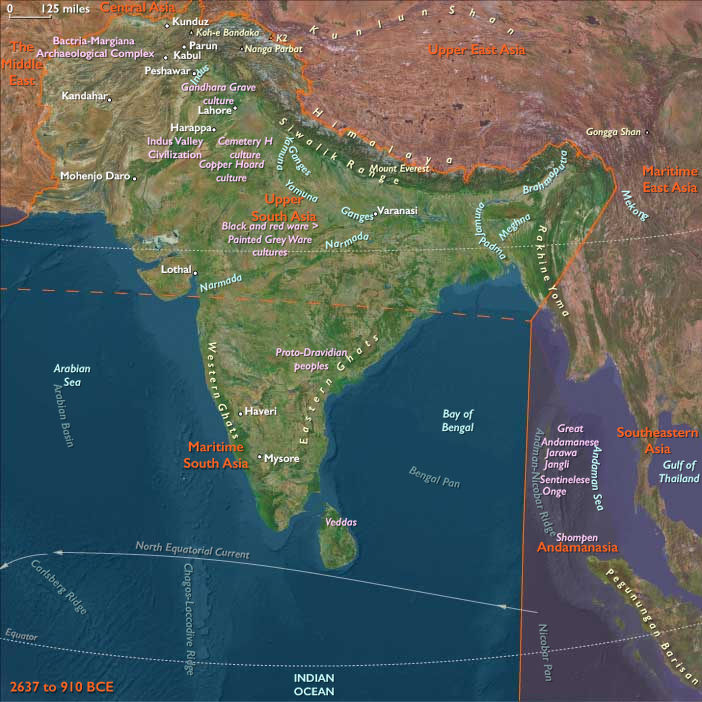
South Asia
View →Subregions