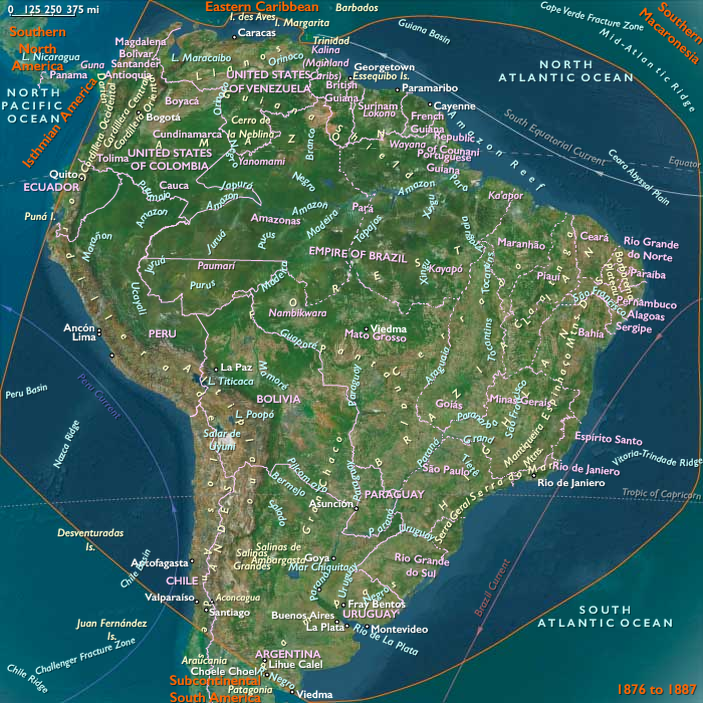
Social as well as economic stagnation is…
1876 CE to 1887 CE
Social as well as economic stagnation is still the rule, and most Colombians are illiterate, poorly housed, and all too subject to disease and early mortality, but they seldom go hungry.
Vacant land is available for farming, and food of some sort is generally abundant.
And in material—if not social—terms, class differences ware less pronounced than they will become later.
Members of the country's small upper and middle sectors can read and write and are proud of their lighter skins and (when possible) distinguished pedigrees, but by European standards their homes are meanly furnished, and the total assets even of the wealthiest are unimpressive.
Moreover, because few luxury goods are produced locally, such commodities have to be brought from overseas and in most cases carried up the Magdalena, then over primitive mountain paths (sometimes on the backs of human carriers) before reaching their destination—at a vast increase over the products' original prices.
This situation is beginning to change with such improvements as the introduction of steamboats on the Magdalena and the gradual accumulation of wealth from commerce or otherwise; meanwhile, to be rich in Bogota is not the same as to be rich in Boston or Bordeaux.
Locations
People
Regions

South America
View →Subregions