
Europe has begun to feel the impact …
Years: 1804 - 1815
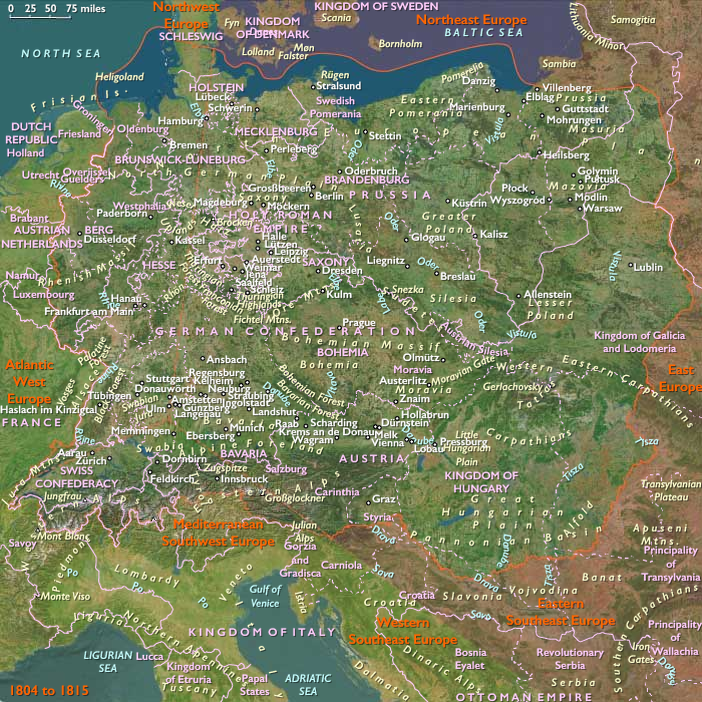
Europe has begun to feel the impact of momentous political and intellectual movements that, among their other effects, will keep the "Polish Question" on the agenda of international issues needing resolution.
Most immediately, Napoleon Bonaparte has established a new empire in France in 1804 following that country's revolution.
Napoleon's attempts to build and expand his empire keep Europe at war for the next decade and bring him into conflict with the same East European powers that had beleaguered Poland in the last decades of the previous century.
An alliance of convenience is the natural result of this situation.
Volunteer Polish legions attach themselves to Bonaparte's armies, hoping that in return the emperor will allow an independent Poland to reappear out of his conquests.
Although Napoleon promises more than he ever intends to deliver to the Polish cause, in 1807 he creates a Duchy of Warsaw from Prussian territory that had been part of old Poland and is still inhabited by Poles.
Basically a French puppet, the duchy does enjoy some degree of self-government, and many Poles believe that further Napoleonic victories will bring restoration of the entire commonwealth.
In 1809, under Jozef Poniatowski, nephew of Stanislaw II Augustus, the duchy reclaims the land taken by Austria in the second partition.
The Russian army occupies the duchy as it chases Napoleon out of Russia in 1813, however, and Polish expectations end with the final defeat of Napoleon at Waterloo in 1815.
In the subsequent peace settlement of the Congress of Vienna, the victorious Austrians and Prussians sweep away the Duchy of Warsaw and reconfirm most of the terms of the final partition of Poland.
Locations
People
Groups
- Poles (West Slavs)
- Austria, Archduchy of
- Prussia, Kingdom of
- Russian Empire
- France, (first) Empire of
- Warsaw, Duchy of
- Poland, Congress Kingdom of
Topics
Subjects
Regions
Subregions
Years: 1804 - 1815
Locations
People
Groups
- Poles (West Slavs)
- Austria, Archduchy of
- Prussia, Kingdom of
- Russian Empire
- France, (first) Empire of
- Warsaw, Duchy of
- Poland, Congress Kingdom of
Topics
Subjects
Regions
Subregions