
Heraclitus, a native of Ephesus on the…
475 BCE
Heraclitus, a native of Ephesus on the coast of Asia Minor, is known for his doctrine of change being central to the universe, and that the Logos is the fundamental order of all.
Heraclitus' life as a philosopher is interrupted by dropsy.
The physicians he consults are unable to prescribe a cure.
He treats himself with a liniment of cow manure and baking in the sun, believing that this method will remove the fluid.
He dies after a day of treatment and is interred in the marketplace.
His writings only survive in fragments quoted by other authors.
Locations
People
Topics
Commodities
Regions
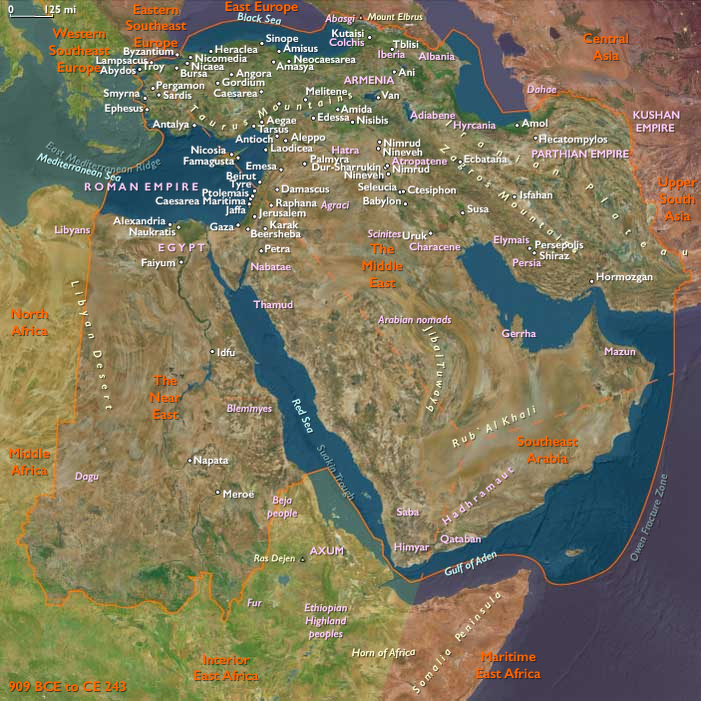
The Near and Middle East
View →Subregions
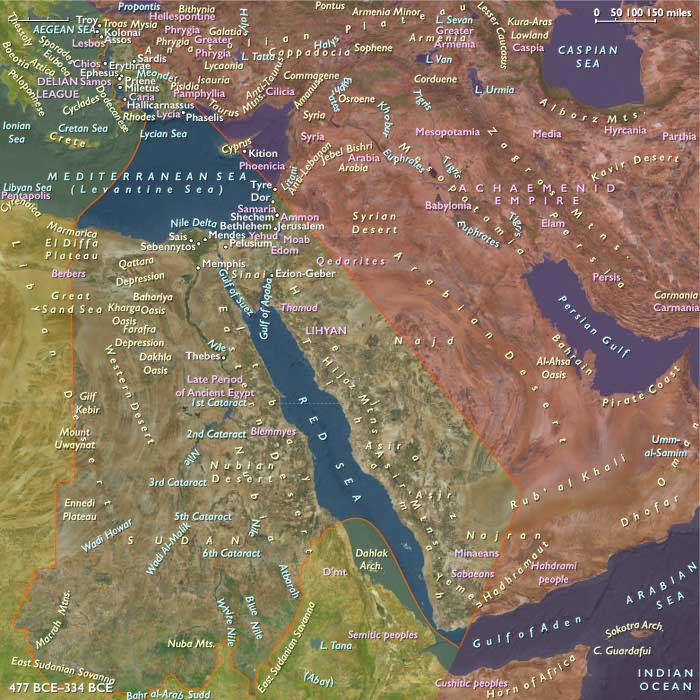
Near East
View →Related Events
Showing 10 events out of 92 total
At the end of the Antiquity period, ancient Gaul is divided into several Germanic kingdoms and a remaining Gallo-Roman territory, known as the Kingdom of Soissons, also known as the Domain of Syagrius.
Simultaneously, Celtic Britons, fleeing the Anglo-Saxon settlement of Britain, settle the western part of Armorica.
As a result, the Armorican peninsula will be renamed Brittany, Celtic culture is revived and independent petty kingdoms arise in this region.
The pagan Franks, from whom the ancient name of "Francie" is derived, originally settle the north part of Gaul, but under Clovis I conquer most of the other kingdoms in northern and central Gaul.
In 498, Clovis I is the first Germanic conqueror after the fall of the Roman Empire to convert to Catholic Christianity, rather than Arianism; thus France is given the title "Eldest daughter of the Church" (French: La fille aînée de l'Église) by the papacy, and French kings will be called "the Most Christian Kings of France" (Rex Christianissimus).
The Franks embrace the Christian Gallo-Roman culture and ancient Gaul s eventually renamed Francia ("Land of the Franks").
The Germanic Franks adopt Romanic languages, except in northern Gaul where Roman settlements are less dense and where Germanic languages emerge.
Clovis makes Paris his capital and establishes the Merovingian dynasty, but his kingdom does not survive his death.
The Franks treat land purely as a private possession and divide it among their heirs, so four kingdoms emerge from Clovis's: Paris, Orléans, Soissons, and Rheims.
Bishop Avitus of Vienne has published treatises in confutation of the Nestorian, Eutychian, and Sabellian heresies; he has also written against the Pelagian errors of Faustus, abbot of Lerins, and converted many Jews who had settled in his diocese (Venant. Fortun. l. v. c. 5).
The Division of Clovis' Kingdom: The Frankish Tradition of Partition (511 CE)
Unlike the Roman concept of state-owned imperial land, the Franks treat land as private property, dividing it among heirs rather than maintaining centralized rule. Upon Clovis I's death in 511 CE, his kingdom is partitioned among his four sons, following Frankish succession customs. This division results in the emergence of four Frankish kingdoms centered in:
- Paris – Ruled by Childebert I
- Orléans – Ruled by Chlodomer
- Soissons – Ruled by Chlothar I
- Reims – Ruled by Theuderic I
Consequences of the Frankish Partition System
- Political Fragmentation – Instead of a single Frankish kingdom, four independent realms emerge, each ruled by a Merovingian king.
- Dynastic Rivalries – The sons of Clovis compete for dominance, leading to internecine wars and assassinations.
- Temporary Unity and Further Divisions – While at times the kingdom is reunified under a single ruler, the Frankish practice of partition ensures continued cycles of division and consolidation.
Despite the fragmentation, the four kingdoms retain a common Frankish identity and remain politically interconnected, setting the stage for future unifications under later Merovingian and Carolingian rulers.
Atlantic West Europe (556–567): Merovingian Unification, Dynastic Rivalry, and Religious Consolidation
From 556 to 567, Atlantic West Europe—encompassing the Merovingian kingdoms across modern-day France (Gaul), Burgundy, and the Low Countries—saw crucial developments as the region moved towards increased territorial unity under the Merovingian dynasty, even amid ongoing dynastic rivalries. Ecclesiastical structures strengthened further, and cultural synthesis deepened the region's emerging medieval identity.
Political and Military Developments
Rise and Dominance of Chlothar I
- Chlothar I (r. 511–561), the last surviving son of Clovis, finally achieved full Frankish unification in 558 after the deaths of his brothers and nephews, briefly reuniting the Frankish kingdoms under a single crown for the first time since Clovis.
- Upon Childebert I’s death (558), Chlothar swiftly secured Paris, expanding his rule over Neustria, Austrasia, Aquitaine, and Burgundy, thereby becoming the sole ruler of Frankish Gaul.
Dynastic Instability and Partitioning
- Chlothar’s unified rule lasted only until his death in 561, when, according to Frankish custom, his territories were divided among his four sons:
- Charibert I received Paris (Neustria)
- Guntram obtained Burgundy and parts of Aquitaine
- Sigebert I ruled Austrasia
- Chilperic I controlled northern Neustria and the Low Countries
- This division immediately renewed dynastic rivalries and instability among the Merovingian brothers, foreshadowing future conflicts.
Economic and Social Developments
Rural Prosperity and Land Ownership
- Agricultural estates (villae) remained economic mainstays, supporting the aristocracy and monasteries.
- Stability under Chlothar I allowed for a brief period of economic growth, enhancing trade networks linking regions such as the Loire, Seine, and Rhône valleys.
Towns and Emerging Urban Patterns
- Cities such as Paris, Tours, Dijon, Bordeaux, Metz, and Orléans served as administrative and ecclesiastical centers, growing modestly amid relative stability.
- Local marketplaces and fairs continued to facilitate regional commerce and craft specialization.
Religious and Cultural Developments
Strengthening of Church Authority
- Bishops and abbots consolidated influence through increased royal patronage and land grants, expanding their administrative and judicial authority.
- Regional church councils, notably the Council of Tours (567), established stricter ecclesiastical discipline, promoted monastic reform, and strengthened episcopal control.
Growth of Monasticism and Patronage
- Numerous monasteries founded or endowed during Chlothar’s reign (such as Saint-Médard in Soissons) became cultural, educational, and economic hubs, preserving classical and Christian texts and promoting literacy.
Cultural Achievements
- Merovingian metalwork, manuscript illumination, and decorative arts continued flourishing, blending Germanic traditions with Christian iconography.
- Literary activity centered in monastic scriptoria produced works contributing to Christian theology and historical chronicles.
Legacy and Significance
The period 556–567 was pivotal, marked by the brief unification of the Frankish kingdoms under Chlothar I, followed by renewed partition and intensified dynastic rivalry among his sons. Despite these conflicts, the foundations of Merovingian political structures, economic stabilization, and strong ecclesiastical institutions set the stage for subsequent medieval developments in Atlantic West Europe.
Chlothar I Founds the Abbey of St. Medard in Soissons
As part of his patronage of the Frankish Church, Chlothar I, King of the Franks, founds the Abbey of St. Medard in Soissons. This monastery is dedicated to St. Medard, a revered bishop of Noyon, known for his piety, miracles, and influence in Merovingian Gaul.
1. The Importance of the Abbey
- The Abbey of St. Medard becomes one of the most important religious institutions in the Frankish Kingdom.
- It serves as both a monastic center and a royal burial site, later housing the tomb of Chlothar I himself.
- The abbey plays a crucial role in spreading Christian learning and monastic traditions in Merovingian Gaul.
2. Chlothar I’s Role in Strengthening Church Ties
- Chlothar, like his predecessors, recognizes the political and religious significance of supporting monasticism.
- The foundation of the abbey reinforces the close alliance between the Frankish monarchy and the Catholic Church.
- It further establishes Soissons as a spiritual and political center, reflecting its importance in Frankish royal history.
3. The Abbey’s Lasting Legacy
- Over the centuries, the Abbey of St. Medard remains a key pilgrimage site and a place of royal ceremonies.
- It continues to shape monastic culture in Francia, influencing later Carolingian and medieval institutions.
Conclusion
The foundation of St. Medard’s Abbey by Chlothar I marks an important moment in Merovingian religious history, symbolizing the growing influence of monasticism in the Frankish Kingdom. Through such religious patronage, the Franks strengthen their alliance with the Church, further securing their rule over Gaul.
The Dedication of the Abbey of Saint-Germain-des-Prés (558 CE)
The original Abbey of Saint-Germain-des-Prés, founded by Childebert I, King of Paris, is formally dedicated on December 23, 558 CE, by Germain, Bishop of Paris.
1. The Abbey’s Foundation and Purpose
- The monastery was originally named Abbey of St. Vincent, in honor of St. Vincent of Saragossa, whose tunic Childebert had taken from Spain during his campaign against the Visigoths.
- It was intended as a major religious institution at the gates of Paris, reinforcing the city's growing importance as a spiritual and political center.
2. The Role of Bishop Germain of Paris
- Bishop Germain of Paris plays a crucial role in the dedication ceremony, officially consecrating the abbey for Christian worship.
- He later becomes so closely associated with the monastery that, after his canonization, the abbey is renamed in his honor, becoming Saint-Germain-des-Prés.
3. A Lasting Religious and Cultural Center
- The Abbey of Saint-Germain-des-Prés becomes one of the most important monastic institutions in Frankish Gaul.
- Over time, it serves as a royal burial site, a center of Christian learning, and an influential monastic community.
- Its dedication in 558 CE marks the continued expansion of Christian monasticism under the Merovingians, strengthening the connection between Frankish royalty and the Catholic Church.
Conclusion
The dedication of Saint-Germain-des-Prés by Bishop Germain of Paris in 558 CE symbolizes the deepening ties between the Frankish monarchy and the Church. The abbey remains a major religious landmark, shaping the spiritual and cultural identity of medieval Paris and beyond.
Chlothar I Suppresses a Revolt in Saxony and Imposes Tribute (559 CE)
In 559 CE, Chlothar I, King of the Franks, successfully suppresses a revolt by the Saxons and Thuringii in the region of Saxony (modern-day Germany). Following his victory, he imposes an annual tribute on the defeated Saxons, requiring them to deliver 500 cows per year as a symbol of Frankish dominance.
1. The Saxon and Thuringian Revolt
- The Saxons and Thuringii, located in the northeastern frontier of the Frankish kingdom, frequently resisted Frankish control.
- Their rebellion in 559 CE likely stemmed from:
- Resentment toward Frankish expansion into their lands.
- A desire to assert independence from Frankish overlordship.
- Ongoing conflict over territorial and economic control.
- Chlothar leads a military campaign into Saxony, defeating the rebels and reestablishing Frankish authority in the region.
2. The Imposition of Tribute
- As a means of ensuring continued submission, Chlothar demands an annual tribute of 500 cows from the Saxons.
- This tribute serves multiple purposes:
- Economic gain, enriching Frankish nobility and the royal treasury.
- Symbolic subjugation, reinforcing Saxon dependence on the Franks.
- Deterring further revolts, as the tribute system forces the Saxons to maintain ties with the Franks.
3. The Legacy of Frankish-Saxon Conflict
- Although Chlothar enforces Frankish dominance, Saxon resistance will continue for centuries, culminating in the Saxon Wars under Charlemagne (late 8th century).
- The tribute of 500 cows annually represents an early example of Frankish tributary rule, a strategy used in later conquests.
- The event demonstrates Chlothar's ability to maintain control over the eastern frontier, securing his status as the most powerful Merovingian ruler of his time.
Conclusion
By 559 CE, Chlothar I effectively consolidates his rule over Frankish and non-Frankish territories, imposing his authority through military suppression and economic tribute. His success in Saxony marks one of the final conquests of his reign, solidifying Frankish influence over Germanic lands well into the medieval period.
Chlothar I: Sole Ruler of the Franks and the End of His Reign (558–561 CE)
In 558 CE, following the death of his brother Childebert I, Chlothar I becomes the sole King of the Franks, unifying all of the territories originally ruled by Clovis I. His rule extends over most of Gaul and large parts of Germania, and he leads expeditions into Saxony, further consolidating Frankish influence over the eastern frontier.
1. Chlothar’s Sole Rule Over the Frankish Kingdom (558 CE)
- With Childebert’s death, Chlothar reunites the Merovingian kingdom, becoming the undisputed King of the Franks.
- His rule spans Gaul and Germania, making him one of the most powerful monarchs in post-Roman Western Europe.
- He leads campaigns into Saxony, continuing the Frankish expansion eastward.
2. Internal Struggles: The Revolt of Chram
- The end of Chlothar’s reign is marked by internal dissension, particularly the rebellion of his son Chram.
- Chram revolts multiple times, seeking to seize power from his father.
- After one failed rebellion, Chram flees to Brittany, where he gathers support.
3. Chram’s Defeat and Brutal Execution
- Chlothar pursues Chram into Brittany, determined to eliminate his rebellious son.
- Upon capturing him, Chlothar shuts Chram, along with his wife and children, in a cottage, which he then sets on fire, burning them alive.
- This act of filicide deeply disturbs Chlothar, who is soon overwhelmed with remorse.
4. Chlothar’s Death and His Final Act of Penance
- Wracked with guilt, Chlothar travels to Tours, where he seeks forgiveness at the tomb of St. Martin, one of the most revered saints in the Frankish kingdom.
- Shortly afterward, in late 561 CE, Chlothar dies at the royal palace at Compiègne, bringing his reign to an end.
5. The Re-Division of the Frankish Kingdom (561 CE)
Following Frankish tradition, Chlothar’s unified kingdom is once again divided among his surviving sons:
- Charibert I – Receives Aquitaine, ruling from Paris.
- Sigebert I – Inherits Austrasia, with Metz as his capital.
- Guntram – Rules Burgundy, centered in Orléans.
- Chilperic I – Takes control of Neustria, governing from Soissons.
This division reignites rivalries between the Frankish kings, leading to decades of internal conflicts, assassinations, and power struggles, particularly between Chilperic and Sigebert.
Conclusion: Chlothar’s Legacy
- Chlothar I reunifies the Frankish kingdom for a brief period but fails to establish lasting unity, as his sons immediately divide the realm upon his death.
- His military campaigns expand Frankish power, securing dominance over Gaul and parts of Germania.
- His brutal treatment of Chram highlights the ruthlessness of Merovingian succession struggles, which will continue to shape Frankish politics for generations.
- His pilgrimage to St. Martin’s tomb reflects the growing role of the Catholic Church in Frankish royal life, reinforcing the idea that monarchs sought divine legitimacy and absolution for their actions.
Despite his momentary reunification of the Frankish kingdom, Chlothar’s death marks the return of fragmentation, setting the stage for future conflicts among his heirs that will define the next phase of Merovingian rule.
The Avars, still in the pay of Constantinople, push west until, in 562, they meet the enlarged Frankish kingdom at the Elbe.
King Sigebert I repels an attack on Austrasia by the Avars at Regensburg.
Justinian's generals have conquered Italy in a series of campaigns waged from 540.
Pockets of resistance, reinforced by Franks and Alemanni who had invaded Italy in 553, linger on until 562, by which time Constantinople is in control of the whole of the country.