
…the island’s population center shifts to the…
1200 CE
…the island’s population center shifts to the northern Jaffna peninsula and …
Locations
People
Groups
Topics
Commodities
Regions
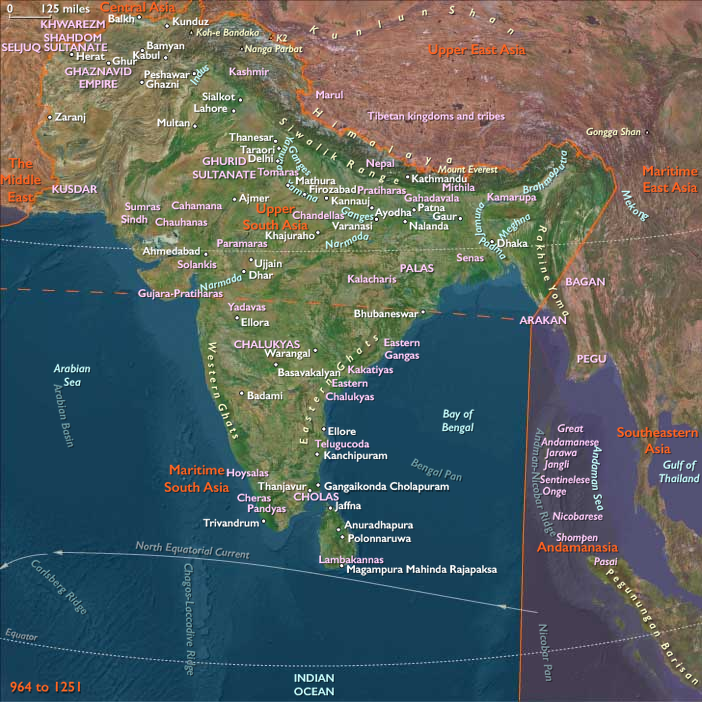
South Asia
View →Subregions
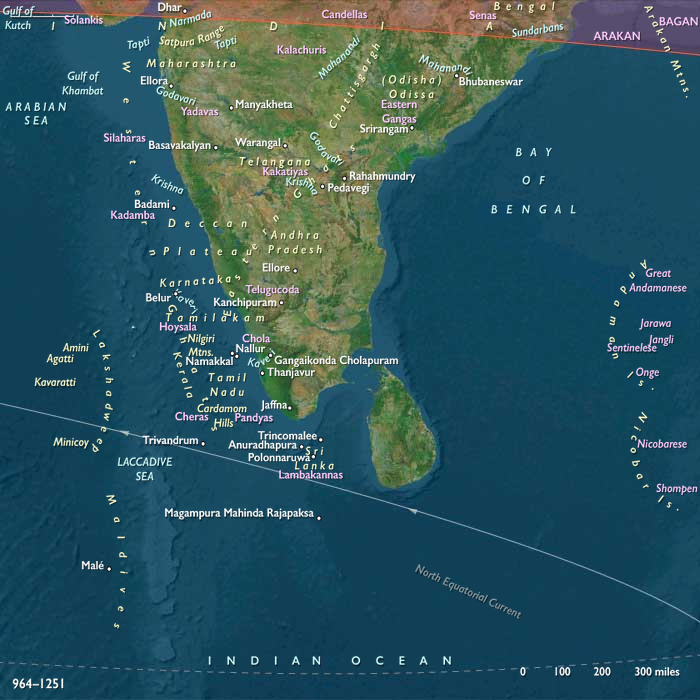
Maritime South Asia
View →Related Events
No active filters.
Showing 10 events out of 47716 total
The anonymous Austrian epic tragedy, the “Nibelungenlied,” written about 1200, combines Teutonic myth with realities of court life in the setting of courtly love and chivalry.
Based on the tales of the Norse “Elder,” or “Poetic Edda” and the “Volsungasaga” but less directly concerned with the gods, the somber tale revolves around heroic feats, royal revenge, and magical powers.
The warrior hero, the near-invulnerable Siegfried, possessed of a cape that bestows the power to become invisible and a wondrous sword called Balmung, enters the territory of the Nibelung kings of Burgundian legend and takes all the symbols of power, including Queen Kriemhild, by prowess.
The fatalistic plot sets Kriemhild and Brunhild of Iceland against each other, and a sequence of complicated reprisals leads to everyone's ultimate downfall.
Wolfram von Eschenbach, a poor aristocrat patronized by Landgrave Hermann I of Thuringia, for whom Eschenbach writes the unfinished epic “Willehalm,” about William of Toulouse—who fought the Moors in 783 but ended his life as a monk—also writes some fine lyric poems and a stanzaic romance, “Titurel” (two fragments survive).
The poet is celebrated, however, for his long narrative poem, “Parzival,” written in 1200, an account the knight Parsifal's quest for the Holy Grail.
The origins of Alexios Palaiologos are obscure.
His family is wealthy and mostly known as civil and military officials under the Komnenian emperors.
Alexios's father was probably the sebastos and megas hetaireiarches George Palaiologos, the son or grandson of Alexios I Komnenos's staunchest supporter George Palaiologos.
Through his grandmother, Alexios shares in the blood of the Komnenian house.
In circa 1198, Alexios had been chosen by Emperor Alexios III, who was without male offspring, to wed his eldest daughter, Irene.
She was a widow of Andronikos Kontostephanos, and Alexios Palaiologos was forced to divorce his own beautiful first wife (whose name is unknown) to marry her.
The wedding, accompanied by lavish celebrations, had taken place in spring 1199.
Alexios had thus become the imperial heir apparent, and is elevated to the rank of despot.
At the same time, the emperor's second daughter Anna, also a widow, had been wed to Theodore Laskaris, the future founder of the Empire of Nicaea.
Shortly afterwards, both imperial sons-in-law are sent alongside general Manuel Kamytzes against the rebel Ivanko in Thrace.
During this campaign, in the siege of Kritzimos, Alexios's father George is killed.
The campaign fails when the imperial force is trapped in an ambush and Kamytzes is captured.
This success emboldens Ivanko, who now claims the imperial title.
In spring 1200, Alexios III pretends to be willing to begin negotiations, and sends Alexios Palaiologos to meet the rebel.
Alexios gives solemn promises of safety, but when Ivanko appears in the imperial camp, he is arrested and executed.
In February of the same year, Alexios had been called upon to help with the riots that broke out in Constantinople in protest against the embezzlement of charitable donations by the prison warden John Lagos.
A large mob had taken control of the capital's prisons and opened them, and battled the guards of the emperor, who was away at Chrysopolis.
Alexios Palaiologos had led troops into the city and suppressed the revolt after inflicting heavy casualties on the populace.
Nizami's “Haft Paikar,” written in 1197, and “The Sikander Nama,” written in 1200, about the life of Alexander the Great, complete the five long dramatic poems known collectively as the “Khamsa.”
Rainfall pattern in Sri Lanka is influenced by monsoon winds from the Indian Ocean and Bay of Bengal.
The "wet zone" and some of the windward slopes of the central highlands receive up to twenty-five hundred millimeters (98.4 in) of rain each month, but …
…the leeward slopes in the east and northeast receive little rain.
Most of the east, southeast, and northern parts of the country comprise the "dry zone", which receives between 1,200 mm (47 in) and 1,900 mm (75 in) of rain annually.
The arid northwest and southeast coasts receive the least amount of rain at 800 mm (31 in) to 1,200 mm (47 in) per year.
Periodic squalls occur and sometimes tropical cyclones bring overcast skies and rains to the southwest, northeast, and eastern parts of the island.
Humidity is typically higher in the southwest and mountainous areas and depends on the seasonal patterns of rainfall.
Sri Lanka’s advanced civilization continues to thrive in the dry zone, supported by a massive irrigation system, until about 1200, when it mysteriously declines and …
…the southern coast and hill country.
Al-Adil, achieving military supremacy in 1200, assumes complete control as sultan, reuniting Egypt and Syria under his leadership and replacing his late brother Saladin's activist policy with one of détente with the Crusaders; this allows, particularly, for increased trade with Europe.
Castile, fattened by its acquisition of half of Navarre’s territory, has made serious gains in Islamic Spain by 1200.
Markward von Annweiler is a ministerialist—that is, he comes not from the free nobility, but from a class of unfree knights and administrators whose purpose is to serve loyally the Imperial administration in any capacity.
During the reign of the Emperor Frederick Barbarossa, Markward had become one of the most important figures in the administration.
Markward had served Barbarossa's son Henry VI in Italy from 1184.
Henry had appointed him Margrave of Ancona and Count of Abruzzo, placing him in a highly strategic position in north-central Italy.
After Henry’s death, Markward had at first supported his widow Constance of Sicily, but later found himself her enemy.
He had been excommunicated by Popes Celestine III and Innocent III, during their attempts to take over lands in central Italy.
Markward had stayed in Italy, and become a supporter of Philip of Swabia, the brother of Henry.
Markward's political and military activities cause great problems for the Popes, whose control of Sicily gradually weakens.
Two years after Constance's death, Philip gives Markward the lordship of Palermo, where the underage heir, the future Emperor Frederick II, is resident.
Despite the opposition of Innocent III, Markward becomes Guardian of Frederick II and Regent of Sicily.
Frederick's tutor during this period is Cencio Savelli, who will become Pope Honorius III.